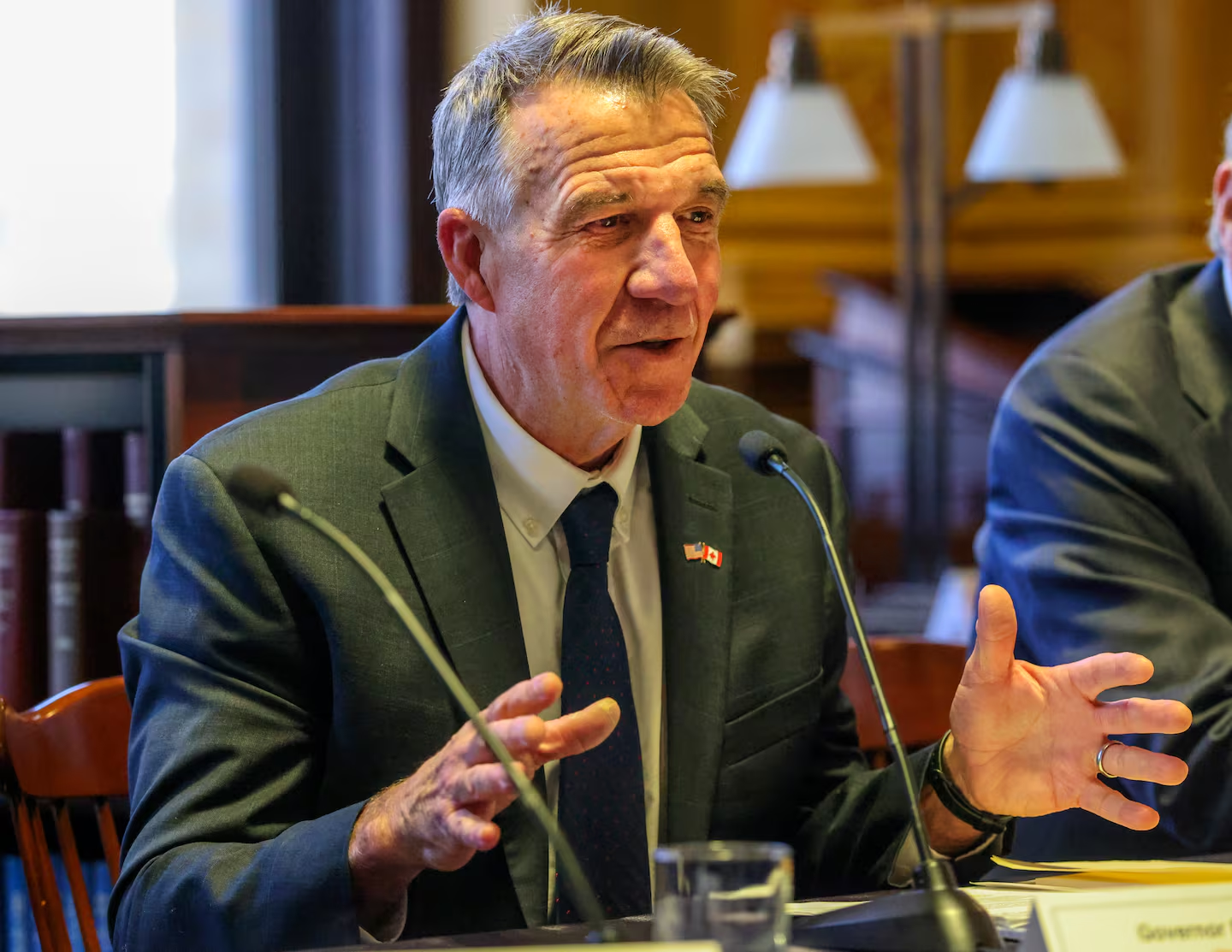
“Affordability has become one of the most talked-about issues in national politics today, and it’s refreshing to hear previous skeptics acknowledge it matters,” Vermont Governor Phil Scott said in an address to the state legislature in January. “Because the affordability crisis that some of us have been talking about for decades is real.”
The moderate Republican first deployed the term in 2013, while serving as lieutenant governor, and it’s been central to his political identity ever since.
A decade into his governorship, Scott is now the second-longest-serving chief executive of a state — and the most popular in the country, with a 74 percent approval rating, according to Morning Consult. That’s in no small part due to his relentless messaging around affordability, even as Vermont has grown ever more expensive.
Scott attributes his early focus on the subject to his blue-collar roots. While serving as lieutenant governor — a part-time job in Vermont — he continued to run an excavation company and compete as a stock car driver at Thunder Road Speedbowl in his gritty hometown of Barre.
“My social network is broad, whether it’s at the racetrack or in the construction field,” Scott said. He’d hear friends and family members say, “I just can’t afford it anymore. I just can’t stay here anymore, because I’ve talked to my cousin in Tennessee or Florida, and things aren’t as bad there as they are here.”
Recent polling suggests that many Americans believe middle class life is out of reach. A majority of registered voters surveyed by The New York Times last month said they could not afford the life they desire, such as the home, family, or car they want. Respondents cited education, housing, and health care as being particularly expensive.
Such sentiments have posed a problem for President Trump, who has struggled to calibrate a message on it. He’s called it a “hoax” and a “Democrat scam,” and has focused his rhetoric on the high-flying stock market, not bread and butter concerns.
While inflation has cooled considerably on Trump’s watch, prices remain high, and 57 percent of Americans disapprove of his handling of cost-of-living issues, according to a recent Reuters-Ipsos poll.
At the state level, some governors have felt similar pressures to deliver. As she seeks reelection this year, Massachusetts Governor Maura Healey, a Democrat, has had to contend with the high cost of housing and skyrocketing energy prices. She sought to tackle it head-on in a January address to the Legislature, expanding on her “affordability agenda” and trying to convey that she understands voters’ anxieties.
“The reality is that these are tough times,” she said. “People are feeling it. Everything is more expensive.”
How much a single governor can do to address affordability is another question.
“Whether life is affordable at a given moment might have to do with the national economy or the global economy,” said Kristoffer Shields, a historian at Rutgers’s Eagleton Center on the American Governor. “There are all kinds of things that are outside of your control.”
Andre Perry, a senior fellow at the Brookings Institution, said governors can pull plenty of levers to address expenses, such as housing, utilities, and child care. Others, though particularly health care, are more difficult to address at the state level, he said — and all leaders have a role to play.
“Affordability is not a one-stop-shop kind of issue,” Perry said. “No one mayor, no one governor, no one president is the primary cause of affordability.”
And Scott himself readily concedes the picture has not improved during his time in office.
“When I talk with Vermonters today, they certainly don’t think Vermont is more affordable than it was 10 years ago,” he said. “Nor do they think it was affordable then.”
Median rents have climbed in the state by 35 percent over just the past five years, while median home prices are up 55 percent, according to the US Census Bureau and Department of Housing and Urban Development. At the same time, household income has grown by just 15 percent. Vermonters now pay some of the highest health insurance premiums in the country.
“The governor has been the governor for 10 years, and we have not seen a huge change in affordability in this state,” Representative Robin Scheu, a Democrat who chairs the House Appropriations Committee, said last month after Scott’s address to the legislature.
According to Stephanie Yu, president of the Public Assets Institute, a left-leaning think tank in Montpelier, affordability is best understood as a function of costs versus wages. The challenge in Vermont, she said, is that household costs tend to be average, but wages tend to be below average. In her view, Scott has focused far too much attention on a third factor: taxes.
“State taxes are not a huge part of anyone’s budget,” she said. “When you think about whether or not you can live in Vermont, it’s more about the costs of housing and health care, and below-average wages.”
Scott disagrees. Throughout his governorship, he’s vowed to oppose any increase in taxes or fees. In January, he said he would not sign the state budget if legislators deviated from his attempts to curtail property tax increases by overhauling the education system.
“I get it’s not all about taxes, but they have an effect on everything,” he said.
Scott’s affordability ambitions have been stymied, he said, by the state’s stagnant growth and aging population — much like other Northern New England states. As Vermont’s working-age population shrinks, fewer people are left paying for costlier services, leading others to flee.
“Our demographics are really the root cause of our problem,” Scott said.
He also points to politics.
Unlike Massachusetts, where state government is dominated by a single party, Vermont is split. For Scott’s entire tenure as governor, the legislature has been controlled by Democrats, at times holding a super-majority.
He blames his political opponents for ignoring his efforts to make Vermont more affordable. And he seems proud to have vetoed a record 57 bills — more than a quarter of all vetoes issued in the state’s history — arguing that he’s prevented Democrats from piling on the costs for taxpayers.
“I think if I hadn’t been here, it would be much worse than it is today,” he said.
Not surprisingly, Democrats in Vermont see it the other way around, criticizing his vetoes of bills that would have raised the minimum wage and established a paid family leave program.
Senate majority leader Kesha Ram Hinsdale pointed to a 2023 child care law, which the legislature enacted over Scott’s objections. It provided an additional $120 million a year in subsidies to families and providers, reducing costs and increasing the number of children served — but Scott opposed a payroll tax of 0.44 percent to fund it.
“That’s a bill the governor vetoed, and it’s probably the best thing we’ve done for middle class affordability in the last decade,” Ram Hinsdale said.
Shields, the Rutgers historian, says he thinks it’s wise for governors to pick up the mantle of affordability, define it on their own terms, and show voters they’re doing what they can to address it.
But that’s not without risk.
“Voters have made clear that they’re not patient,” he said. “If you’re governor and you make a lot of promises about affordability, you’re going to have to be able to point to areas where you’ve made a difference.”
Paul Heintz can be reached at paul.heintz@globe.com. Follow him on X @paulheintz.