Stay informed with free updates
Simply sign up to the Aerospace & Defence myFT Digest — delivered directly to your inbox.
France’s Thales expects to build on a record defence order book and invest more in production, as war in the Middle East adds to a “generation-long” drive by governments in Europe and elsewhere to re-arm.
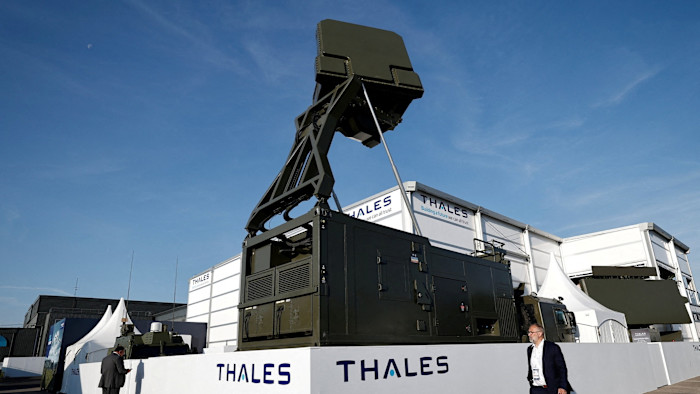
The defence technology group, which makes air surveillance radars and software for fighter jets, including the Rafale, on Wednesday forecast higher revenue growth for the year ahead after sales rose 7.6 per cent to €22.1bn in 2025, driven largely by weapons systems.
Chief executive Patrice Caine said Europe was now “motoring” defence spending, adding to historically strong demand from the Middle East and South-east Asian countries, such as Indonesia, in a shake-up that could last 10 to 20 years.
“We’ve entered a long-term period of investment in defence, spanning a generation,” Caine told reporters.
He said that while it was too early to take stock of the effects of the Middle East conflict, “it is a reminder that the disturbed state of geopolitics in general is leading countries to invest more in security and therefore defence”.
The group said it was monitoring the situation for staff in the UAE and across the region as Iran carries out retaliatory strikes on US allies. A “crisis cell” dating back to the Covid-19 pandemic “has never been dismantled”, Caine said.
Defence activities outperformed Thales’s aviation and space unit in 2025 and offset falling sales in the company’s cyber division.
Paris-based Thales forecast “strong demand, lifted notably by rising defence budgets” for 2026, after its defence order book rose 3 per cent last year to a new high of €15.1bn, driven especially by clients in Asia and European countries beyond France and the UK.
Thales said its overall revenues could grow 6-7 per cent again this year, and forecast higher margins of 12.6 per cent to 12.8 per cent, up from 12.4 per cent in 2025.
Thales said it was also accelerating investments, including to expand manufacturing, lifting this budget by roughly 20 per cent a year. Capital expenditure will reach €830mn-€850mn in 2026.
Finance chief Pascal Bouchiat told the FT some of this was being spent on additional sites for engineers, as well as on design and information systems that also contributed to manufacturing.
Headcount rose by about 2,000 last year to 85,000.
Bouchiat said staff turnover had shrunk to just above 4 per cent from almost 7 per cent three years ago when there was stiff competition for hires from big US tech groups, such as Google, and that young recruits had become more open to joining the industry.
“We could see until around 2021 that some young people were hesitant regarding defence groups,” he added. “That’s no longer the case.”