
The continuous movement of the vocal cords weakens and eventually stops as laryngeal cancer progresses. Researchers have, for the first time, discovered that restoring cellular vibration reduces the aggressiveness of advanced vocal cord cancer. When cancer cells were exposed to sound-wave vibration, a protein that promotes cancer growth and severity decreased.
“What music should we play to our cells?” This question sparked an innovative study on laryngeal cancer that revealed a previously unknown sensitivity of this cancer type to a targeted drug currently under development.
Laryngeal cancer is one of the most common malignant tumors of the head and neck region. The most common early symptom is hoarseness, as the cancer typically appears in the vocal cords, and their movement gradually becomes impaired as the disease develops. Movement decreases because the vocal cord tissue stiffens and the cancer invades surrounding tissue.
The most significant risk factors are smoking and heavy alcohol consumption. The prognosis for advanced laryngeal cancer is poor, and there are currently no targeted drug therapies available.
The stiffer the tissue, the more malignant the cancer
Researchers have long known that increased tissue stiffness promotes cancer malignancy in non-moving tissues such as breast, liver, and pancreatic cancers, because cells sense and respond to the physical properties of their environment. The sensitivity of cells to external forces led researchers to take an interest in laryngeal cancer, which develops in constantly moving tissue.
“We wondered whether ‘movement could be medicine’ and whether tissue stiffening and immobilization contribute to cancer development,” says Academy Professor Johanna Ivaska, Director of the BarrierForce Center of Excellence. “We developed this idea together with BarrierForce Vice Director Professor Sara Wickström and her research group. With their help, we used a bioreactor in which cells were grown on a vibrating membrane placed on top of a loudspeaker.”
The project, conducted primarily in the research laboratory of Academy Professor Johanna Ivaska at the Turku Bioscience Center in Finland also involved three clinicians treating and studying oral cancers at the University Hospitals of Turku and Helsinki, as well as soft matter physicists from the University of Vienna and Milan.
The study also included researchers from the BarrierForce Center of Excellence and the InFLAMES Research Flagship. The study’s lead author, Jasmin Kaivola, who recently completed her doctoral degree at the University of Turku in Finland, came up with the idea of connecting an old mobile phone to the device to play sounds and music, and the experiments began. The results are published in Nature Materials.
Vibration affects cancer cells
The researchers’ predictions proved correct: Exposing cancer cells to vibration-mimicking vocal cord movement reduced their malignancy. One of the observed changes was a decrease in a protein called YAP in the cells.
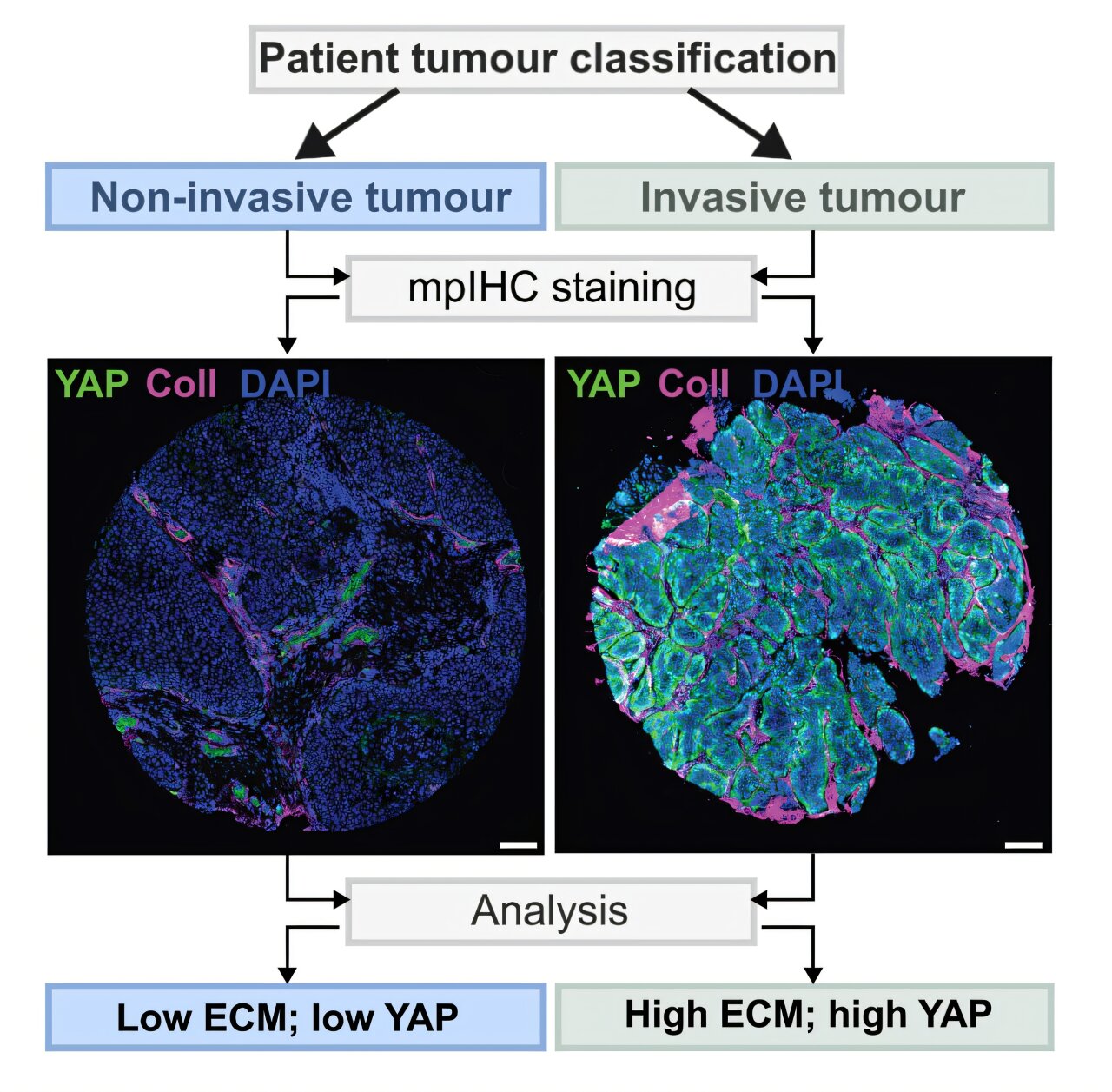
Using samples of early-stage and advanced laryngeal cancer collected from approximately 200 Finnish patients, the researchers found that elevated expression of proteins that increase tissue stiffness enhanced YAP activity and predicted mortality. In an experimental cancer model, the researchers discovered that the cancer was sensitive to a targeted drug under development that inhibits YAP protein activity.
Kaivola notes that the study is groundbreaking because the biomechanics of developing cancers have not previously been studied in moving tissues. She says it would be interesting to investigate whether the mechanism they identified has prognostic value in other cancers of moving tissues, such as lung cancer.
“We are excited about the results and believe that our findings may encourage developers of these drugs to explore their suitability for this difficult-to-treat cancer with a poor prognosis,” says Kaivola.
Publication details
Jasmin Kaivola et al, Restoring the tumour mechanophenotype of vocal fold cancer reverts its malignant properties, Nature Materials (2026). DOI: 10.1038/s41563-025-02473-7
Journal information:
Nature Materials
Clinical categories
Citation:
Good vibrations: Playing music to cells reduces laryngeal cancer aggressiveness in lab tests (2026, March 4)
retrieved 4 March 2026
from https://medicalxpress.com/news/2026-03-good-vibrations-playing-music-cells.html
This document is subject to copyright. Apart from any fair dealing for the purpose of private study or research, no
part may be reproduced without the written permission. The content is provided for information purposes only.