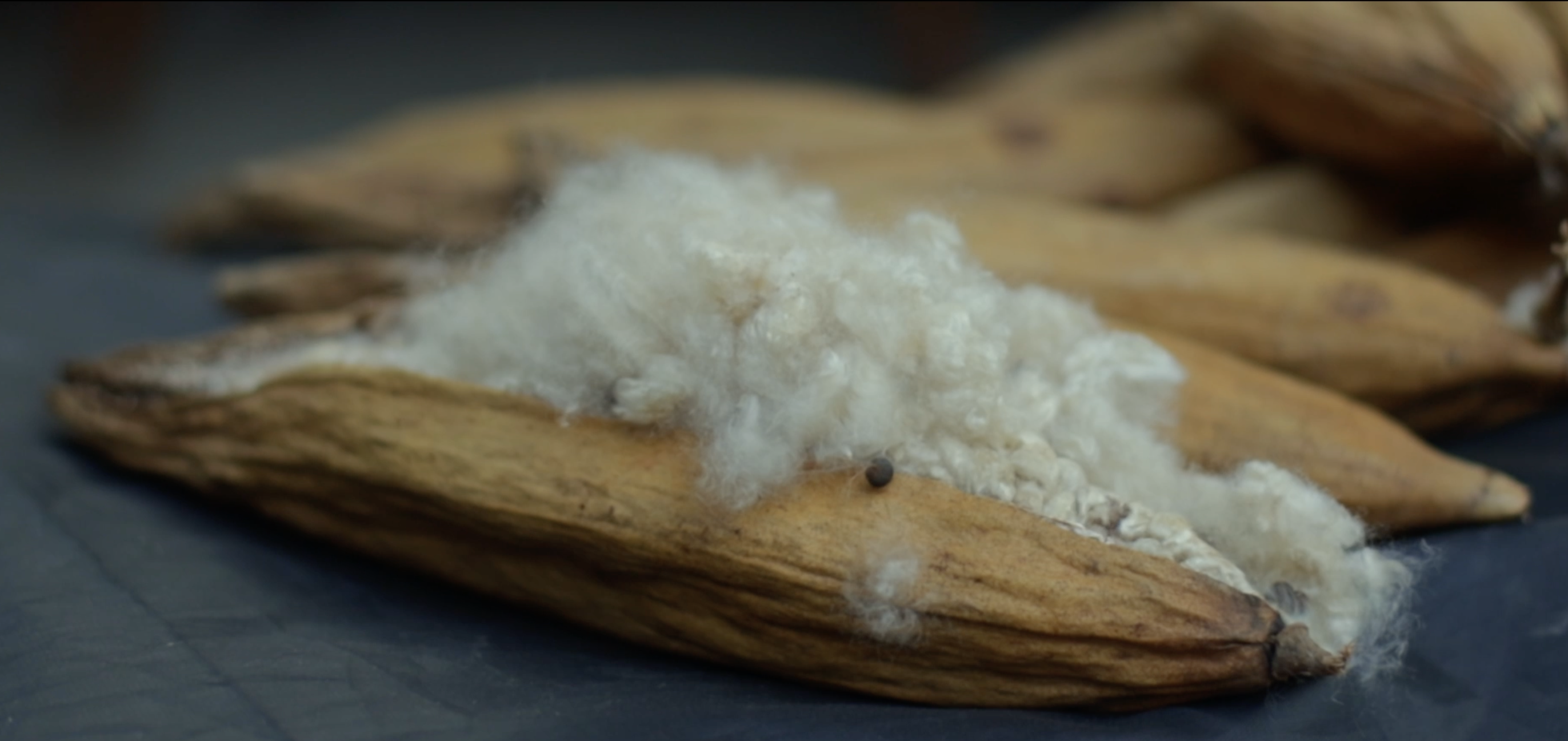
In the warm coastal landscapes of eastern Tanzania, a towering tree quietly sheds what looks like cotton into the wind. Beneath its broad canopy, the kapok tree (Ceiba pentandra) produces silky fibres that drift through nearby villages—long overlooked, often unused, and easily carried away by the breeze. Yet within these soft, weightless strands lies an untapped opportunity: one that connects forests to livelihoods without cutting a single tree.

Kapok tree with matured pods split open.
The Kapok collective taps into this opportunity. On this International Day of Forests, Maliehaa shows us how forest resources could be reimagined—transforming a once-overlooked fruit into a driver of sustainable enterprise.
Kapok Collective, founded by Maliehaa Sumar, exemplifies how non-timber forest products can underpin sustainable economic development. By harvesting kapok fibres from standing trees and transforming them into natural filling for furniture, the initiative offers an alternative to extractive forest use while creating income opportunities for local communities.
This approach reflects the principles of forest landscape restoration—balancing ecological functionality with human well-being—while contributing to Tanzania’s commitments under the African Forest Landscape Restoration Initiative (AFR100), through which the country has pledged to restore about 5.2 million hectares of degraded land. It also aligns with the goals of the Kunming-Montreal Global Biodiversity Framework, particularly targets related to sustainable use of biodiversity, ecosystem restoration, and equitable benefit-sharing.
Kapok Collective’s growth has been supported through the Restoration Factory Programme under The Restoration Initiative, implemented in Tanzania by the Vice President’s Office in collaboration with IUCN, UNEP, Bridge for Billions and reaching the entrepreneurs via Anza Entrepreneurs. The programme is designed to catalyse restoration economies by strengthening enterprises that integrate conservation and business models. Through this platform, Maliehaa Sumar emerged as a national winner, demonstrating the scalability of locally led, nature-positive enterprises.

Her subsequent recognition through the IUCN SUSTAIN Champion Awards further highlights the importance of entrepreneurship in advancing restoration outcomes. Such recognition underscores the role of innovators in operationalising global commitments, translating policy ambitions into tangible action on the ground.
Beyond livelihoods, the initiative also contributes to the transition toward circular and resource-efficient economies. The use of biodegradable kapok fibre as an alternative to synthetic materials reduces environmental pollution and supports sustainable production systems, in line with broader climate and sustainability objectives.
As Tanzania advances the implementation of its national environmental and forest policies, including its restoration and climate commitments, initiatives such as Kapok Collective offer practical pathways for achieving inclusive green growth. On this International Day of Forests, they serve as a compelling reminder that forests are not only ecosystems to be conserved, but also strategic assets for sustainable development—capable of supporting resilient economies when managed responsibly.