The war in the Middle East has driven wildly fluctuating oil prices, leading to uncertain costs at the gas pump. One easy way to avoid high gas prices impacting your weekly budget is to swap in cycling for driving for modest commutes or other daily travel activities, says transportation expert Ralph Buehler.
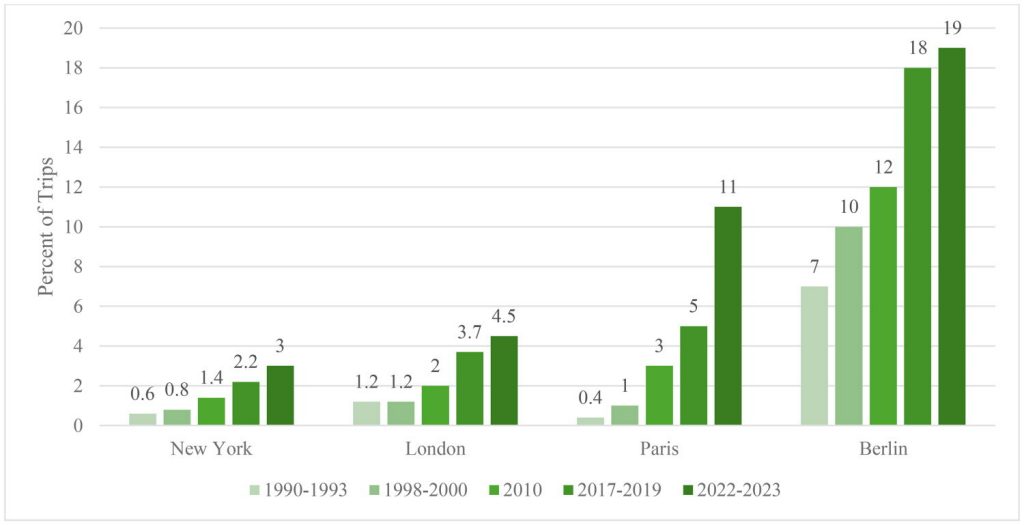
Buehler’s most recent study looked at cycling trends in a number of major world cities and found that, even after the pandemic-fueled cycling boom, many have seen their share of cyclists continue to increase in recent years.
“The key reason for increases in cycling is separated and safe bikeway infrastructure,” said Buehler. “Without such infrastructure, many individuals are not willing to consider riding a bike in a city. Traffic calmed neighborhood streets can be shared with lower levels of slower car traffic.”
In addition to saving on fuel costs, cycling can also avoid parking fees and reduce expenditures on car insurance and maintenance while extending the life of the vehicle before it needs replacement. Cycling improves physical and mental health and can also avoid the anguish of sitting in traffic, all while easing congestion and reducing air and noise pollution.
In Washington, there is currently a legal fight to keep the 15th Street bike lanes open. Buehler says this kind of separated bike infrastructure is crucial to help facilitate more uptake and provide benefits for all commuters, as seen in Paris, London, and New York.
“Bicycle lanes and corridors are associated with greater traffic safety and fewer crashes,” said Buehler. “Separating cyclists from motorized traffic protects cyclists and reduces stress among drivers. Giving cyclists a dedicated space to ride also protects pedestrians on sidewalks. Bicycle lanes can also facilitate better vehicle flow, as cars — big boxes essentially — take up a lot of space in the roadway, often to transport just one person. If several people switch to bicycles, space is freed up and traffic flows more freely.”
Buehler says the cities he studied have been oriented around cars for a long time, but conscious policy shifts have helped shape recent trends.
“Safe infrastructure, along with grassroots support, made it possible to promote cycling there,” said Buehler.
About Buehler
Buehler is a professor and chair of urban and environmental planning and policy in the School of Public and International Affairs at Virginia Tech. Most of his research has an international comparative perspective, contrasting transport and land-use policies, transport systems, and travel behavior in Western Europe and North America. Buehler has led urban planning graduate student classes as they conducted research on bicycling for the City of Falls Church, Arlington County, the City of Alexandria, the District of Columbia, the Federal Highway Administration, and the National Park Service.
Interview
To schedule an interview, contact Noah Frank at nafrank@vt.edu or 805-453-2556.