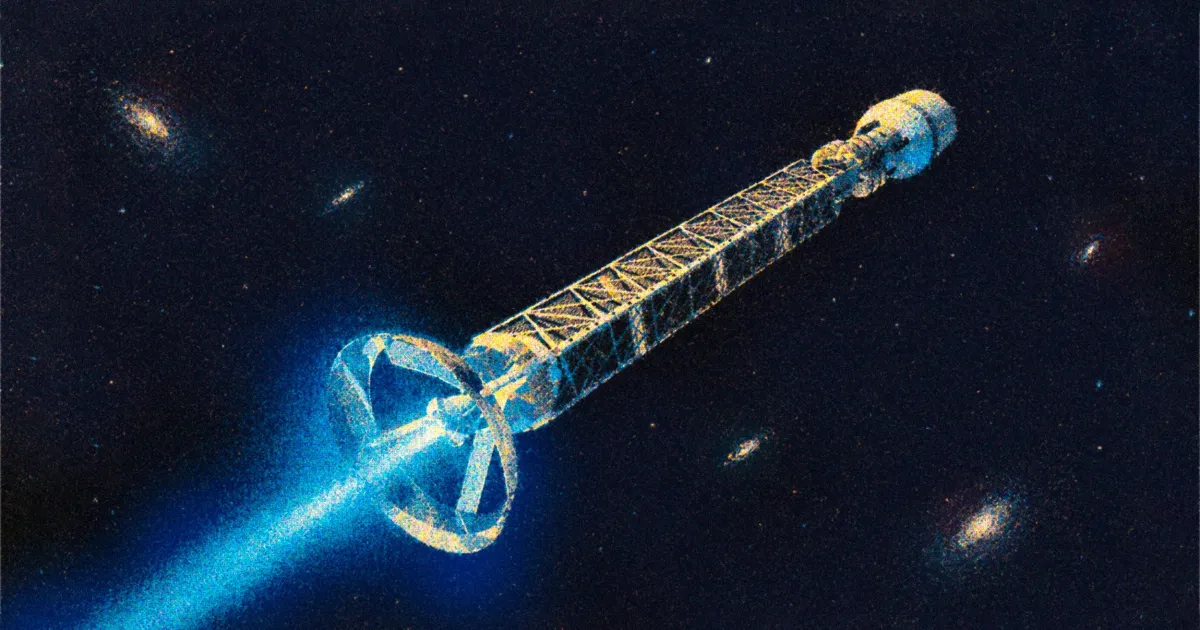
As humanity basks in the aftermath of the unprecedented success of Artemis II, which took humans back to the Moon for the first time in 54 years and brought them farther from Earth than ever before, many of us can’t help but think about grander goals. As a species, we don’t just dream of returning to the Moon, but of heading to places we’ve never been: other planets, other star systems, or even other galaxies. However, there are big problems we have to solve if we ever want to send humans outside of the Solar System: the problems of distance, time, speed, and fuel efficiency.
Interstellar distances are huge, even compared to the vast interplanetary distances we encounter in the Solar System. With current rocket technology, it would take hundreds of human lifetimes to reach even the nearest star, and that’s because we’re limited by speed, which is in turn limited by the efficiency of our fuel sources. Chemical-based rockets leverage quite efficient fuel sources, like liquid oxygen and liquid hydrogen, but transform less than a millionth of the fuel’s rest mass into energy. If we went to nuclear fission-powered propulsion, we could transform about a thousandth of our fuel source’s rest mass (0.1%) into energy, while nuclear fusion-powered propulsion could convert up to almost a hundredth (0.7%) of its fuel source’s rest mass into energy.
But the ultimate fuel source would be a matter-antimatter annihilation: It’s 100% efficient. Barring the discovery of some new law of physics, only antimatter provides the power we’d need for realistic interstellar travel.

The launch of Apollo 17, the ninth and final crewed mission to the Moon as part of the Apollo program, was also the first nighttime liftoff of a Saturn V rocket, occurring on December 7, 1972. The Saturn V remains the heaviest launch vehicle in history, capable of carrying the greatest masses to low-Earth orbit of any rocket ever.
Credit: NASA
Three main challenges arise in the endeavor to use antimatter as rocket fuel, all of which must be overcome if we actually want to have humans embark on an interstellar journey.
- The creation of antimatter. We know how to do this one in laboratory settings, and although it does require much more energy to make the antimatter than we eventually release from its annihilation, that’s not really a problem. What is a problem is that we would have to make antimatter in large amounts. If you add up all the antimatter ever made in all the labs in the history of Earth, you end up with just about a microgram’s worth of antimatter. We’d need many millions of times more to power an interstellar journey.
- The storage of antimatter. The very thing that makes antimatter such a fantastic fuel source — its propensity for annihilating with any normal matter that it contacts — makes it a liability for use as a fuel source. Somehow, we have to store this antimatter in a safe, stable way, and then transport it into a place where it undergoes a controlled annihilation with an equal-and-opposite amount of normal matter.
- The usability of energy derived from matter-antimatter annihilation. Assuming we can overcome these first two problems, we then have to turn that energy of annihilation into useful thrust: ideally by shunting the post-annihilation particles in the opposite direction we want the spacecraft to accelerate.
Let’s look at these problems a little more in depth, one at a time.

Whether two particles collide inside an accelerator or in the depths of space is irrelevant; all that matters is that we can detect the debris of what comes out, including newly created “daughter” particles. Although the flux of high-energy particles in space is lower, the achievable energies are far greater than in terrestrial laboratories. Under high-energy conditions, new particle-antiparticle pairs can be generated during these events, including both fundamental (quark, lepton) particles and composite (baryon, meson) ones.
We know how to create antimatter in labs; you simply smash particles together at high energies. For example, the easiest way to make an antiproton is to smash two protons together at high-enough energies so that, after the collision, there’s enough “extra” energy, via Einstein’s E=mc², to make an extra proton-antiproton pair. Protons are a dime-a-dozen, so we don’t really care about keeping them — the antiprotons are the antimatter that we’re after. Therefore, we design electric and magnetic fields to bend and confine them so that they don’t annihilate away with the first proton they encounter.
The Large Hadron Collider (LHC) at CERN is the location of the highest-energy proton-proton collisions, but we’re better off using lower-energy collisions to create antiprotons. The reason is that if we create an antiproton from a high-energy collision, the antiproton will have a lot of kinetic energy, making it difficult to control, confine, or keep from running into something that contains a proton. In fact, the record-setting collider prior to the LHC, the Tevatron at Fermilab, used to make antiproton beams that would collide with protons in their accelerator, leading to incredible fundamental discoveries in the late 20th century, including the top quark.

Just as an atom is a positively charged, massive nucleus orbited by one or more electrons, antiatoms simply flip all of the constituent matter particles for their antimatter counterparts, with positron(s) orbiting the negatively-charged antimatter nucleus. The same energetic possibilities exist for antimatter as matter. First hypothesized in 1928/9 by Dirac, antimatter (in the form of positrons) was first detected in the lab only a few years later: in 1932.
We know how to store antimatter in labs as well. Electric and magnetic fields are used to bend charged particles, and if you know the mass, charge, and kinetic energy of the antimatter you’ll be creating, you can leverage those fields to store antimatter indefinitely. First, you slow the particles down, and then you create a near-perfect vacuum inside a cavity: a region devoid of normal matter except for the container walls. You then set up a series of quadrupole electric fields and uniformly homogeneous magnetic fields inside the cavity to confine particles of a uniform mass and charge within it: a Penning trap.
However, Penning traps are really only useful if you have small numbers of particles to confine. If you have too many particles, the mutual repulsion from having so many like charges together will “push” many of those charges into the walls of the container anyway, causing you to lose the antimatter particles you worked so hard to create and confine. While it’s a tremendous achievement that we just successfully transported antimatter (on a truck!) for the first time, the fact is there were only 82 antiprotons inside the transported Penning trap. (The trap itself weighed over 1,000 kg, and yet it was the most compact large-scale Penning trap ever built.) For a kilogram of antimatter, there would be more than 1027antiprotons to contain: far too many to confine with a setup like this.

On March 23, 2026, antimatter was successfully transported, via truck, without being destroyed or lost. A device known as a Penning trap, here being loaded onto a transport truck, contained nearly 100 antiprotons within it, all of which were successfully accounted for upon the truck’s completion of its journey. This also represents the smallest, lightest such Penning trap ever successfully operated.
We’re ultimately going to have to take a different approach for antimatter containment, but that may be possible thanks to an experiment conducted in the 2010s and 2020s: the ALPHA-g experiment. Its goal was to:
- create large numbers of neutral antiatoms,
- pin them so that they wouldn’t annihilate with the container walls,
- release them so they could experience Earth’s gravitational field,
- and measure whether antimatter fell down (as predicted), fell up (which would’ve enabled warp drive), or did something entirely different.
ALPHA-g was a success. It not only proved that antimatter gravitates the same way that normal matter does, but also demonstrated that antiatoms could be created, controlled, and stored, at least temporarily. To usefully apply this to space travel, we’d need to find a way to create large numbers of antiatoms and keep them in a compressed state, where they wouldn’t smash into container walls and could be stored long-term.
Penning trap experiments (like BASE) and antiatom experiments (like ALPHA-g) represent significant progress toward the goal of antimatter storage, but we still have a long way to go to turn this science-fiction technology into science fact.
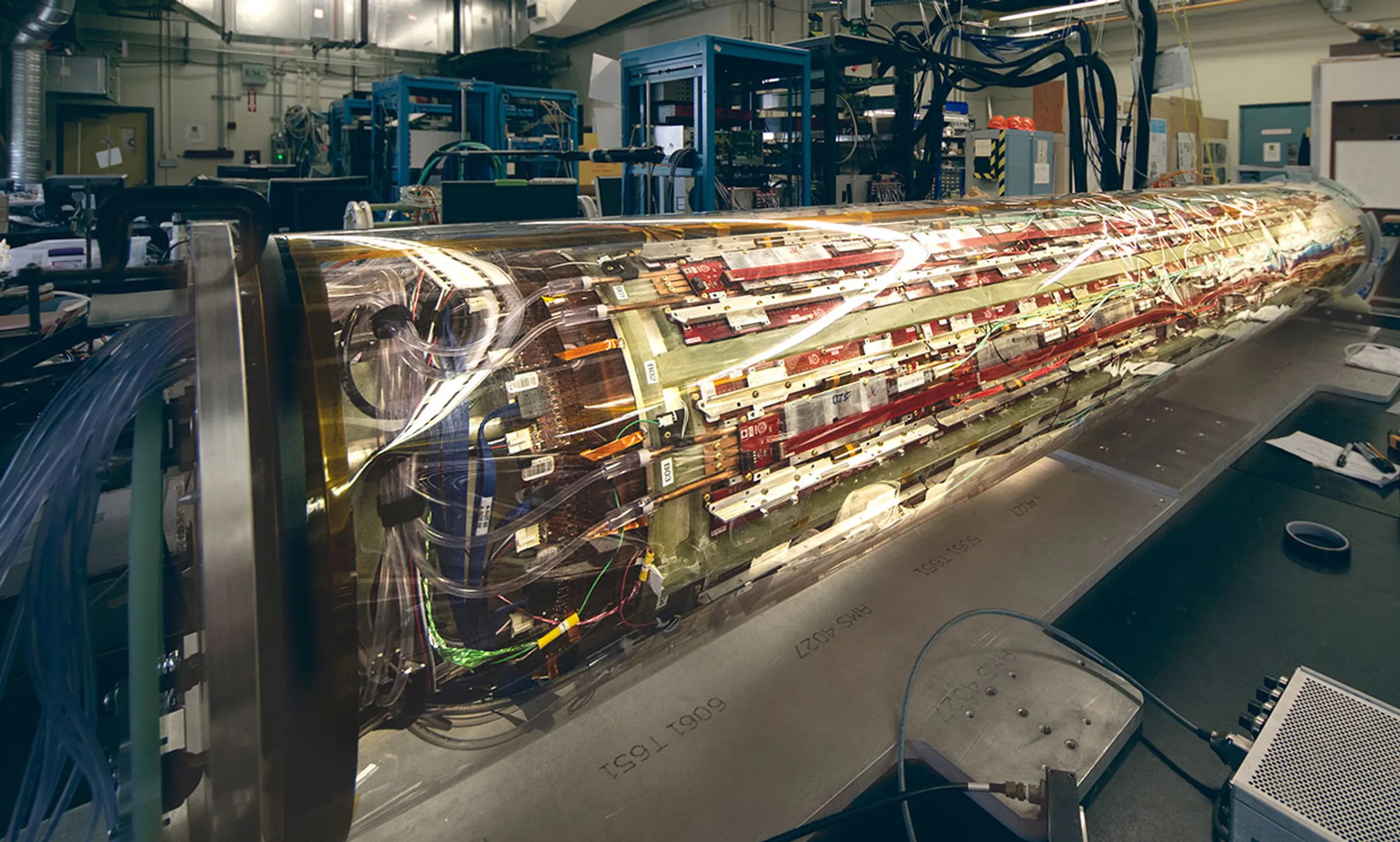
The ALPHA-g detector, built at Canada’s TRIUMF facility, was oriented vertically and filled with neutral antiatoms confined by electromagnetic fields. When the fields release, most antiatoms will randomly fly away, but a few that happen to be at rest will have the opportunity to move solely under the influence of gravity. If they would have fallen up, many speculations that had previously been constrained to the realm of science-fiction would have become plausible. As the experiment showed, however, antiatoms fall down in a gravitational field, killing our best hope for antigravity and warp drive technologies.
And then, once you create and store a large quantity of antimatter, you’ll need some way to bring tiny amounts of that antimatter, a little bit at a time, into an “engine” with an equal-and-opposite amount of normal matter. When the matter and antimatter collide together, they’ll annihilate each other into pure energy (in the form of photons) in the exact inverse of the way the antimatter was first created: via Einstein’s E=mc². The problem then becomes what to do with the high-energy gamma-ray photons that arise from annihilation. If you don’t build anything special, they’ll simply smash into the walls of your spacecraft, ionizing atoms and causing damage, rather than generating thrust.
The key to controlling the photons comes from a surprising source: astronomy. In astronomy, we don’t use a conventional mirror to observe high-energy gamma-rays and X-rays; they would either pass through or be absorbed by that type of matter. Instead, we build a cavity filled with mirrors set at very shallow angles (what we call “grazing angles“), which can then be used to control where those high-energy photons wind up. By arranging a series of mirrors of the right material in this fashion, we could ensure that the photons created by matter-antimatter annihilation get shunted out of the rear of the spacecraft, providing thrust in the opposite (forward) direction as part of the equal-and-opposite reaction demanded by physics.

When very high-energy photons are produced, such as X-rays or gamma-rays, they cannot be focused by a conventional mirror; they would simply ionize the electrons present in the material, be absorbed by them, or pass right through them. Instead, if you wish to focus or redirect them, you must set up an array of grazing mirrors to reflect and/or focus that light in the desired direction. This setup shows the High Resolution Mirror Assembly aboard NASA’s Chandra X-ray Observatory, and it could be applied to a matter-antimatter annihilation chamber aboard a spaceship.
This, at last, converts your matter-antimatter annihilation into thrust: again, with up to 100% efficiency. Efficiency, in this case, means that 100% of your fuel (where 50% is matter and 50% is antimatter) gets converted into useful energy, which can be used to generate momentum-changing thrust and accelerate your spacecraft. This leads to a grand plan for reaching another star system:
- use a big, heavy-lift conventional rocket to place a capsule with your crew, plus the matter, antimatter, and annihilation engine, into Earth’s orbit (make multiple trips if you need to),
- then begin steadily accelerating toward your destination until you’re moving at your desired speed,
- then coast,
- then, at the halfway point, turn the ship to the opposite orientation,
- then coast again until it’s time to begin decelerating,
- and then steadily decelerate at the same rate you accelerated at earlier until you arrive at your destination.
If you can accelerate at 1 g (the gravitational acceleration experienced on Earth, 9.8 m/s²) for the first half of the trip, and then turn the ship around and decelerate at the same rate for the second half of the trip, it’s straightforward to calculate the amount of time it would take to reach a nearby star. Instead of tens or hundreds of thousands of years, the trip could be done in mere decades: short enough for a human crew to still be alive when they arrive at their destination. (Albeit, with no return trip possible.)
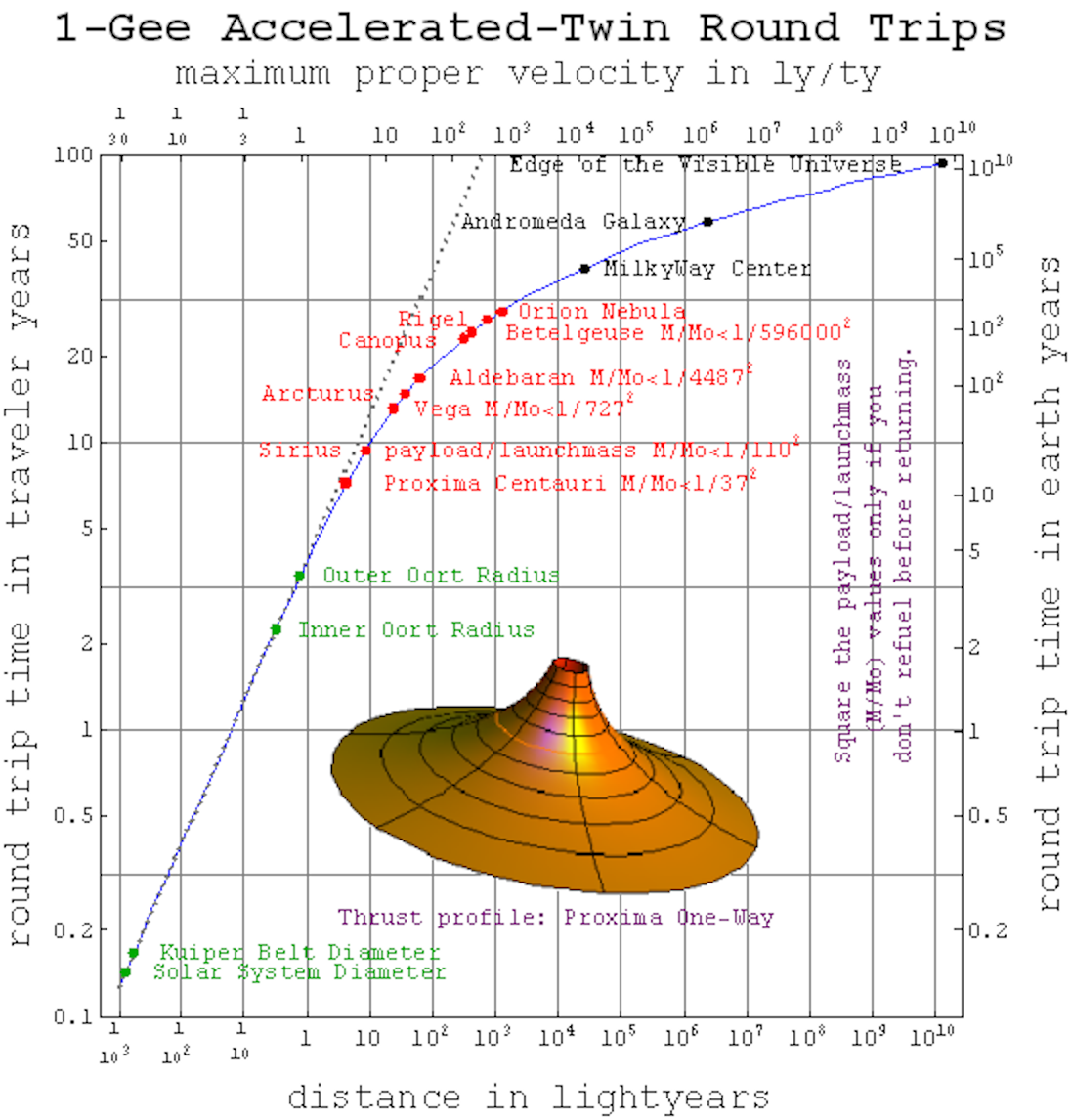
If you were to get in a spaceship and accelerate at 1g (Earth’s acceleration) for the entirety of the trip, you could travel at nearly the speed of light after only a few years of acceleration. As you increased your speed ever closer to the speed of light, the effects of time dilation would get progressively more severe. In theory, distances of many light-years could be traversed in experienced times of much less than a year, but one must reckon with the weight of realistic fuel sources as well.
However, there’s an enormous problem even if you did everything we mentioned up to this point:
- generate all the needed antimatter,
- develop antimatter storage,
- develop and build a suitable matter-antimatter annihilation chamber,
- and use a conventional launch vehicle to lift the payload and the fuel into Earth’s orbit.
The problem is this: the sheer amount of fuel that you’d need to make an interstellar journey happen. Let’s imagine we have a small payload of only 500 kg (1,102 pounds) including the astronauts and all of their food, water, and supplies. If you want to accelerate it at 1 g, you’d only need a small amount of matter-and-antimatter to annihilate: 16 milligrams worth, or 8 milligrams of matter with 8 milligrams of antimatter.
However, that will only get you one second’s worth of acceleration! If you want to accelerate for longer, you’ll need more fuel. With one gram of matter and one gram of antimatter, you can get two full minutes of acceleration. With 300 grams of matter and 300 grams of antimatter, you can get 10 hours of acceleration, which would get you up to speeds of 368 km/s — more than 82,000 miles per hour. That’s twice as fast as the maximum speed of the Parker Solar Probe, which, to date, is humanity’s fastest spacecraft ever flown.

This illustration shows the Parker Solar Probe approaching perihelion: its closest approach to the Sun. It achieved its closest approach ever on December 24, 2024, coming within just 4.43 solar diameters of the Sun’s photosphere. It became the fastest spacecraft ever created by humanity during that, and subsequent, perihelion passes.
But if you want to reach even the nearest stars in a reasonable amount of time, you need to travel much faster. Remember, stellar distances are measured in light-years, with the closest star system still over four light-years away. If you want to get there in a couple of decades, you need to accelerate until you reach more than 20% the speed of light, which is more difficult than you might initially think.
Sure, you can do the math and calculate that, in order to reach 20% the speed of light (roughly 60,000 km/s), you’d need about 50 kg worth of antimatter and 50 kg worth of matter as fuel. It would take you approximately 10 weeks of constant acceleration to reach that speed. Then, you’d journey for approximately 20–25 years (the amount of time it would take you to traverse around 4 light-years at that speed), with the astronauts keeping themselves alive with that tiny payload inside. You’d then need to spend another 50 kg worth of antimatter and another 50 kg worth of matter in matter-antimatter annihilation to decelerate, finally coming to rest in the Proxima/Alpha Centauri system if you did your calculations correctly.
Only with maximum (~100%) fuel efficiency, which you can only achieve with matter-antimatter annihilation, do you avoid the catastrophic problem associated with all other propulsion strategies: the need to bring enormous amounts of fuel on board the spacecraft.
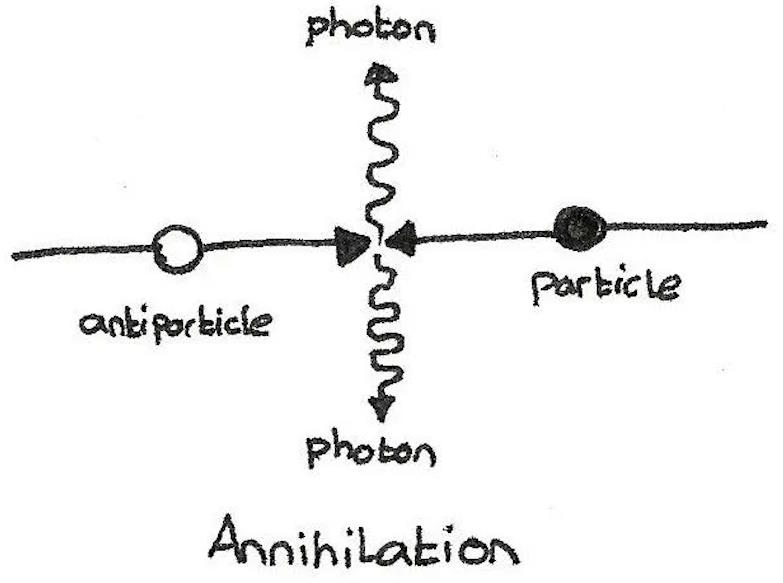
Whenever you collide a particle with its antiparticle, it can annihilate away into pure energy. This means if you collide any two particles at all with enough energy, you can create a matter-antimatter pair. But if the Universe is below a certain energy threshold, you can only annihilate, not create. The pathway to using antimatter as fuel in space involves producing it in copious quantities here on Earth, storing it, and then annihilating it with matter in a controlled fashion inside a spaceship’s reaction engine.
Credit: Andrew Deniszczyc/revise.im
This is the best that the conservation of energy will permit for a spacecraft, at least, given the limits of the laws of physics as we currently understand them. The next-best option to matter-antimatter annihilation, which is 100% efficient at converting matter into energy, is nuclear fusion as it works in the Sun — and that only converts 0.7% of its initial rest-mass into usable energy. Instead of needing 100 kg of antimatter to accelerate a 500 kg payload, you’d need at least thousands of tons (millions of kilograms) of hydrogen, plus a constantly-working fusion reactor, and you’d have to extract and jettison the spent fuel (helium) along the way. Remember: You don’t just need to accelerate/decelerate the mass that’s going to be arriving at your ultimate destination. You need to accelerate/decelerate your unspent fuel at every stage along your journey.
For all methods besides matter-antimatter annihilation, you’re inevitably wasting more than 99% of your mass, meaning that all of that “fuel” just sits there as useless heavy mass that you need to transport during your journey. Matter-antimatter annihilation is the only option for interstellar travel where most of what you’re bringing with you is payload, rather than propellant, and the effective exhaust velocity (because it’s purely in the form of photons) is the maximum possible: the speed of light.
The advances required will be substantial, but of all the fuel sources that we know of, only antimatter, ultimately, is capable of powering our dreams of becoming an interstellar civilization.