The federal government is also launching a sovereign wealth fund capitalized by a $25B federal endowment
Editor’s note: This article originally appeared on ParliamentToday, a Village Media newsletter devoted exclusively to covering federal politics.
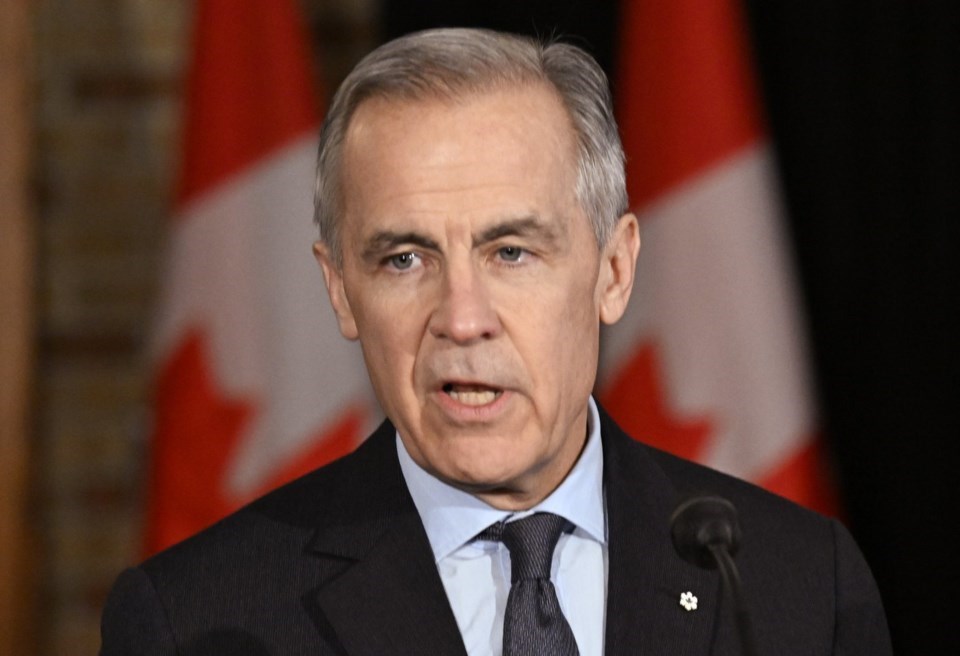
Prime Minister Mark Carney says Tuesday’s spring economic update will include “good news” on the government’s fiscal health and a progress update on his efforts to strengthen the economy against U.S. President Donald Trump’s trade aggressions.
“The update will detail just the scale to which foreign direct investment has increased in Canada, how it’s outpacing all other major economies right now,” Carney told reporters in Ottawa on Monday.
The government’s spring economic update, to be tabled on April 28, will also indicate how non-U.S. exports are performing, Carney added.
Late last week, the prime minister hinted that Canadian exports to markets other than the U.S. are “responding significantly,” alongside capital spilling into the country.
“We’re just getting started. You’re going to see more, but the momentum is there,” he said at the time.
On Monday, Carney announced Ottawa’s plans to create a new sovereign wealth fund, which will get a $25-billion initial endowment from the federal government. The Canada Strong Fund is being billed as a national savings and investment account meant to support domestic “nation-building projects,” although the prime minister said investments wouldn’t be restricted to initiatives referred to his Major Projects Office.
When asked where the government was going to get an extra $25 billion, Carney simply said there will be “good news” in the spring economic update on the country’s fiscal situation, as well as the government’s performance on spending and deficit targets.
“This has been core to our strategy, which is to spend less, get spending under control so that Canada can invest more,” he said.
The Canada Strong Fund will be managed by an independent Crown corporation, responsible to Parliament, and Canadians will be able to invest their personal money into it if they choose to. The government said it will be different from the Canadian Infrastructure Bank and the Canada Growth Fund.
“When you lend money, you hope to get it paid back, and then you move on. That’s what the Canada Infrastructure Bank does,” Carney explained. “You don’t get the returns that the underlying business or project gets, the equity returns, the returns to the owner, which are substantially, if it’s well-run, substantially higher than the returns for debt. That’s what this does.”
It’s unclear what the target return will be.
The Liberals are promising to hold consultations on the “specific design” of the fund, with Finance Minister François-Philippe Champagne later predicting it would take “months” to establish.
Conservative Party Leader Pierre Poilievre said he expects the Liberal government to “double down” on what he’s called “credit card budgeting” in the spring update, questioning why a new sovereign wealth fund is needed when there are already similar initiatives that exist.
“He wants to put another $25 billion on the national credit card to gamble on a Liberal slush fund that will enrich Liberal insiders at the expense of hard-working Canadians,” he said. “You need to have wealth for those funds.”
“If a project has a business case, why would the government need to fund it? If it doesn’t have a business case, why would the government want to fund it, and why can’t projects get funding now?”
Bloc Québécois House leader Christine Normandin said her party will reserve judgment on the fund until more details are provided, but appeared skeptical.
“So far, basically what we understand is that the government (is asking) for a blank cheque of $25 billion to invest in what we suppose will be (the) oil and gas industry,” she told Hill reporters. “I beg to be corrected if that’s not the case.”
The MEI, a public policy think tank, issued a statement from an economist criticizing Carney’s announcement, warning that the Canada Strong Fund, which has a mandate to invest domestically, could crowd out private venture capital formation and hold the “potential for political interference in the allocation of funds.”
The economist also noted that a typical sovereign wealth fund is funded by budgetary surplus, not debt.
“If the prime minister wants to create another sovereign wealth fund, he should take inspiration from Norway by implementing strict safeguards and presenting balanced budgets,” said Emmanuelle B. Faubert, economist at the MEI.
What else will be in the spring economic statement?
The fiscal update will be tabled just over a week after an over four-month temporary removal of the federal excise tax on gas and diesel took effect. The federal government is hoping the measure, which is estimated to cost about $2.4 billion, means the cost of gas will drop by 10 cents a litre of gasoline and four cents per litre of diesel until Labour Day.
The spring economic update will also show the impact of the government’s new spending on the deficit, which was projected at $78.3 billion as of the 2025 budget, with no balanced budgets in the four years that follow.
The large spending was defended at the time by Champagne, who said it fell within the “range” of what many economists expected amid the U.S. trade war.
It’s unclear if the spring economic update will provide any insight into Carney’s plans to balance the operating budget within three years — a pledge he made during the 2025 election campaign.
Carney said this would be achievable by separating capital spending and running a deficit on infrastructure, public transit and energy projects while bringing the operating budget out of the red. The 2025 budget suggested that the capital spending deficit could reach $58 billion by 2028-29 due to investments in “nation-building projects” and defence, among other things.
Ottawa has pledged to meet NATO’s new spending goal of five per cent of GDP by 2035, having reached its previous target of two per cent of GDP in March, and said it wants to double non-U.S. exports, with Carney travelling around the world to deepen trade partnerships as Ottawa gears up to review the Canada-United States-Mexico Agreement (CUSMA).
The 2025 budget outlined a plan to offset some of this spending with $60 billion in cuts over five years, including a little less on transfers to provinces and territories and changes to the public service, including a voluntary early-retirement incentive.
Economists have noted that the spring economic update is coming at a time of heightened geopolitical turmoil and “renewed inflation risk.”’ This includes not only the trade negotiations with the U.S., but also the war in the Middle East, which is expected to impact inflation and economic growth amid higher oil prices.
It’s also coming a day before the Bank of Canada announces its next interest rate decision on April 29.
“In this environment, Canada remains exposed to spillovers from global repricing, even where domestic fundamentals compare favourably,” wrote Scotiabank vice-president of economic policy Rebekah Young.
Young added that she expects to see the spring economic update reflect the Liberals’ affordability measures, such as the GST groceries and essential benefit, as well as tax relief for first-time homebuyers. But otherwise, she doesn’t expect the federal government to change its strategy.
“Recent global events have reinforced — and emboldened — the federal government’s investment agenda,” her fiscal note read. “Interest is building, but it remains early days, with clearer proof points still needed to move markets from cautious optimism to conviction. Any decisive shift in policy or fiscal strategy is more likely a Budget 2026 story.”
In its monthly fiscal monitor published Friday, Finance Canada posted a budgetary deficit of $25.5 billion from April 2025 to February 2026, higher than the $19.3 billion reported for the same time in 2024-25. Revenue clocked in at $453.2 billion for the 11-month period.
Big money committed in the 2025 budget:
Among the money promised in Carney’s first budget as prime minister were:
- $13 billion for its newly created Build Canada Homes;
- $51 billion to improve and expand community and regional infrastructure through a new Build Communities Strong Fund; and
- $81.8 billion on defence over five years.
The fall fiscal document also earmarked $213.8 million over five years for its new Major Projects Office, with the Canada Infrastructure Bank’s statutory envelope also increased by $10 billion to make investments in nation-building projects referred to the Major Projects Office, which the budget said would “unlock more projects.”
Energy Minister Tim Hodgson said late last week that by April 2027, the government’s electricity and nuclear strategies will have been published and begun to be implemented, with five to 10 projects part of the government’s major projects agenda having reached a final investment decision or have broken ground.
What are others looking for?
The Liberals are in a much stronger position in the House ahead of the spring economic update than they were for their 2025 budget, with a majority mandate in hand thanks to five floor-crossers and three byelection wins. This means that they do not need the support of other political parties to push forward their legislative agenda.
But that doesn’t mean opposition parties will quietly accept the update.
In an open letter to Carney shared on social media on Sunday, Poilievre called on the Liberals to cap the deficit for 2026-27 at $31 billion and present a plan to achieve a balanced budget “in the medium term.” The Conservative leader also made a long list of requests, including scrapping the controversial Alto rail project and reining in spending on external consultants.
Poilievre was hearkening back to the Justin Trudeau Liberals’ 2024 fall economic statement in making his request.
“Justin Trudeau left office anticipating a $31-billion deficit for this year. Let’s see what Mark Carney has. We all thought that it was impossible for anyone to spend more recklessly than Liberal Justin Trudeau, and then along came Mark Carney, (who) said, ‘Hold my champagne,’” Poilievre quipped.
Bloc Québécois Leader Yves-François Blanchet, meanwhile, has said his party has 11 proposals they would like to see in the spring economic update, including a wage subsidy for businesses impacted by U.S. tariffs, an increase in health transfers to provinces, and a raise in the old age pension for retirees between the ages of 64 and 74.
The Federation of Canadian Municipalities asked the government to “accelerate local infrastructure investments” through the Build Communities Strong Fund, particularly in small and rural cities. Over the last two months, Carney has started to roll out this funding, with commitments to Brampton, Ottawa, and Toronto.
The FCM is also asking for a reversal of cuts to the Canada Public Transit Fund and a topping up of programs to support homelessness prevention.