
Published as part of the Financial Integration and Structure in the Euro Area 2026
Empirical evidence points to a set of interrelated structural blockages that continue to limit the effectiveness of European capital markets in supporting innovation and long-term growth. Households’ limited exposure to risk capital contributes to a marked mismatch between Europe’s large savings and its financing needs.[1] Additionally, when households do invest in equity, a substantial share of it is channelled to the United States, supporting, among others, its innovative sectors. To translate the savings and investments union (SIU) agenda into actionable priorities, policymakers need sound and simple metrics that quantify how far European capital markets are from their potential, and where fragmentation remains most binding. Building on previous analytical framing, indicators of market development and integration can be mapped to bottlenecks in the capital markets union (CMU) across three stages: (i) facilitating access to capital markets (“entry”), (ii) enabling cross-border scaling (“expansion”), and (iii) improving opportunities to finance growth and fostering successful outcomes (“exit”).[2] This box sets out a compact set of CMU indicators aligned with these goals. The aim is to highlight key structural gaps and help assess progress on CMU objectives under the SIU strategy.
EU households save a relatively high proportion of their income compared to other jurisdictions, but allocate a large share of their financial assets to bank deposits, leading to significantly untapped potential for savings to be channelled into productive investments. In aggregate, EU households hold around a third of their financial assets in cash and deposits, with investments in securities amounting to roughly half that share. If EU households were to align their deposit-to-financial assets ratio with that of US households, a stock of up to €8 trillion could be redirected into long-term, market-based investments.[3] The Savings and Investment accounts (SIA) recommendation proposed by the European Commission in September 2025 aims to unlock this potential by allowing savers to invest in products that would finance European companies and the twin transition.[4] The proposed pension package, which promotes auto-enrolment and the uptake of supplementary pensions while also lowering key barriers to equity investments by pension funds, represents an important part of this endeavour. [5],[6]
When savings do reach capital markets, euro area households largely finance non-EU companies. Looking at direct and indirect (through investment funds) equity exposure of euro area households, half of their holdings are in instruments issued outside of the EU (Chart A). There are, however, major differences across the euro area: less than 23% of the equity holdings of Slovak households were issued within the EU compared with more than 86% for France. The US capital markets capture 34% of euro area equity holdings, which is similar to the share of domestic equities (35%), highlighting the persistent attractiveness of US markets offering consistently higher returns than the EU.[7] This disproportionate weighting of US-issued equities is particularly pronounced for indirect holdings (47% of total), as capital invested through European funds is mainly allocated to the United States (50%) in line with its overall weight in global portfolios. While a higher degree of international diversification tends to provide a better risk insurance for investors, an over exposure to certain US industry segments and USD denominated securities represent a significant channel of contagion.
Chart A
Euro area household equity holdings, by issuer region
(Q4 2024, percentage points of total)
Sources: ECB (SHS), LSEG, and ECB calculations.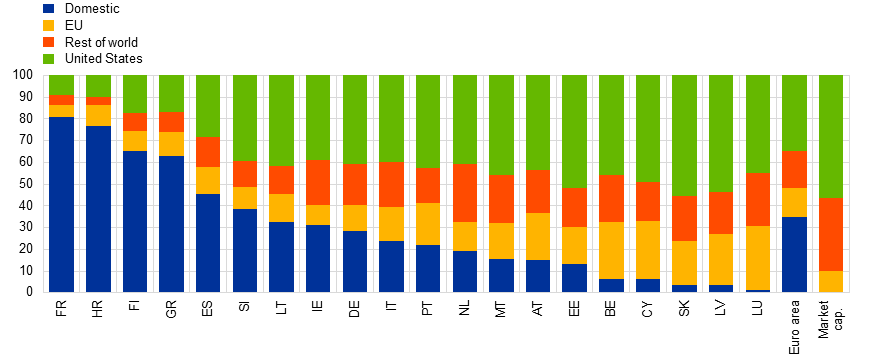
Notes: Listed shares held by euro area households (institutional sectors S.14, S.15, and S.1MU) by issuer region for the 20 euro area countries at the end of Q4 2024. The dataset includes only listed shares issued by non-financial corporations (institutional sector S.11) and banks (institutional sector S.122) held by households directly, by purchasing shares in them or via investment fund shares. Investment fund holdings are analysed on a look-through basis.[8]
The fragmented nature of EU capital markets remains a key obstacle to achieving sufficient scale and liquidity to attract investment and increase returns. Supervisory fragmentation, tax disparities and differences in market infrastructure further exacerbate these inefficiencies. Accelerating regulatory harmonisation and removing structural barriers to cross-border investments are essential to make EU capital markets more attractive. In this regard, the market integration package proposed by the European Commission, including capital market supervision, has the potential to deliver tangible progress.[9]
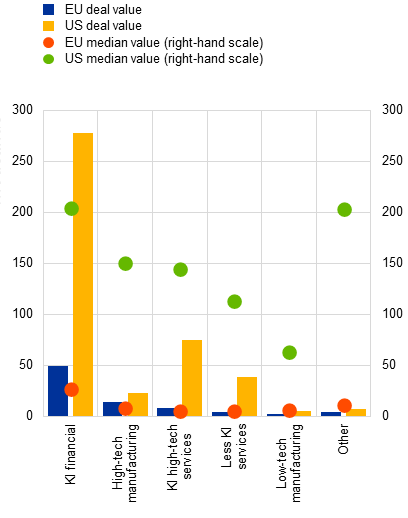
Initial public offerings (IPOs) and venture capital (VC) investment in the EU have consistently lagged behind those in the United States. US IPOs have outperformed those in the EU across all segments, with median valuations in knowledge-intensive and high-tech sectors often reaching ten times those of their European counterparts (Chart B, panel a). A similar pattern emerges in private markets: in the EU, VC investment is significantly lower both as a share of GDP and in terms of median deal size.[10] This gap is due to a combination of demand for and supply of capital: on the supply side, the lack of sufficiently sized VC funds in Europe is partially filled by a strong presence of foreign investors (for more details, see Box 4).
Chart B
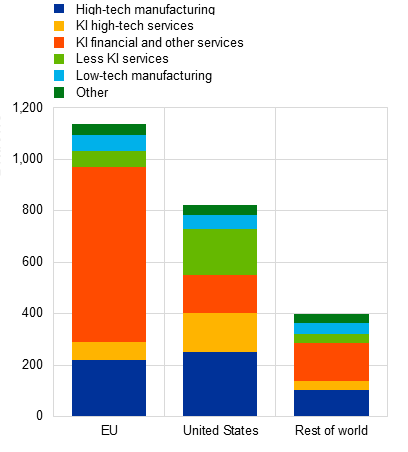
European IPOs and household equity holdings
|
a) IPOs across regions and sectors |
b) Euro area households’ holdings of listed equity, by issuer region and sector |
|---|---|
|
(Jan. 2020-Dec. 2024; left-hand scale: EUR billions, right-hand scale: |
(Q4 2024, EUR billions) |
 |
 |
Sources: Eurostat, Dealogic, ECB (SHS) and ECB calculations.
Notes: KI stands for knowledge-intensive. Panel a): the sector classification is based on Statistical Classification of Economic Activities in the European Community at the 2- or 3-digit level for compiling groups according to the level of technological intensity. Panel b): listed shares held by euro area households (institutional sectors S.14, S.15 and S.1MU) by issuer region as of Q4 2024. The dataset includes only listed shares issued by non-financial corporations (institutional sector S.11) and banks (institutional sector S.122) held by households directly, by purchasing shares in them or via investment fund shares. Investment fund holdings are analysed on a look-through basis.[11]
The underdevelopment of Europe’s VC ecosystem is reinforced by household investment patterns that favour traditional services in Europe while directing equity capital towards innovative sectors in the United States. For EU-issued equities, households predominantly invest in financial sector companies. By contrast, high-tech manufacturing and services, which are crucial sectors for the digital economy, account for the largest share of US-issued equity held by EU households (49%), compared with only 26% of EU-issued equity. This divergence is remarkable in absolute terms as well, with EU households holding around €292 billion in these sectors in Europe against €404 billion in the United States (Chart B, panel b). Given that euro area households hold close to €35 trillion in financial assets, this implies that investments in EU high-tech sectors account for only about 1% of the total.[12]
The efficient implementation of the policy measures proposed as part of the SIU strategy should advance the development and integration of capital markets. The SIA Recommendation and the review of the Solvency II and IORP II frameworks, if implemented in an efficient manner, should be able to enhance equity market development quite quickly. In the longer run, key structural barriers to integration can be addressed through the market integration package on supervision and market infrastructure, as well as more fiscal convergence. This should raise capital market scale and liquidity, thus strengthening the attractiveness of EU markets. Finally, strengthening domestic investment and growth in the EU is essential given that the Union’s persistent current account surplus reflects a structural excess of savings over domestic investment. Fostering deeper venture capital markets should increase the long-run supply of risk capital for Europe’s innovative firms.