Let the Music Play
Jeffrey Deitch
May 2–June 6, 2026
New York
For the Critics Page in this journal, Walter Robinson once wrote, “Artists want to be called ‘great’ by critics, possibly more than they want anything,” before adding, “critics are failed artists.” Having moved between both roles, Robinson understood the dynamic firsthand. Robinson passed away in February 2025, and Let the Music Play, organized by Carlo McCormick, is a posthumous solo exhibition of his work. On view at Jeffrey Deitch in SoHo, the show features fifty-four paintings spanning roughly from 2011–24, with a few remaining undated. The survey presents various subjects divided into categories such as “Still Lifes,” “Normcore,” “Painter Paintings,” “Romance Paintings,” “Nurses on Paper,” and a singular self-portrait. The intimate, undated self-portrait seems to harken back to the late 1960s, when Robinson would have been about eighteen or nineteen years old. He paints himself with thick brown hair, wavy and coiffed, dressed in a suit jacket and dark purple tie. His gaze is lowered, but the likeness is unmistakably him.
Robinson was a longtime fixture at New York gallery openings, particularly among painters. A tough critic and painter’s painter, his figurative work was as much about paint itself as it was about subject matter. Rising out of Pop art while simultaneously critiquing the genre, his aesthetic could be described as kitschy pulp novels meet Richard Prince nurses, J.Crew catalogues, Wayne Thiebaud sweets, and the absurdity of Claes Oldenburg without the immense scale. He painted representationally using thick brushstrokes, tongue-in-cheek subjects, and a staunch seriousness about painting as a medium.
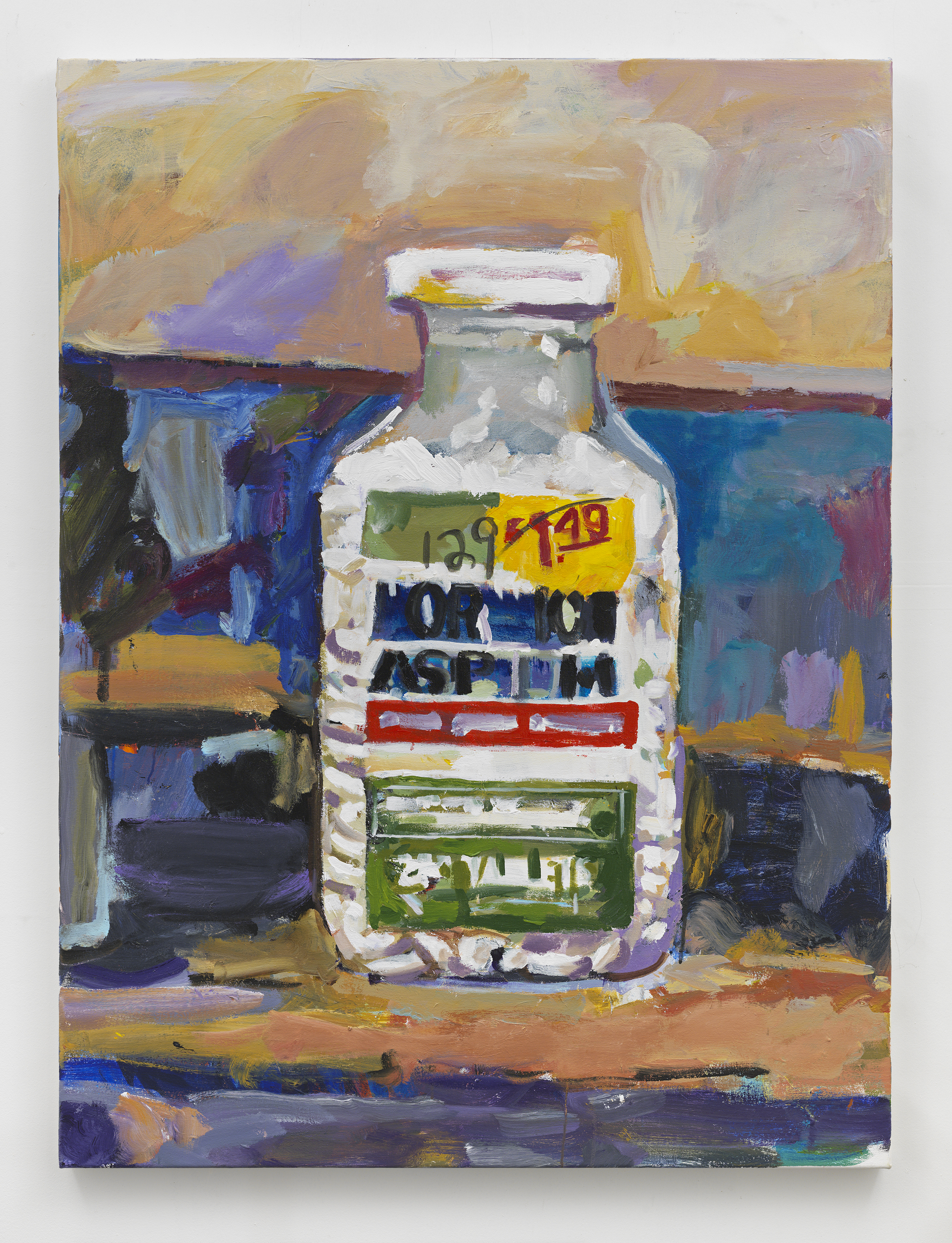
It is not an easy feat to make art while also critiquing art. Somehow Robinson never lost his clout. Or did he? He had very loyal fans and likely just as many detractors. But Let the Music Play is a dedicated exposition of his consistency: subjects who live in a shallow depth of field often engage the viewer with a seductive gaze or through the banality of their objecthood. His Wendy’s Baconator (2021) is as appetizing as it is abject, the greasiness of bacon and beef shimmering in the larger-than-life portrayal. Up close, the burger becomes almost abstract, swaths of subtly shifting color punctuated by highlights made with seemingly singular strokes.
So was Walter Robinson a failed artist and a good critic, or vice versa? According to his own statement, it is impossible—or at least unlikely—to be both. Yet in one of his later paintings, Norwich (2024), he was still coming into his own. There is a frenetic energy to the piece. Less confined to subject matter, the painting depicts an off-brand bottle of aspirin, the regular price of $1.40 crossed out and $1.29 written nearby. The purples and fuchsias dominate the composition; the bottle becomes less about remedy than an excuse to make a painting. It is his Giorgio Morandi moment, but with a Robinson palette. Americana references are unmistakable throughout and Robinson seemed to worship and despise the machine.