Abstract
Sputum culture is essential for identifying pneumonia pathogens, but its sensitivity remains limited. This study evaluated the clinical utility of repeated sputum cultures and factors associated with detecting additional significant isolates in subsequent cultures. We retrospectively analyzed adult patients with pneumonia who underwent three serial sputum cultures at a tertiary hospital between January 2021 and December 2022. We excluded patients with over 48 h interval between each sputum sample or those with coronavirus disease 2019. Initial and subsequent culture results were compared, and clinical factors associated with detecting additional significant isolates were evaluated. A total of 132 patients were included. Sputum quality (p = 0.71) and culture positivity rates (p = 0.25) were similar across serial cultures. Fungi, particularly Candida species, were more frequently isolated from subsequent cultures (p = 0.02). The cumulative detection rate of significant isolates did not improve, although the cumulative number was higher in third than initial cultures (p = 0.01). Hypertension, inappropriate empirical antibiotics, shorter intervals to repeat culture, and greater pneumonia severity were independent risk factors for detecting additional significant isolates. Serial sputum cultures provided limited additional diagnostic information and were not associated with meaningful improvement in the sputum quality, culture positivity, or cumulative detection of significant isolates.
Citation: Yun JH, Park J, Ki HK (2026) Clinical usefulness of repeated sputum culture for the identification of pneumonia pathogens: A retrospective study. PLoS One 21(6):
e0351167.
https://doi.org/10.1371/journal.pone.0351167
Editor: Felix Bongomin, Gulu University, UGANDA
Received: January 20, 2026; Accepted: May 22, 2026; Published: June 10, 2026
Copyright: © 2026 Yun et al. This is an open access article distributed under the terms of the Creative Commons Attribution License, which permits unrestricted use, distribution, and reproduction in any medium, provided the original author and source are credited.
Data Availability: Data requests may be directed to the Medical Information Team, Konkuk University Medical Center (contact person: Hoon Su Son; telephone: +82-2-2030-7032; email: hsson@kuh.ac.kr). The data will be securely stored and maintained by the institution to ensure long-term availability.
Funding: The author(s) received no specific funding for this work.
Competing interests: The authors have declared that no competing interests exist.
Introduction
Sputum culture is an important laboratory test for identifying the pathogens responsible for pneumonia. In Korea, pneumonia is one of the leading causes of death, and its burden is particularly high among older adults and patients with underlying comorbidities [1]. The American Thoracic Society and Infectious Diseases Society of America guidelines for community-acquired pneumonia (CAP) recommend sputum culture for patients at risk of resistant pathogens or those requiring hospitalization [2]. Similarly, Korean guidelines recommend sputum culture and urinary antigen testing for Streptococcus pneumoniae and Legionella species in hospitalized patients with CAP, and blood culture in severe pneumonia [3]. In Korea, Staphylococcus aureus, S. pneumoniae, and gram-negative bacilli, including Pseudomonas aeruginosa and Klebsiella pneumoniae, have been reported as major causative pathogens of CAP [3,4]. In a meta-analysis, the sensitivity of all sputum cultures was 36% (22–53%), regardless of sputum quality, and 73% (26–96%) when only good-quality samples were analyzed [5]. Wide variations in sputum culture sensitivity are mainly attributed to prior antibiotic use, differences in sample quality, and delayed specimen processing [6,7]. Therefore, adequate sputum quality and timely sampling are essential for improving culture sensitivity. Nevertheless, the overall diagnostic yield of sputum culture remains suboptimal.
To overcome these limitations, non-culture-based tests, such as urinary antigen tests and polymerase chain reaction (PCR), have been introduced [8,9]. These methods can enhance the pathogen detection, guide antibiotic selection, and reduce inappropriate antibiotic use [10]. However, they have limitations, including the inability to provide antibiotic susceptibility results and higher costs compared with culture-based methods. Therefore, sputum culture remains an important diagnostic tool in clinical practice.
In pulmonary tuberculosis, repeated sputum examination is an established strategy to improve diagnostic sensitivity, and current guidelines recommend obtaining multiple sputum specimens [11–13]. However, unlike tuberculosis, bacterial pneumonia is usually treated with immediate antimicrobial therapy after specimen collection, which may rapidly reduce culture yield. Although repeated sputum cultures are sometimes performed in routine clinical practice, their additional diagnostic value in bacterial pneumonia remains uncertain. Clarifying this issue may help identify low-value testing and support diagnostic stewardship in clinical practice.
In this study, we evaluated repeated sputum culture results to determine whether it improves pathogen detection in pneumonia. Moreover, we investigated clinical factors associated with the identification of significant isolates on subsequent sputum cultures.
Materials and methods
Study design
We enrolled adult patients with pneumonia who were admitted to a tertiary hospital in Seoul, Republic of Korea, between January 2021 and December 2022. Patients with International Classification of Diseases (ICD)-10 codes relevant to pneumonia and available sputum culture results were screened. Their medical charts were retrospectively reviewed. We included patients who underwent three consecutive sputum cultures (at admission and twice subsequently). The decision to perform repeated sputum cultures was made at the discretion of the attending physician as part of routine clinical care, rather than according to a hospital or study protocol. Only hospitalized adult patients were included in this study. Patients were excluded if the initial sputum culture was not obtained within 48 h of admission; if subsequent cultures were performed more than 48 h apart; if there was no clinical evidence of pneumonia within 48 h of admission; or if patients were diagnosed with coronavirus disease 2019 (COVID-19).
The results of the initial, second, and third sputum cultures were analyzed. The sputum sample quality, culture positivity rates, and identified isolates were compared across serial cultures. The cumulative rates and counts of significant isolates were also compared. Additionally, subgroup analyses restricted to good-quality sputum samples and expectorated sputum samples were performed to assess the potential influence of sputum quality and specimen collection method on the results. Clinical factors associated with identifying additional significant isolates in subsequent sputum cultures, which were not detected in previous cultures, were analyzed.
Definitions
Pneumonia was diagnosed when radiologic evidence of pulmonary infiltration (X-ray or computed tomography) was accompanied by at least two of the following clinical criteria: i) body temperature of ≥38°C or <36°C; ii) white blood cell count of ≥11,000 or <4,000/μL; and iii) presence of purulent sputum or endotracheal aspiration. Sputum samples were graded using the modified Murray–Washington grouping system [14]. Samples classified as Group 4 (epithelial cells 10–25/low-power field [LPF] and white cells > 25/LPF) or Group 5 (epithelial cells <10/LPF and white cells >25/LPF) were considered good quality. Sputum quality was considered improved if an initially poor-quality sample met these criteria in subsequent cultures. Microorganisms were categorized as Gram-positive cocci (GPC), Gram-positive bacilli (GPB), Gram-negative bacilli (GNB), or fungi. Isolates, such as viridans streptococci, Enterococcus species, Candida species, and Corynebacterium striatum, were considered contaminants. Microorganisms not classified as contaminants were considered significant isolates. COVID-19 testing was performed using quantitative real-time reverse transcription PCR (Real-Q 2019-nCoV Detection Kit, BioSewoom, Seoul, Republic of Korea). Respiratory virus testing—including adenovirus, bocavirus, seasonal coronavirus, influenza, human metapneumovirus, parainfluenza virus, respiratory syncytial virus, and rhinovirus—was performed using PCR (Real-Q RV Ⅱ Detection Kit, BioSewoom).
Clinical factors—including age, sex, underlying comorbidities, pneumonia severity, and empirical antibiotic use—were reviewed. Pneumonia was classified as community-acquired or hospital-acquired. Chronic lung diseases included bronchiectasis, tuberculosis sequelae, asthma, and chronic obstructive pulmonary disease. Ischemic heart disease, heart failure, arrhythmias, and valvular heart disease were categorized as chronic heart diseases. Liver cirrhosis and hepatitis were classified as chronic liver diseases. Patients with chronic kidney disease or end-stage renal disease were categorized as having chronic renal disease. Patients who had received steroids, immunosuppressants, chemotherapy, or radiation therapy within 1 month before admission were considered immunosuppressed. Pneumonia severity was assessed using the CURB-65 score, with severe pneumonia defined as a CURB-65 score ≥3. Patients who were intubated within 7 days of admission were classified as having undergone intubation. The appropriateness of empirical antibiotic therapy was evaluated based on initial sputum culture results and was classified as appropriate if identified pathogens were susceptible, inappropriate if they were non-susceptible, and not assessable if no microorganisms were identified or if isolates were considered contaminants.
Sputum culture
Sputum samples were obtained by expectoration or tracheal aspiration and immediately transferred to the laboratory. Samples were stored at 4–8℃ and inoculated onto blood agar and MacConkey agar plates regardless of sputum quality. Incubation was performed at 37℃ with 5% CO₂ for up to 24 h. Identification and antibiotic susceptibility testing were conducted using the VITEK®2 system (bioMérieux, Hazelwood, MO, USA).
Statistical analysis
The chi-square and Fisher’s exact tests were used for categorical variables to evaluate differences between groups. The t-test and Mann–Whitney U test were used to compare continuous variables. Differences were considered statistically significant when the p-value was < 0.05. Statistical significance for serial sputum culture comparisons (e.g., initial vs. second sputum culture) was set at p < 0.017 using the Bonferroni method. Trends in the cumulative number of significant isolates were assessed using a generalized linear mixed model. Logistic regression analysis was performed to identify factors associated with detecting additional significant isolates in subsequent sputum cultures. Statistical analyses were performed using SPSS software (version 29.0; SPSS Inc., Armonk, NY, USA) and R software (version 4.3.2, R Foundation for Statistical Computing, Vienna, Austria).
Ethical approval and consent to participate
The hospital’s Institutional Review Board (IRB No. 2023-04-077) approved this study. The informed consent requirement was waived owing to the study’s retrospective nature. Clinical data were accessed for research purposes between 31/05/2023 and 31/12/2024. During data collection, the authors had access to identifiable patient information, which was anonymized prior to analysis.
Results
Patients
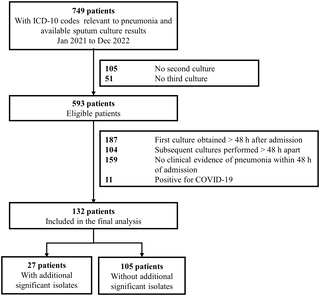
During the study period, 749 patients with ICD-10 codes related to pneumonia and available sputum culture results were screened. Among them, 187 patients underwent initial sputum culture more than 48 h after admission, 105 did not undergo second sputum culture, 51 did not undergo third sputum culture, 104 underwent subsequent sputum culture more than 48 h apart, 159 lacked clinical evidence of pneumonia within 48 h of admission, and 11 were tested positive for COVID-19. The remaining 132 patients were included in the analysis (Fig 1).
Fig 1. Flowchart of the study population.
During the study period, 749 patients with ICD-10 codes relevant to pneumonia and available sputum culture results were screened. Of these, 105 and 51 patients, respectively, from whom a second and third sputum culture was not obtained, were excluded. The remaining 593 patients were eligible for the study. After excluding 187 patients whose first sputum culture was obtained > 48 h after admission, 104 patients whose subsequent sputum cultures were performed > 48 h apart, 159 patients without clinical evidence of pneumonia within 48 h of admission, and 11 patients who tested positive for COVID-19, 132 patients were included in the final analysis. Among them, 27 patients had additional significant isolates identified in subsequent sputum cultures, whereas 105 did not. Abbreviations: ICD, International Classification of Diseases; COVID-19, coronavirus disease 2019.
Comparison between serial sputum cultures
There were 46 (35%) good-quality sputum samples in the initial cultures, 47 (36%) in the second, and 41 (31%) in the third, with no significant differences among groups (p = 0.71). Sputum quality improved in 27 patients (21%) in the second culture and in 19 patients (14%) in the third culture. The median interval from admission to culture was 1 day (interquartile range [IQR], 1–1) for the initial culture, 2 days (IQR, 1–2) for the second culture, and 3 days (IQR, 2–3) for the third culture. Positive culture results were observed in 48 (36%) initial cultures, 60 (46%) second cultures, and 59 (45%) third cultures, with no significant differences between groups (p = 0.25). S. aureus and P. aeruginosa were the most common GPC and GNB isolates, respectively. Most fungi were identified as Candida species, except for four Aspergillus isolates. Detection rates of GPC and GNB were similar across serial cultures (p = 0.77 for GPC; p = 0.99 for GNB). However, fungi were detected more frequently in subsequent cultures (p = 0.02), particularly in the third culture compared with the initial culture (p = 0.005). No significant differences were observed in either the rate or cumulative rate of significant isolates detection across serial sputum cultures (p = 0.85 and p = 0.09, respectively) (Table 1). The median interval from the initiation of empirical antibiotic therapy to the second and third sputum cultures was 2 and 3 days, respectively. Antibiotic therapy had been changed from the initial empirical regimen before the second and third sputum cultures in 17 (13%) and 39 (30%) patients, respectively. Microbiological outcomes did not differ significantly according to whether empirical antibiotic therapy had been changed before subsequent sputum cultures (S1 Table). Nonetheless, the cumulative number of significant isolates increased by approximately 1.6-fold in the third sputum culture compared with the initial culture (p = 0.01), whereas this trend was not observed for the second culture (Table 2).
When only good-quality sputum samples were analyzed, positive culture rates between the initial and subsequent cultures remained similar (17 [37%] vs. 23 [49%] vs. 22 [54%], p = 0.12). S. aureus and P. aeruginosa were the most common GPC and GNB isolates. Significant isolates were identified in 14 (30%), 18 (38%), and 13 (32%) of the initial, second, and third cultures, respectively, and did not significantly differ (p = 0.88) between serial cultures (S2 Table). An additional subgroup analysis restricted to expectorated sputum samples was performed to assess the potential influence of specimen collection method (S3 Table). In this analysis, no significant differences were observed in sputum quality, culture positivity, or detection and cumulative detection of significant isolates across serial sputum cultures. However, fungi were more frequently identified in subsequent sputum cultures (p = 0.01), particularly in the third sputum culture (p = 0.003).
Additional isolates not identified in prior sputum cultures were detected in 28 (21%) of the second and 24 (18%) of the third cultures. S. aureus was the most common GPC isolate, while K. pneumoniae and P. aeruginosa were predominant among the GNB isolates. Most fungal isolates were Candida species. Among the additional isolates, significant isolates were identified in 13 (46%) and 14 (58%) of the second and third cultures, respectively (Table 3).
Comparison between patients with and without additional significant isolates
Significant isolates were newly identified in subsequent sputum cultures in 27 (16%) of 132 patients. Age and sex distributions were comparable between the two groups. Most patients (91%) had CAP, which was similar across groups. Hypertension (15 [56%] vs. 28 [27%], p = 0.004) and a history of cerebrovascular accident (CVA) (8 [30%] vs. 8 [8%], p = 0.005) were more common in the group with additional significant isolates. These patients also had higher CURB-65 scores (p = 0.02) and shorter intervals from admission to the initial culture and from the initial to the second culture (p = 0.03 and p = 0.04, respectively). No significant differences were observed in intubation status, prior antibiotic use, sputum sample quality, or quality improvement between the groups. However, inappropriate empirical antibiotics were administered more frequently (8 [30%] vs. 10 [10%], p = 0.01) in the group with additional significant isolates (Table 4).
Factors associated with additional significant isolates in subsequent sputum cultures
In the univariate analysis, hypertension (odds ratio [OR], 3.44; 95% confidence interval [CI], 1.44–8.24), history of CVA (OR, 5.11; 95% CI, 1.71–15.28), higher CURB-65 scores (OR, 1.46; 95% CI, 1.04–2.03), shorter intervals from admission to the initial culture (OR, 0.40; 95% CI, 0.17–0.94) and from the initial to the second culture (OR, 0.46; 95% CI, 0.22–0.94), and inappropriate empirical antibiotic use (OR, 4.00; 95% CI, 1.40–11.46) were associated with additional significant isolates (Table 5). Multivariate analysis included these variables, as well as age, intubation status, quality improvement in subsequent sputum samples, and prior antibiotic use. Hypertension (adjusted OR [aOR], 3.94; 95% CI, 1.38–11.19; p = 0.01), higher CURB-65 scores (aOR, 1.96; 95% CI, 1.18–3.26; p = 0.01), inappropriate empirical antibiotic use (aOR, 7.42; 95% CI, 1.94–28.44; p = 0.003), and shorter intervals from admission to the initial culture (aOR, 0.10; 95% CI, 0.02–0.45; p = 0.003) and from the initial to the second culture (aOR, 0.17; 95% CI, 0.06–0.52; p = 0.002) were identified as independent factors associated with detecting additional significant isolates in subsequent cultures.
Discussion
In this study, we systematically evaluated repeated sputum culture results in patients with pneumonia. Positivity rates and sputum sample quality did not differ significantly between initial and subsequent cultures. Fungi, particularly Candida species, were detected more frequently in subsequent sputum cultures, whereas the cumulative detection rate of significant isolates did not increase. Hypertension, shorter intervals to culture, inappropriate empirical antibiotic use, and higher CURB-65 scores were identified as independent risk factors for the detection of additional significant isolates in subsequent cultures.
The overall sputum culture positivity rate was 42%, consistent with previously reported diagnostic yields [5]. GNB were the most frequently identified organisms, with P. aeruginosa being the most common isolate in both initial and subsequent cultures. An Asian meta-analysis reported that GNB were identified in 13% of hospitalized patients with CAP, with K. pneumoniae being the most common pathogen [15]. In our study, 59 patients (45%) were at risk for P. aeruginosa infection due to chronic lung disease, hematologic malignancy, solid organ cancer, or immunocompromised status, which may have influenced the observed sputum culture results.
Repeated sputum cultures did not improve sputum quality, culture positivity, or the cumulative detection rate of significant isolates. Similar findings were observed even when analyses were restricted to good-quality sputum samples. As all patients received antibiotic therapy after the initial sample was obtained, the sensitivity of subsequent sputum cultures may have been reduced [7]. Sputum culture results may provide clinically relevant information in patients with pneumonia, as suggested by a recent study showing an association between sputum culture results and the duration of hospitalization in CAP [16]. However, our findings indicate that routine repetition of sputum cultures offers limited additional diagnostic value. Additionally, reducing unnecessary repeated sputum cultures may contribute to cost savings, reduce laboratory workload, and improve diagnostic stewardship. Previous studies have demonstrated that diagnostic yield can be improved using alternative sampling methods, such as tracheal aspiration, sputum induction, or bronchial lavage [17–21]. Therefore, rather than repeating sputum cultures, efforts should first be made to obtain an adequate initial respiratory specimen. If the initial sputum culture remains non-diagnostic and the patient does not respond to empirical antibiotic therapy, alternative diagnostic approaches, such as tracheal aspiration, bronchoscopy, or other adjunctive microbiologic tests, including molecular tests, may be considered depending on the clinical situation.
The number of fungal isolates significantly increased in subsequent sputum cultures, with most identified as Candida species. Broad-spectrum antibiotics—including piperacillin/tazobactam (administered to 86 patients), third-generation cephalosporins (29 patients), cefepime (two patients), and carbapenems (two patients)—were commonly used. Levofloxacin was administered to 16 patients (three as monotherapy and 13 in combination). Broad-spectrum antibiotics disrupt normal airway microbiota and promote fungal overgrowth [22,23]. Thus, antibiotic-induced dysbiosis may explain the increased detection of Candida species in subsequent sputum cultures.
Shorter intervals to culture, inappropriate empirical antibiotic use, and higher CURB-65 scores were independently associated with the detection of additional significant isolates in subsequent sputum cultures. Shorter intervals to sputum collection likely reflect a reduced impact of antibiotic exposure on culture results. Previous studies have shown that sputum culture sensitivity decreases over time following antibiotic administration [7]; therefore, cultures obtained soon after treatment initiation may provide additional microbiological information. Appropriate and timely empirical antibiotic therapy is associated with improved survival and shorter hospital stays [24,25]. Conversely, inappropriate empirical antibiotic use may be less effective and is often associated with the detection of new isolates in subsequent sputum cultures. In patients who fail to respond to initial empirical therapy, repeated sputum cultures may assist in identifying causative pathogens. In cases of severe pneumonia, clinicians may pursue more aggressive diagnostic evaluations, including more frequent intubation and invasive sampling procedures. Moreover, mixed infections are common in severe pneumonia [26], which may further increase the likelihood of detecting additional isolates in subsequent sputum cultures.
This study has several limitations. First, patients diagnosed with pneumonia at >48 h after admission were excluded to minimize the effect of prior antibiotic exposure on culture sensitivity, which may have introduced selection bias. Consequently, most patients had CAP, limiting the generalizability of the findings to hospital-acquired pneumonia. Additionally, the study population was relatively older and predominantly male, which may further limit the generalizability of our findings to other patient populations. Second, distinguishing true infection from colonization, particularly for GNB, was difficult in this retrospective study. Although we performed an additional analysis restricted to good-quality sputum samples, misclassification of colonizing organisms as significant isolates cannot be excluded. Third, as sputum samples were collected serially, superinfection with hospital-acquired pathogens during the sampling interval cannot be excluded. Fourth, the relatively small number of patients included in the analysis of factors associated with additional isolates may have limited statistical power. Despite these limitations, this study systematically evaluated consecutive sputum cultures and demonstrated no significant improvement in sputum quality, positivity rate, or cumulative detection of significant isolates, despite a numerical increase in recovered isolates. These findings suggest that the clinical utility of repeated sputum cultures in bacterial pneumonia is limited and that alternative diagnostic approaches may be considered when the initial sputum culture is non-diagnostic and the clinical response is unsatisfactory.
Conclusion
The quality of sputum samples, the positivity rate of sputum cultures, and the cumulative detection rate of significant isolates were not improved with repeated sputum cultures. Candida species were more frequently isolated in subsequent cultures. Therefore, repeated sputum cultures should be interpreted cautiously, as they provide limited additional information concerning pneumonia pathogens and may not be necessary for all patients.
References
- 1.
Choi MJ, Song JY, Noh JY, Yoon JG, Lee SN, Heo JY, et al. Disease burden of hospitalized community-acquired pneumonia in South Korea: analysis based on age and underlying medical conditions. Medicine (Baltimore). 2017;96(44):e8429. pmid:29095281 - 2.
Metlay JP, Waterer GW, Long AC, Anzueto A, Brozek J, Crothers K. Diagnosis and treatment of adults with community-acquired pneumonia. Am J Respir Crit Care Med. 2019;200:e45–67. - 3.
Lee MS, Oh JY, Kang CI, Kim ES, Park S, Rhee CK, et al. Guideline for antibiotic use in adults with community-acquired pneumonia. Infect Chemother. 2018;50(2):160–98. pmid:29968985 - 4.
Ju KR, Lim SY, Jang Y, Lee H, Jung SY, Yoo S, et al. Epidemiology and clinical characteristics of community-acquired pneumonia in hospitalized patients at a single tertiary center in Korea. J Korean Med Sci. 2025;40(49):e293. pmid:41430749 - 5.
Ogawa H, Kitsios GD, Iwata M, Terasawa T. Sputum gram stain for bacterial pathogen diagnosis in community-acquired pneumonia: a systematic review and bayesian meta-analysis of diagnostic accuracy and yield. Clin Infect Dis. 2020;71(3):499–513. pmid:31504334 - 6.
Song JY, Eun BW, Nahm MH. Diagnosis of pneumococcal pneumonia: current pitfalls and the way forward. Infect Chemother. 2013;45(4):351–66. pmid:24475349 - 7.
Abers MS, Musher DM. The yield of sputum culture in bacteremic pneumococcal pneumonia after initiation of antibiotics. Clin Infect Dis. 2014;58(12):1782–3. pmid:24604901 - 8.
Gadsby NJ, Musher DM. The microbial etiology of community-acquired pneumonia in adults: from classical bacteriology to host transcriptional signatures. Clin Microbiol Rev. 2022;35(4):e0001522. pmid:36165783 - 9.
Ginocchio CC, Garcia-Mondragon C, Mauerhofer B, Rindlisbacher C, and the EME Evaluation Program Collaborative. Multinational evaluation of the BioFire® FilmArray® Pneumonia plus Panel as compared to standard of care testing. Eur J Clin Microbiol Infect Dis. 2021;40(8):1609–22. pmid:33655440 - 10.
Dessajan J, Timsit J-F. Impact of multiplex PCR in the therapeutic management of severe bacterial pneumonia. Antibiotics (Basel). 2024;13(1):95. pmid:38247654 - 11.
Dugdale CM, Zachary KC, McEvoy DS, Branda JA, Courtney A, Craig R, et al. Second time’s the charm? Assessing the sensitivity and yield of inpatient diagnostic algorithms for pulmonary tuberculosis in a low-prevalence setting. Open Forum Infect Dis. 2024;11(6):ofae253. pmid:38872849 - 12.
Lewinsohn DM, Leonard MK, LoBue PA, Cohn DL, Daley CL, Desmond E, et al. Official American thoracic society/infectious diseases society of America/centers for disease control and prevention clinical practice guidelines: diagnosis of tuberculosis in adults and children. Clin Infect Dis. 2017;64:e1–33. - 13.
Migliori GB, Sotgiu G, Rosales-Klintz S, Centis R, D’Ambrosio L, Abubakar I, et al. ERS/ECDC statement: European union standards for tuberculosis care, 2017 update. Eur Respir J. 2018;51:1702678. - 14.
Murray PR, Washington JA. Microscopic and baceriologic analysis of expectorated sputum. Mayo Clin Proc. 1975;50(6):339–44. pmid:1127999 - 15.
Peto L, Nadjm B, Horby P, Ngan TTD, van Doorn R, Van Kinh N, et al. The bacterial aetiology of adult community-acquired pneumonia in Asia: a systematic review. Trans R Soc Trop Med Hyg. 2014;108(6):326–37. pmid:24781376 - 16.
Altundal MMB, Gulec Balbay E, Cangur S, Oksuz S. Association between sputum culture results and duration of hospitalization in patients with community-acquired pneumonia: a cross-sectional study. Pneumon. 2025;38(4):1–9. - 17.
Chuard C, Barth Reller L. Diagnostic value of Gram stain and culture of sputum and endotracheal aspirates in bacteremic pneumococcal pneumonia. Clin Microbiol Infect. 1999;5(2):106–9. pmid:11856229 - 18.
Bandyopadhyay T, Gerardi DA, Metersky ML. A comparison of induced and expectorated sputum for the microbiological diagnosis of community acquired pneumonia. Respiration. 2000;67(2):173–6. pmid:10773789 - 19.
Lahti E, Peltola V, Waris M, Virkki R, Rantakokko-Jalava K, Jalava J, et al. Induced sputum in the diagnosis of childhood community-acquired pneumonia. Thorax. 2009;64(3):252–7. pmid:19052043 - 20.
Ranzani OT, Senussi T, Idone F, Ceccato A, Li Bassi G, Ferrer M, et al. Invasive and non-invasive diagnostic approaches for microbiological diagnosis of hospital-acquired pneumonia. Crit Care. 2019;23(1):51. pmid:30777114 - 21.
Rueda ZV, Bermúdez M, Restrepo A, Garcés C, Morales O, Roya-Pabón C, et al. Induced sputum as an adequate clinical specimen for the etiological diagnosis of community-acquired pneumonia (CAP) in children and adolescents. Int J Infect Dis. 2022;116:348–54. pmid:35063681 - 22.
Krause R, Halwachs B, Thallinger GG, Klymiuk I, Gorkiewicz G, Hoenigl M, et al. Characterisation of Candida within the Mycobiome/Microbiome of the lower respiratory tract of ICU patients. PLoS One. 2016;11(5):e0155033. pmid:27206014 - 23.
Zubiria-Barrera C, Bos M, Neubert R, Fiebig J, Lorenz M, Hartmann M, et al. Impact of Antibiotic Therapy on the Upper Respiratory Tract and Gut Mycobiome in Patients with Cystic Fibrosis. J Fungi (Basel). 2025;11(9):631. pmid:41003177 - 24.
Houck PM, Bratzler DW, Nsa W, Ma A, Bartlett JG. Timing of antibiotic administration and outcomes for Medicare patients hospitalized with community-acquired pneumonia. Arch Intern Med. 2004;164(6):637–44. pmid:15037492 - 25.
Menéndez R, Torres A, Reyes S, Zalacain R, Capelastegui A, Aspa J, et al. Initial management of pneumonia and sepsis: factors associated with improved outcome. Eur Respir J. 2012;39(1):156–62. pmid:21828033 - 26.
Wu X, Li Y, Zhang M, Li M, Zhang R, Lu X, et al. Etiology of severe community-acquired pneumonia in adults based on metagenomic next-generation sequencing: a prospective multicenter study. Infect Dis Ther. 2020;9(4):1003–15. pmid:33170499