It was once a term only used among people interested in stock markets and investing, but now ‘Initial Public Offering’ or IPO has become a buzz word.
Global tech giants have been receiving extensive media coverage over their plans to invest billions in AI, but to do that they need to raise more money.
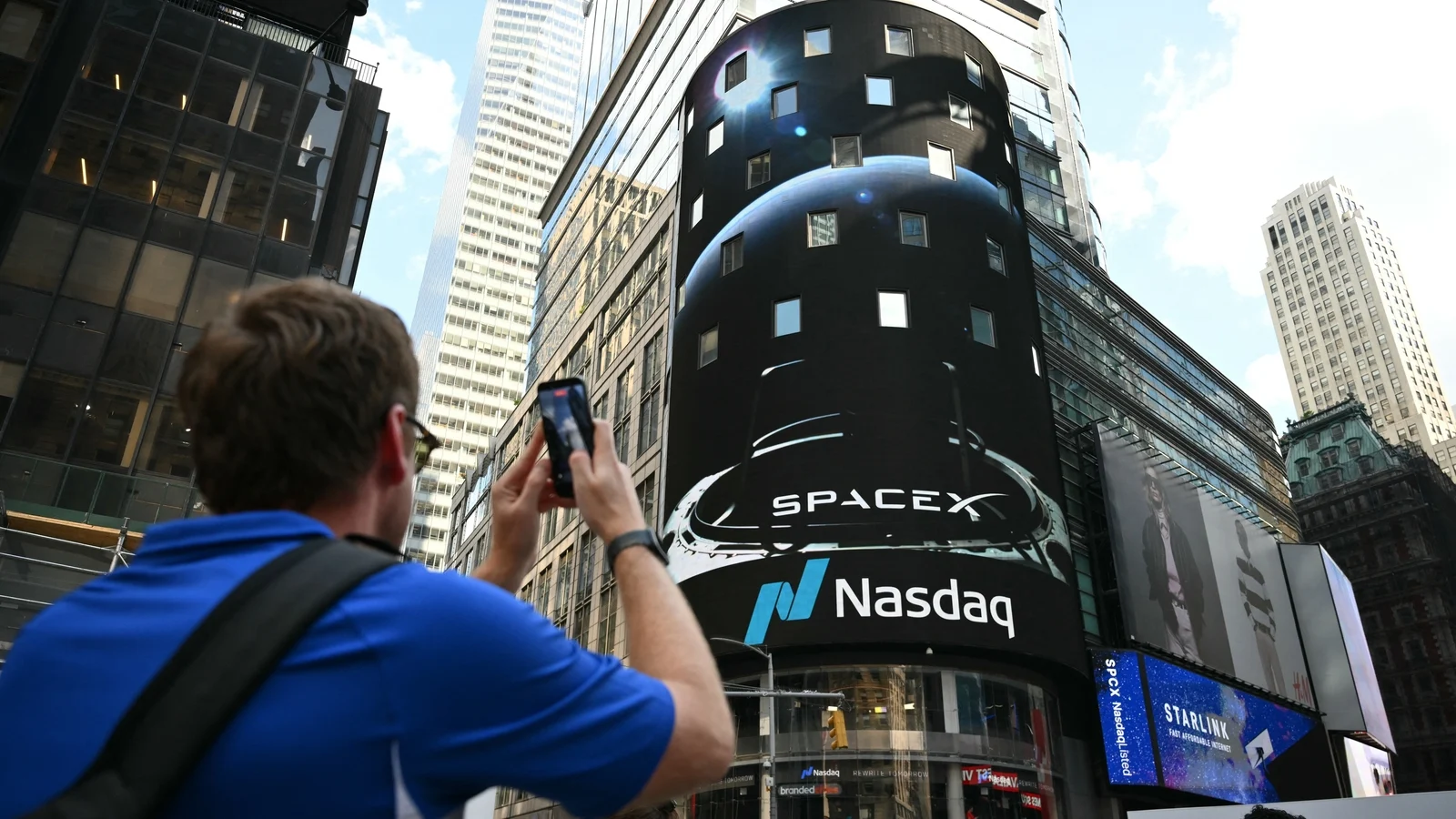
This week, SpaceX’s IPO raised a record $75 billion on the sale of 555.56 million shares, valuing it at $1.77 trillion, a record for an initial offering.
The rocket manufacturing company needs a huge amount of capital to fulfil its plans to build data centres in space that will harness energy from the sun.
SpaceX was on course to blow past $2 trillion in market valuation in its US Nasdaq debut on Friday, reflecting the frenzy for the Elon Musk-led company and putting it on track to become the sixth largest publicly listed company in the United States.
Shares were indicated to open around $175 a share, or about a 30% jump from its $135 IPO price, setting the stage for a blockbuster opening for the world’s biggest IPO.
Earlier this week Open AI, which makes Chat GPT, announced it had filed confidentially with US securities regulators to go public.
The company said it has not decided on the timing of its initial public offering yet and that it announced the confidential filing because it expected it to leak.
It came a week after its rival Anthropic, which makes the Claude chatbot, also filed confidentially.
There could be an element of ‘FOMO’ when it comes to investing in these AI giants, the fear of missing out.
But are we at risk of a runaway stock market with bubble signs and red flag warnings?
What is an IPO?
An IPO is an Initial Public Offering.
It’s when a privately owned company transitions to a publicly listed company or ‘goes public’ on the stock market.
This allows the company to sell shares to investors for the first time and therefore it’s the first time it can raise finance publicly.

As well as raising money for expansion and developing new products, or to pay off debt, it can also raise a company’s profile and media coverage.
The process also means companies are subject to regulatory requirements.
These regulations can incur costs and expose companies to public and investor scrutiny.
The costs include preparing financial reporting documents, audit fees, investor relations departments, and accounting oversight committees.
The obligations also include filing quarterly and annual financial reports and keeping shareholders and the market informed.
Why don’t we hear more about Irish IPOs?
The Dublin ISEQ Overall Index first started on 4 January 1988 and has contained upwards of 90 companies at various points in its history.
The index tracks Irish shares in publicly listed companies.
By the mid-2020s, the number of companies actively traded on the main market dropped closer to 20.
The ISEQ 20 index tracks the 20 largest and most heavily traded “blue chip” stocks.
Blue chip stocks are from companies that are large, well-established, financially sound and less risky.
The Irish stock market represents a very small portion of the total market capitalisation of world stock markets.
Some of the largest stocks on the Irish market, CRH and Flutter Entertainment, left it in recent years for the more liquid capital markets of the US where there are higher trading volumes and activity as well as better price stability.

– Kevin Timoney
Davy Chief Economist Kevin Timony believes there has been limited appetite from Irish companies to go public since the financial crash.
“There’s not a lot of interest in taking out new debt and consequently not a lot of interest in equity raising as a means of financing growth,” he said.
Reflecting on SME financing surveys and the Department of Finance SME survey, he said there is a preference for firms in Ireland to grow out of profits and existing cash rather than through sourcing additional cash.
“I think ultimately there will be a change in that, but it’s just been a long shadow of the global financial crisis, one of many.
“And what you see then is, not a huge amount of action in terms of IPOs or financing through debt.
“But there are signs it could be starting to turn on that, maybe the second half of this decade which we’re in now, it would see more action than the first half where there was a fairly limited amount.
He also noted that with AI changes in the US, and potentially in Europe in time, it could impact on new business formation.
“AI is reducing the barriers to a new business being created and that offers opportunity to scale, and then you could get opportunities to raise finance again through those sorts of channels,” said Mr Timoney.
“I think from the existing economy side of things, with the likes of higher interest rates, it hasn’t been the right environment for it for a few years, but that I don’t think that’s going to be the case forever.”
Can Irish people buy shares in US companies?
Yes, Irish residents can get access to US shares.
They can access them through investments funds like an Exchange Traded Fund (ETF), usually through a broker or an insurance company and paying a fee for the service.
Or an individual can use a regulated online trading platform.
Growth earned on these shares is subject to tax once it passes the annual allowance.

“When you invest through a broker or an insurance company such as Aviva, Zurich or Irish Life, if you go to take the money out, the exit tax is charged on the growth so that’s taken care of for you,” explained Leah McMahon, Senior Financial Planner at Fairstone Limerick.
She acknowledged that some customers might complain about higher charges when using a broker, but she said a lot of the work is done for them where they can just contribute and then take out the cash when they want and not worry about taxes.
“If you go down the route of a trading platform, such as Trading 212, DeGiro or eToro, to specifically buy a share and get growth on it, it is subject to capital gains tax, and that’s not calculated on the platform.
“You have to tell revenue that you’ve bought and sold a share made a growth, and after your annual capital gains allowance of €1,270, there’s your 33% exit tax,” said Ms McMahon.
She also warned people need to be careful about currency conversion, the fluctuations and the knock-on effect on their return.
For anyone considering buying individual shares her advice is to “be informed”.
If there is a dividend paid by a company on a share there is an extra layer to understand in terms of what taxes need to be paid, she said.
“The other side is the emotional investing that shares, when you’re in a particular share by itself, that moves up and down.
“It could be quite volatile at times so people may pull out and cash in their shares when they shouldn’t have.”
Do these latest IPOs come with red flag or bubble warnings?
As global tech firms values rapidly rise, we have signs of a bubble.
SpaceX ranked seventh among US-listed firms when its shares begin trading on the Nasdaq today, though it lost money last year and other mega-caps far outpace its revenue.
Following its IPO it was valued at at $1.77 trillion.
The sale broke the previous record for the largest-ever IPO held by state-run oil giant Saudi Aramco, which raised $25.6 billion on Riyadh’s exchange in December 2019, valuing it at $1.71 trillion.
The other companies that have filed for a public listing potentially later this year, Open AI and Anthropic already have private valuations of nearing $1 trillion.
Meta’s market value is $1.44 trillion, Amazon is valued at $2.6 trillion, Nvidia and Apple are valued over the $4 trillion mark, with Nvidia closing in on $5 trillion, while Microsoft which hit $4 trillion last July is currently valued at $2.9 trillion.
These market valuations are often multiples of the revenue or profit the companies are making, but they’re high because investors are factoring in future growth.
The soaring values draw comparisons to the dot com stock market bubble and subsequent crash,
In the late 1990s, internet companies attracted massive investment.
Investors poured money into companies with a “.com” name.
Low interest rates and interest in technology along with FOMO meant it was easy to raise capital, including for start ups with no track record.
In an article in Investopedia from April this year it highlighted how the dotcom crash was triggered by the rise and fall of US technology stocks.
It said heavy investments in startups with little to no profit and many publicly listed startups without viable business models, ultimately led to the market collapse when investment funds dried up.
Some companies went bust as the bubble burst but others like Amazon and eBay survived the crash as the bubble corrected itself.
If there is an AI bubble crash at some point its likely some companies will fail and some will still succeed.
But we must wait and see if these companies can fulfil their aspirations.
For now, with SpaceX widely viewed as a dress rehearsal for a new generation of mega-listings, market participants will also be watching for signals on investor appetite ahead of forthcoming IPOs for AI heavyweights Anthropic and OpenAI.