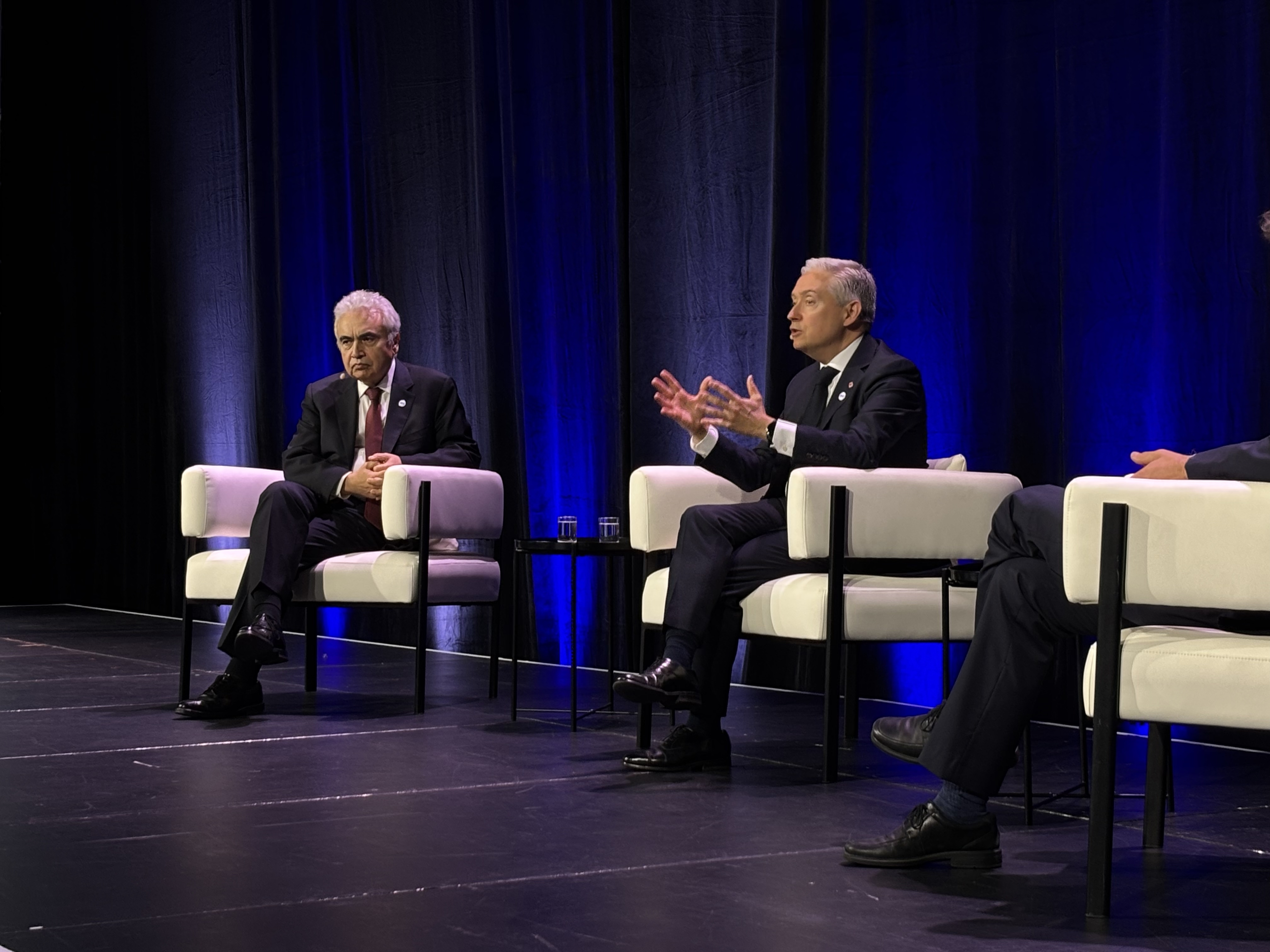
Canada’s government is striking the “right balance” between seizing oil-and-gas export opportunities opened up by geopolitical upheaval and pursuing its long-term ambition of building a clean power-driven economy, Finance Minister François-Philippe Champagne said.
Champagne rejected criticism that the strategy is contradictory, saying it addresses both the near-term disruption in global energy markets sparked by the US-Israel war on Iran, and the long-term, accelerating global shift to renewables.
“There is the short-term reality created by the current geopolitics, which is forcing countries to adjust and adapt. But people are preconscious that in the future, economies are going to be turning more and more toward electricity,” he said in French to reporters at the International Energy Agency’s Energy Efficiency conference in Montreal.
Champagne described a “short-and medium-term opportunity” in global oil-and-gas demand alongside a “long-term vision” of a clean economy.
“It is a case of getting the right balance, which I think [this government is] doing,” he said.
“There are still decades before the world arrives at a program of decarbonization such as what we will have here in Canada, where we are approaching it responsibly and sustainably,” he added.

This spring, Ottawa and Alberta agreed on the terms to build a new West Coast oil pipeline to transport increased crude production and develop the world’s largest carbon capture and storage project. Alberta will submit its project proposals to the federal Major Projects Office this week without backing from private-sector proponents, The Globe and Mail reported on Tuesday.
Ottawa has also announced strategies to develop nuclear power and expand and upgrade the country’s power grid system to meet rising demand for electricity.
“It is not a choice between the two [fossil fuels or renewable energy],” Champagne said.
As the global energy transition unfolds, he said, “countries will turn to Canada for decades to come for their energy, considering the risk that we are seeing with a number of [oil and gas] producing countries.”
Too risky for public funds
Moe Kabbara, CEO of the Transition Accelerator, a think tank, said companies and the market, not government, should bear the risk of fossil-fuel bets.
“The question worth asking is what ‘short to medium term’ really means? These are 30 to 40-year assets, and Asian demand, while real, is more uncertain than the headline suggests,” Kabbara told Canada’s National Observer.
China is electrifying faster than almost anyone forecast, and that bends the long-run picture down,” he said about the long-term outlook for Chinese oil demand.
While the minister is right about striking a balance, Kabbara said, the more pressing question is how Ottawa spends its limited public funds.
“It’s scarce, and it’s best deployed to build industries where Canada can win as the electrification trend accelerates — not to absorb the demand risk on a commodity bet the market is better placed to make itself,” Kabbara said.
Clean-energy investment worldwide outpaced spending on fossil fuels by two to one last year, according to the IEA.
In Canada, capital spending on power generation averaged US$7.3 billion (C$10.3 billion) a year between 2021 and 2025, the IEA said, with US$5.3 billion (C$7.5 billion) going to renewable energy projects and the remaining US$2 billion (C$2.8 billion) split between new fossil fuel and nuclear developments.
Construction of new wind and solar farms in Canada has slowed over the past two years. Even so, as much as 60 gigawatts (GW) of new wind and solar power — more than a third of the country’s current electricity generation capacity — will need to be connected to provincial grids to meet surging power demand, according to the Canadian Renewable Energy Association.
CanREA, an industry body, estimates the market for renewable energy projects will top $200 billion by 2035.
Nevertheless, fossil fuels will remain a key part of Canada’s energy mix in the coming years, says the national energy regulator.
Fossil gas output is expected to rise over the next 25 years, along with “potential gains for oil,” the Canada Energy Regulator said in its 2026 Canada’s Energy Future released in March.

Political will
Champagne’s “all-energy” view of global markets was echoed by IEA executive director Fatih Birol, who spoke to reporters after joining the finance minister at a fireside chat during the summit.
Birol said “strong steps” will need to be taken in the next two or three years to convince international markets that “Canada is coming.”
“When countries think of critical minerals, LNG, renewables, SMRs [small modular nuclear reactors], Canada comes to their mind. The only issue is building infrastructure,” he said, adding he believed the Liberal government’s political will “is very strong.”
According to the IEA’s latest World Energy Outlook, oil demand under its so-called Current Policies Scenario is projected to plateau at 113 million barrels per day by 2050, before beginning to decline. The IEA has faced criticism for scaling back its focus on climate change and the energy transition after the Trump administration threatened to leave the Paris-based agency.
“Even in a world where we see climate change becoming a determining political force, we will still need oil and gas for the world, but maybe less than today,” Birol said.
“I would prefer that oil comes from countries like Canada, than from others that are politically volatile,” he added.
Prime Minister Mark Carney’s “energy superpower” strategy since he took office last year has emphasized boosting oil-and-gas production, chiefly through a plan to expand liquefied natural gas (LNG) exports to Asia and Europe.
International climate and shareholder advocacy groups have called this approach an “increasingly risky gamble” that mistakes a temporary oil and gas “windfall” for a durable energy transition strategy.
Canada Strong subsidies?
Meanwhile, Canada’s first national sovereign wealth fund, launched in April, has drawn criticism from clean energy advocates as a potential “back door” for more public fossil-fuel subsidies.
The Canada Strong Fund and its $25 billion in seed funding should target upgrading transmission lines and building a connected, coast-to-coast electricity grid instead of “propping up” the oil and gas sector, Environmental Defence analyst Aly Hyder Ali said this spring.

This week, the federal government announced a plan to build five power ‘interties’ — connectors linking provincial grids that currently operate independently — as a first step toward a trans-Canadian clean electricity network that would form the backbone of a recently unveiled National Electricity Strategy.
Capturing the international oil and gas sales that Ottawa is banking on, while meeting surging domestic power demand on a constrained grid, will require Canada to “build at speed and to a scale not seen for generations,” Champagne said.
“We are starting that process. The nexus between energy security, economic security, and national security is becoming one for every country,” the minister said. “And countries are looking for dependable partners as the world energy architecture is being redesigned.”
Canada — first with oil and gas and later with clean electricity — is positioning itself to supply countries planning for the next 30 to 40 years, Champagne said.
These countries “already have us top of mind because they need a partner that can provide them with resiliency and the trust that they need to build their economies for the long-term,” he said, without naming specific potential customers.
“The world is a big place,” he said. “Some countries will be quicker to move toward electrification and others will still mean decades of demand for LNG, for instance, certainly the way that Canada can produce it, sustainably and responsibly.”