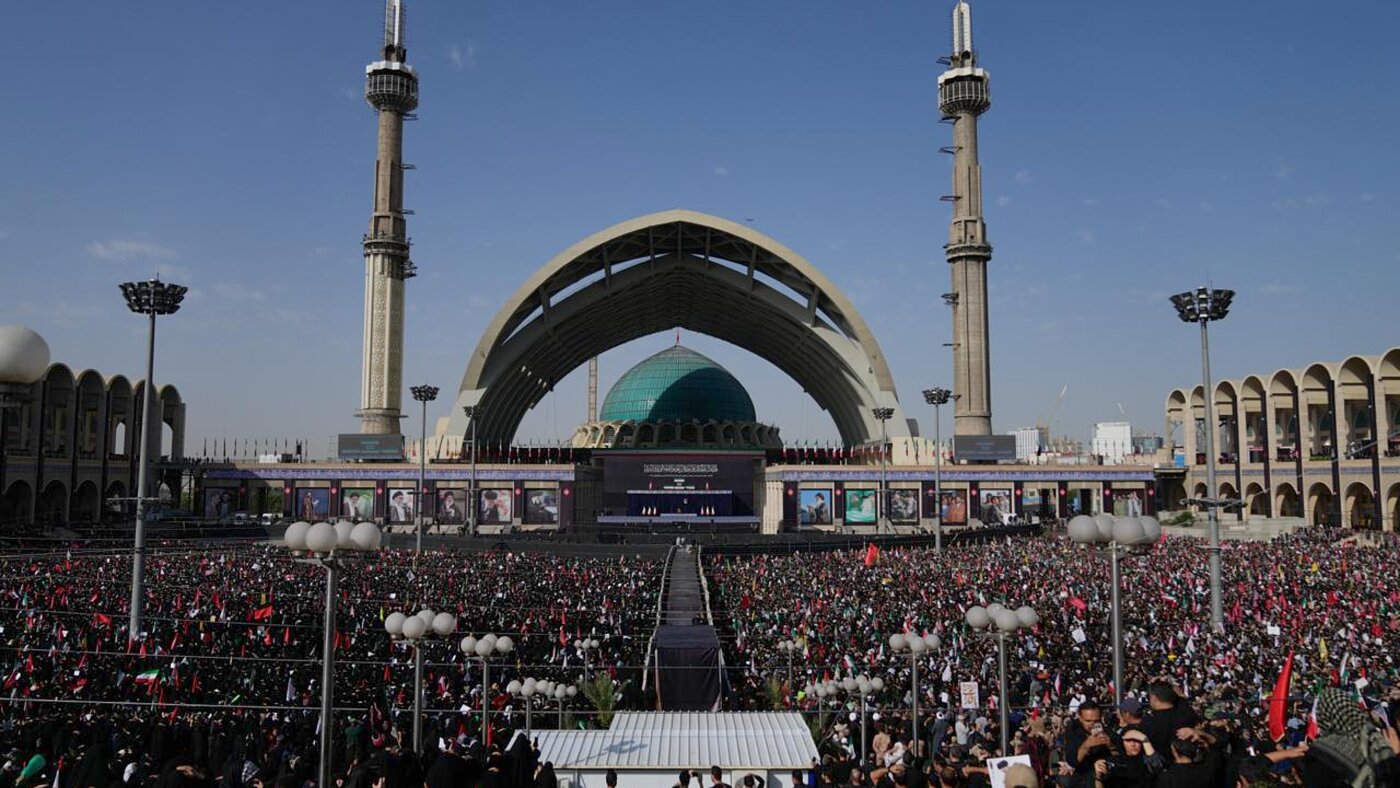

A crowd attends the start of the dayslong funeral ceremonies at the Imam Khomeini Mosalla Grand Mosque in Tehran, Iran, Saturday, July 4, 2026.
Altaf Qadri/AP
hide caption
toggle caption
Altaf Qadri/AP
ISTANBUL — Four months after Iran’s Supreme Leader was killed in U.S.-Israeli airstrikes, the country is holding his funeral.

Iranian state media showed huge crowds at the Imam Khomeini Grand Mosalla — a large prayer complex in Tehran — visiting the casket of Ayatollah’s Ali Khamenei, who was killed on Feb. 28 at the start of the U.S.-Israel war against Iran. The caskets of four of his killed family members were also on display.
Men and women in the crowd wore black and wept openly. Women slapped their heads with their hands in mourning, while men beat their chests in unison, a tradition observed at Shia funerals. There were chants of “Death to America” and big red signs that read “#KillTrump.” Some people waved flags, including red ones that symbolize revenge and many yellow ones that represented the Iranian-backed Lebanese militia Hezbollah. Hezbollah and Israel have been fighting since the beginning of the war.

A spokesperson for the funeral preparations issued a statement saying that the ceremonies were delayed this long because of “the war conditions” and “the brutal U.S. invasion.”
The funeral is one way the Iranian regime is trying to show stability and power to Iranians and the world, sending a message that the Islamic revolutionary power that leads the country still enjoys popularity.
World Leaders

Iranian religious leaders and other mourners pay their respects before the coffins of slain Iranian Supreme Leader Ayatollah Ali Khamenei and members of his family during a viewing ceremony ahead of the dayslong funeral ceremonies at the Imam Khomeini Mosalla Grand Mosque in Tehran, Iran, Friday, July 3, 2026.
Vahid Salemi/AP
hide caption
toggle caption
Vahid Salemi/AP
On Friday, a number of official foreign delegations and religious leaders attended a ceremony as Khamenei lay in state.
Russia, which has supported Iran during the war and has received drones from Iran for its war in Ukraine, sent former president Dmitry Medvedev. Pakistan sent its Prime Minister Shehbaz Sharif. Other foreign attendees included the president of Iraq, the Afghan foreign minister and a delegation from Hamas. Saudi Arabia, which has been at odds with Iran for decades – and where Iran attacked a U.S. military base in March, sent a delegation.
The Iranian president, Masoud Pezeshkian, and the speaker of parliament, Mohammad Bagher Ghalibaf, who has led the ceasefire negotiating team with the U.S., were seen praying near the caskets. There has been no sign of Iran’s current leader, Khamenei’s son, Mojataba Khamenei. He has not been seen in public since he took over in March.
Iranians divided
Khamenei was a divisive figure in Iran. He was Supreme Leader since 1989 and oversaw the expansion of the Iranian Revolutionary Guard Corps, or IRGC.

A man holds a picture of slain Iranian Supreme Leader Ayatollah Ali Khamenei as a crowd waits for his casket to arrive at the Imam Khomeini Mosalla Grand Mosque for the start of the dayslong funeral ceremonies in Tehran, Iran, Saturday, July 4, 2026.
Altaf Qadri/AP
hide caption
toggle caption
Altaf Qadri/AP
The IRGC was responsible for the killing of at least 7,000 people during nationwide antigovernment protests that broke out in December 2025, according to HRANA, an Iranian human rights organization.
A 32-year old woman whose brother was killed during the protests in January told NPR that Khamenei’s funeral gave her little comfort. She asked NPR not to use her name fearing government retaliation.
“Even in the Ayatollah’s death he still causes us torment,” she told NPR.
33-year old Fatmeh, who asked NPR to only use her first name because she was afraid of retaliation from the government, said she argued with her family all the time, especially her mother who she says sees Khamenei as part of her religion.
“She is definitely going to take part in the funeral,” Fatmeh said about her mother.
Mourners will be able to visit Khamenei’s body in Tehran until the end of the weekend.
On Monday, a funeral procession will take the body to the city of Qom and then the procession will cross into Iraq where he will be taken to Shia religious sites in the holy cities of Najaf and Karbala. He will finally be transported back to Iran where he will be buried in his birthplace of Mashhad on Thursday.
Iranian officials say they expect millions of people to attend.