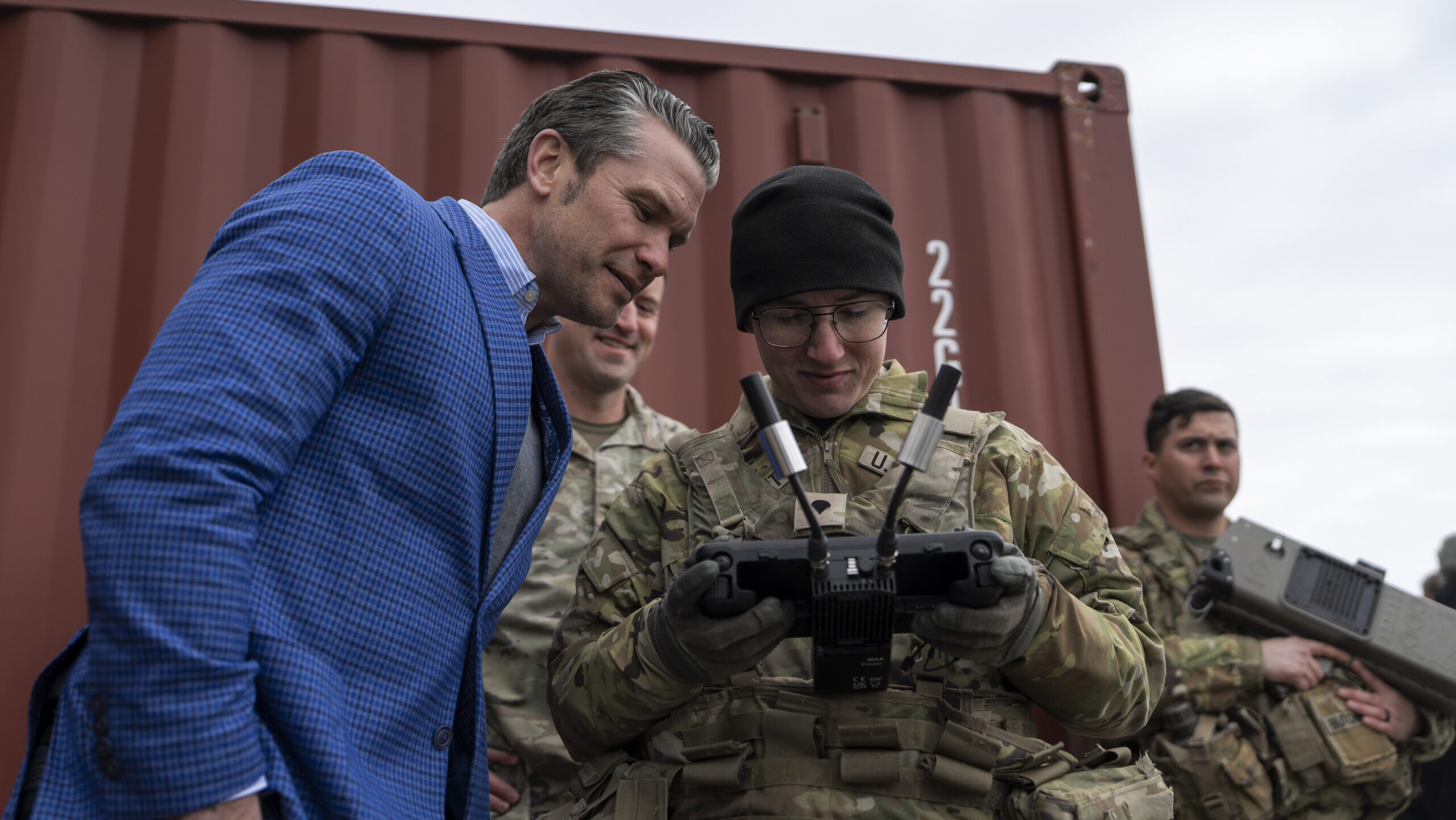
WASHINGTON — A week-and-a-half after Secretary of Defense Pete Hegseth ordered a sweeping centralization of most service-run drone programs under one manager, no one’s yet been named to fill that powerful role.
There aren’t even widespread rumors about who is under consideration for the Direct Reporting Portfolio Manager job, colloquially being called the “drone czar.” But in a town where personalities often trump policy, experts told Breaking Defense that who runs the new office — and how well they manage the inevitable intramural frictions — matters more than what’s written in the formal memorandum [PDF] establishing the office.
“A memo by itself never solves anything, but in this case I’m willing to give the benefit of the doubt to the secretary,” said Jack Shanahan, a retired Air Force three-star who led similarly centralized high-tech efforts as head of Project Maven and the Joint AI Center. “I put this in the category of ‘better to be bold and move out right now, than to wait for a perfect solution in a year or two.’”
But there are plenty of devils in the details, Shanahan told Breaking Defense. “So much will depend on personality and service support,” he said. “If this DRPM stays lean, has the unmistakable and continuous backing of [top leaders], works with rather than against the services, and spends a lot of time on the Hill getting congressional buy-in, it may turn out to be a master stroke. If all that doesn’t happen, it could end up looking like the F-35 JPO.”
RELATED: F-35 Production Move Was ‘Acquisition Malpractice’: Top DoD Buyer
It’s crucial, Shanahan said, that “the person hired into the role is recognized as a confidante of the DSD [Deputy Secretary of Defense Steve Feinberg], along with Emil Michael [the Pentagon CTO].”
The new drone boss must also have “the kind of wasta needed to let everyone know that they ignore the DRPM at their peril,” Shanahan added, using an Arabic colloquialism for the personal, informal influence that allows a well-connected individual to get things done despite bureaucratic obstacles.
That kind of top cover is both essential and easily lost, added David Berteau, a former assistant secretary of defense who’s spent decades in the Pentagon, academia and industry.
Look closely at Hegseth’s memo, Berteau said in a series of emails. While it lays out nine broad bullet points about what kinds of unmanned systems are under the new office’s “directive authority,” and which ones are excepted, there are at least dozens of individual programs that could be included, he said, but no definitive list of which actually are. So who decides?
One dense paragraph explains how the DRPM “will provide oversight and authoritative direction…for all UxS [Unmanned Systems] programs,” albeit “in coordination with the respective Military Department Secretary or other DoW Component.”
So what if the drone czar and the service disagree?
“Disputes over UxS budget activities will be resolved by the DepSecWar,” the memo says — that is, Deputy Secretary Feinberg.
“I know from long experience that one can only take so many disputes to the DepSec,” Berteau wrote. “If you win the first ones, the rest fall in line. If you lose more than one or two, you’ve lost them all.”
Those bureaucratic battles may begin immediately, because four different budgets are currently in motion. Reconciliation funding that Congress appropriated for fiscal 2025 needs to be formally obligated before FY26 ends on Sept. 30, Berteau noted, “less than 90 days from now.” FY26 funds are in full flow, the FY 27 request is on the Hill and the multi-year plan for FY 28-32 is being brainstormed in the bowels of the Pentagon.
RELATED: Pentagon races to spend $152B reconciliation pot — or face cuts
“It will take time to stand up the new office. Congressional and annual budget cycles will not wait,” he said.
Berteau’s bottom-line assessment of the consolidation of drone programs? “This action may create a better structure, more integrated priorities and improved outcomes, but that will be in the long run,” he told Breaking Defense. “In the short run, it will slow things down.”
Mission Impossible? Or Just Mission Very Hard?
Former Air Force Secretary Frank Kendall was even more skeptical about the long-term prospects for Hegseth’s reform.
Kendall has championed delegating key decisions to the armed services whenever possible. His new book, Lethal Autonomy, even includes detailed chapters on the distinct demands of optimizing unmanned systems for different environments — land, air, sea, space — and he argues that only the services have the necessary expertise to refine drones to thrive in their respective domains, not the Office of the Secretary of Defense.
RELATED: Frank Kendall on the trouble with banning autonomous weapons [Book excerpt]
“Based on decades of experience, I’m not a fan of these sorts of OSD-run things,” Kendall told Breaking Defense. “It’s sending a big vote of no confidence in the services and circumventing the leadership responsible for equipping those services.
“At the end of the day the services have to embrace autonomous systems,” he said. “They’re the institutions that are going to have to man these systems, operate them, provide logistics for them and train people for them. Trying to do all that from outside the service is problematic.”
While all the experts interviewed for this story acknowledged the pitfalls of Pentagon politics, Kendall was by far the most pessimistic about the as-yet-unnamed DRPM’s ability to manage frictions with the services. By contrast, Lexington Institute vice president Rebecca Grant had written an op-ed for Breaking Defense just weeks before Hegseth’s memo in which she advocated for the creation of just such an office, and she applauded Hegseth’s implementation of the idea.
“A drone-dominance DRPM is the right move, since the Department wants to spend a lot of money and buy 200,000 drones right now,” Grant said in an interview. “Just the acquisition urgency is a strong rationale.”
There’s also the successful precedent of other Direct Reporting Program Managers created for underwater warfare and Golden Dome missile defense, she argued. “Feinberg likes the DRPMs. [They’re] working, so of course he wants a DRPM drones to sort out the wild, wild west of this billion dollar fast-paced acquisition.”
That said, the new DRPM is even more complicated than its predecessors and, uniquely, oversees programs from all three military departments: Army, Air Force, and Navy. “It’s a really, really novel portfolio, something that we have just not seen before,” she acknowledged. “It does raise a lot of doctrinal and deconfliction issues.”
But, she said, many of those are the same division-of-labor debates that have bedeviled the Department of Defense since its creation, like how high an Army aircraft, manned or unmanned, should be able fly before it becomes the responsibility of the Air Force. No one has ever found the perfect org chart to fix those problems. They’re definitely hard to solve, she said, but hardly impossible.
A lot of it does come down to picking the right person, Grant said: “This DRPM-drone is really gonna have to be a top-flight manager.”
Aaron Mehta and Ashley Roque contributed reporting to this story.