One of the most infamous comments uttered about the Iraq War was then-Vice President Dick Cheney’s prediction, just days before it began, that US troops would be “greeted as liberators.”
Over the years, that comment came to epitomize not just the George W. Bush administration’s broken promises, but also its apparent failures to prepare for and understand the war it launched. How could it be so brazen as to directly predict something that turned out to be so wrong?
The Trump administration’s track record on the Iran war is rife with similar examples.
Over the last four and a half months, President Donald Trump and those around him have confidently made predictions that quickly fell apart.
It often seems as if Trump, especially, has little to no understanding of what’s happening with the war he launched. But the wayward comments are hardly limited to him.
Here are some of the biggest examples.
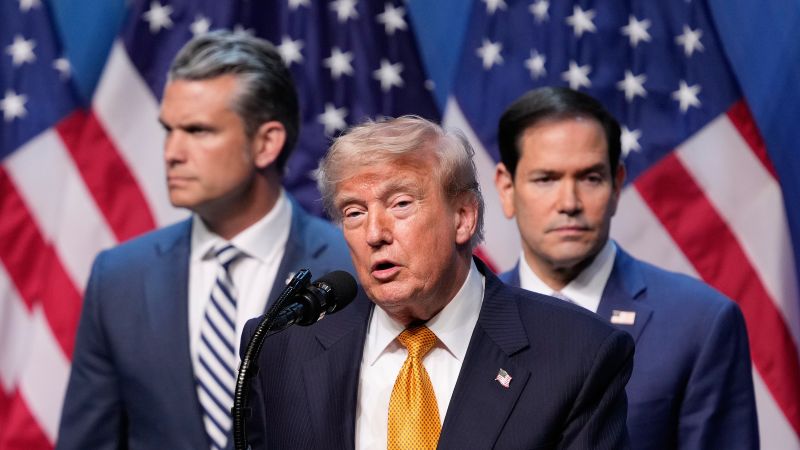
Trump shocked the world on Monday by confidently announcing the United States would soon take over the Strait of Hormuz as its “guardian” and charge countries 20% cargo fees for passage.
Except this ran counter to what the administration previously said about anyone charging tolls in the strait.
“We’ve always said a tolling system in the strait would be unacceptable. But we don’t just say that; the world has said that,” Secretary of State Marco Rubio said in May. He also said it would be “completely illegal, by the way.”
Trump’s Monday comments also raised the prospect of the United States needing a sustained military presence to control the strait for years to come.
In other words: It seemed wholly impractical. And sure enough, just a day later, Trump reversed himself.
That the president would even float something so extreme and difficult suggests he’s not terribly clued in on what’s feasible. CNN reported Tuesday that advisers scrambled to talk him out of the idea.
Trump predicted early on that the war would be brief, repeatedly projecting it would last “four to five weeks.”
More than two months in, on May 1, he said that it “shouldn’t be too long.”
It’s now been four and a half months — with no end in sight.
Many of the early predictions weren’t hard and fast, and the administration argues the war wasn’t ongoing during the ceasefire, which Trump has since declared over. But officials’ early projections suggested the administration anticipated a much different type of war.
After the US and Iran agreed on a memorandum of understanding last month, Trump and Vice President JD Vance spoke as if Iran’s leaders had suddenly seen the light.
“We’re dealing with people that I think are very rational people,” Trump said on June 16, adding that Iran’s leaders were “nice to deal with” and “not radicalized.”
Vance said in an interview with CNN’s Jake Tapper: “The coolest thing about the progress we’ve made over the last few weeks is that you see people within the Iranian system, senior leadership, even IRGC officials say, ‘You know what, we may have some animosity, we may have some mistrust, but we recognize the way that we’ve done business with the United States for 47 years is a mistake.’”
It didn’t take long for the administration to eat those words. After the ceasefire and the memorandum crumbled last week, Trump called Iran’s leaders “cuckoo,” “evil,” “sick,” “dirty players” and “scum.”
It’s not clear whether Trump and Vance believed what they were saying earlier or whether they were just saying nice things.
But either way, their comments quickly came to look pollyannaish — as many predicted at the time.
When he first launched strikes on Iran in late February, Trump was focused on the idea that the Iranian people could rise up and change their regime.
He even concluded his announcement that night by focusing on the idea.
“I call upon all Iranian patriots who yearn for freedom to seize this moment — to be brave, be bold, be heroic, and take back your country,” Trump said. “America is with you. I made a promise to you, and I fulfilled that promise. The rest will be up to you, but we’ll be there to help.”
But when the popular uprising didn’t happen, Trump quickly dropped the subject — as if it was never his goal to begin with. And today, he’s talking as though it were unthinkable.
“Unless they could be completely armed, I never thought they’d have that kind of an uprising, because these people are violent,” Trump told radio host Hugh Hewitt on Monday. “Their so-called leadership is very violent.”
But Trump clearly thought it was a possibility at one point. In fact, it was a major point of emphasis.
When Iran made its big move to gain leverage by shutting the Strait of Hormuz, the administration initially shrugged it off and suggested it couldn’t possibly last.
“It’s something we’re dealing with; we have been dealing with it,” Defense Secretary Pete Hegseth said on March 13. He added that people “don’t need to worry about it.”
A few days earlier, on March 9, Trump said the strait “doesn’t really affect us” because “we have so much oil.”
“The Strait of Hormuz is going to remain safe,” Trump added.
The strait has not remained — or been consistently — safe. And while it’s true that other countries have been more impacted by Iran shutting it down, the closure has also wrought significant damage on the US economy.
It’s also giving Iran major leverage over Trump.
Related to its naiveté about the strait, the administration has made many wayward assurances about gas prices.
In an interview with Tapper on March 8, Energy Secretary Chris Wright said gas prices would be back under $3 per gallon “before too long.”
Pressed on precisely when, Wright said that, even in the “worst case,” it would be “weeks” rather than “months.”
It’s been even worse than Wright’s worst-case scenario. More than four months later, gas still isn’t under $3 per gallon. Prices haven’t fallen below $3.70 in the national average, according to Gas Buddy, and they’re now spiking again after renewed hostilities.
The bad prediction underlines how the administration didn’t seem to fully anticipate just how much damage Iran could do by closing the Strait of Hormuz.
Trump has said dozens of times that Tehran was “begging” for a deal, it was “desperate” and “dying” to make one, and that it wanted a deal “so badly” and “very badly.”
He also routinely predicted a deal was just around the corner.
But the events of the past three months have shown the opposite. Iran has not only held out for very significant concessions, it’s also scuttled what seemed to be pretty favorable terms in last month’s memorandum of understanding.
Perhaps it’s some wishful thinking or spin from Trump, but it suggests he doesn’t understand the motivations of his adversary.
From the war’s earliest days, Trump and Hegseth claimed Iran’s military defeat was so absolute that the United States could basically fly anywhere it wanted to without risk.
At a March 4 briefing, Hegseth claimed the US and Israel “will have complete control of Iranian skies” within a week.
“And Iran will be able to do nothing about it,” Hegseth said.
Trump repeated in the weeks that followed that Iran “can’t do a thing about it.”
“They have no anti-aircraft equipment. Their radar is 100% annihilated,” Trump said. “We are unstoppable as a military force.”
But by early April, Iran managed to take down two US aircraft.