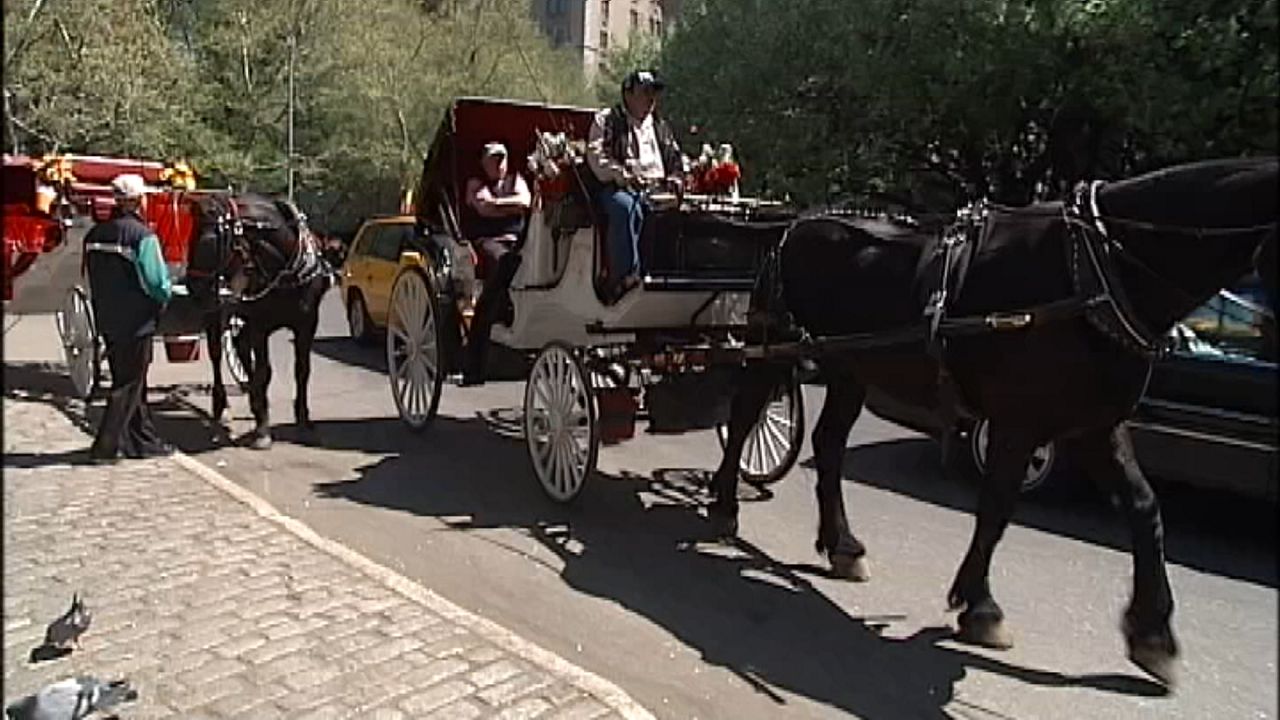
An animal rights activist gave impassioned testimony at City Hall about the need for stricter regulation of horse carriages.
“There’s no obvious and clear way that you can protect animals in a motorized vehicle environment,” she said.
What You Need To Know
- The horse carriage debate goes back decades, but an outright ban was first proposed by Council Member Tony Avella in 2007
- Anti-horse carriage activists helped sink the mayoral candidacy of City Council Speaker Christine Quinn in 2013
- Mayor Bill de Blasio never delivered on his campaign promise to ban horse carriages
The year wasn’t 2026. It was December 1992, and Mayor David Dinkins was vetoing a bill that would have loosened restrictions on the industry.
“The council has chosen to amend the law in several unacceptable ways,” Dinkins said.
Horse carriage operators, even then, felt burdened by regulations, despite having more free rein to traverse city streets. But attitudes began to shift, and in 2007, Council Member Tony Avella proposed an outright ban on the industry.
“It’s a business, and they’re making money on the backs of the animals,” he said at a rally on the City Hall steps.
But Mayor Michael Bloomberg and City Council Speaker Christine Quinn balked at the idea.
“It’s something that a lot of tourists really love,” Bloomberg said. “We certainly aren’t banning automobiles every time there’s an accident.”
Quinn said: “It’s one of the things people have on their to-do list when they come to New York City.”
Her stance would cost her a few years later when she ran for mayor and was the subject of relentless attacks backed by animal rights activists.
They ran negative ads and protested her appearances, sometimes chanting the acronym “ABQ” for “Anybody But Quinn.”
The campaign had one clear beneficiary: Mayor Bill de Blasio.
“They’re not meant to be on concrete. They’re not meant to be in traffic jams. It’s obvious,” de Blasio said in 2011.
During his 2013 run for mayor, de Blasio rode to victory having promised, at one point, to ban horse carriages on his first day in office.
“We are going to get rid of the horse carriages. Period,” he said just two days before taking office.
That’s not how it turned out. “It is a very complicated issue,” he would later explain.
De Blasio never got the City Council buy-in. A plan to replace the carriages with antique cars flopped, and he would never deliver on his campaign promise, turning some of the same activists who helped get him elected against him.
“When a mayor promises, runs on a campaign promise and says over and over again he is banning this industry, that’s what we hold him to,” one activist said.
Mayor Eric Adams never took an interest in a horse carriage ban until last September, when he announced a plan to phase out the industry — a move widely viewed as a campaign ploy.
It came after an incident involving an out-of-control carriage horse.
“That last incident was a wake-up call for all of us, having that horse run free,” he told NY1.
He dropped his reelection bid shortly after, once again sparing the industry — at least momentarily.
“This has been a years-long campaign to destroy this industry and the people in it,” said Christina Hansen, a veteran horse carriage operator and longtime spokesperson for the industry.