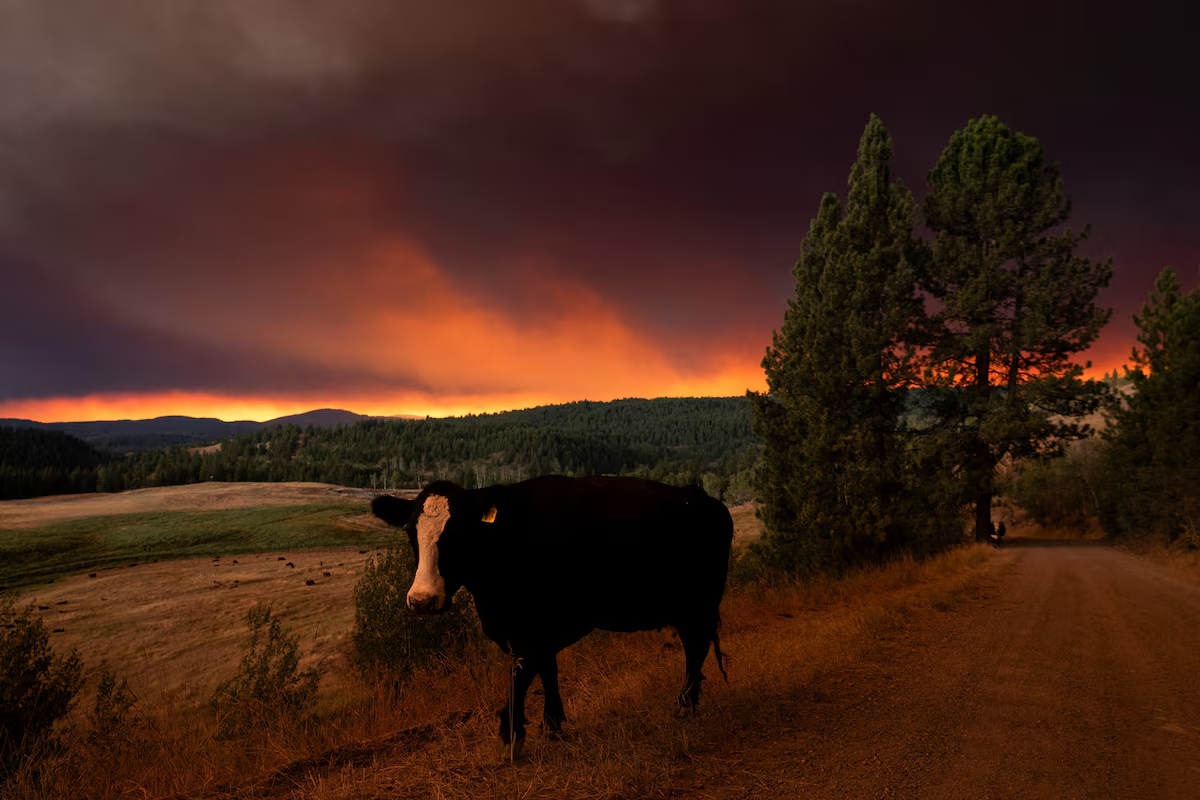
Wildfire smoke looms over the Princeton-Kamloops Hwy between Princeton and Merritt, B.C., on Monday. Within the past three weeks, well over two million people have been evacuated due to climate-related emergencies.Paige Taylor White/Reuters
Christina Caron is a former federal public service executive and policy aide to two Canadian Prime Ministers, and the author of two recent peer-reviewed papers on the impact of environmental damage to the economy.
Glen Hodgson is former chief economist at the Conference Board of Canada and a former member of Canada’s Ecofiscal Commission.
The costs of climate change are enormous, and are readily visible in this summer of extreme heat, wildfires, cyclones, tornadoes and floods. Within the past three weeks, well over two million people have been evacuated due to climate-related emergencies – 400,000 in North America and Europe because of wildfires and 1.9 million in China due to typhoons.
Nevertheless, action to mitigate climate change is often framed as being in opposition to our economic interests. Prime Minister Mark Carney stated recently that the climate action plan of the previous Liberal government would have been too expensive for Canadians; that we can’t afford to restrain the growth of oil and gas; and that his government’s actions will raise Canadian emissions. Conservative Leader Pierre Poilievre has described net-zero emissions as a radical idea that implies net-zero growth, jobs and paycheques. The reality is quite the contrary. The evidence is now irrefutable that taking swift climate action will be far cheaper than delaying it.
Climate change is driving down productivity, destroying assets and raising the prices of essentials such as food. It has already significantly lowered living standards. Recent analysis found that global GDP per capita would be more than 25 per cent higher today had no warming occurred.
Assessments of the prospective economic damage from further climate change have been increasing steadily, as damage from extreme weather events has risen and as analyses have become more robust – even without including worst-case scenarios. And a faster transition to a low- or no-carbon economy translates into reduced economic damage. Fortunately, the cost of transitioning to energy sources with minimal greenhouse gas (GHG) emissions, such as wind and solar, has been steadily dropping, with renewable power costs now generally lower than those of conventional energy. In consequence, the cost-benefit balance has shifted, significantly raising the net economic advantage of swifter climate action.
A sober-minded network of 148 central banks (including Canada’s) stated last year, based on extensive analysis, that the cost of transitioning to net-zero emissions is much lower than the cost of facing increasingly severe and frequent weather events. These findings echo those of other major global actors including the International Energy Agency, the United Nations, the World Economic Forum and Swiss Re, one of the world’s largest reinsurance providers.
In the words of esteemed economists Nicholas Stern and Joseph Stiglitz: “In the medium to longer run, there is no high-carbon growth story: the effects of unmanaged climate change are so severe that they will very likely derail any (misguided) attempt at high-carbon growth. The only long-run growth trajectory is a green trajectory.”
Climate-related disasters have many consequences – lives lost and disrupted; homes, businesses and infrastructure ruined; land and water rendered unusable; crops and livestock destroyed. Insured damages from severe weather events and wildfires last year exceeded $2.4-billion in Canada, and $100-billion globally.
Most climate-related losses are not insured, however, and individuals who incur them may never be able to rebuild homes or businesses. Meanwhile the costs of repairing public infrastructure are passed on to taxpayers. Reconstruction is often slow and expensive, and can displace other new, productive investments. Moreover, the negative economic effects of a single extreme weather event have been shown to persist for more than two decades.
As climate change accelerates, its costs are also increasing at an ever-rising rate. In a world being pummelled by climate-related disasters of growing frequency, intensity and scope, our ability to recover from one event before we are hit by the next is diminishing.
One reason that climate change is accelerating, in addition to continued rising human emissions, is the concerning emergence of self-reinforcing feedback loops. The very wildfires that have been exacerbated by climate change are themselves huge sources of GHG emissions, transforming some forests from net carbon sinks to net carbon emitters. In 2023, Canadian GHG emissions from forest fires exceeded those directly generated by people.
Global productivity growth has flatlined over the past fifteen years, in part because of environmental factors including climate change. Accelerating climate breakdown may well drive productivity growth into sustained negative territory.
The growing adverse consequences of climate change underline the urgency of transitioning to net-zero emissions. Timely action to reduce emissions will be less costly than the economic and social burden of a world becoming continually hotter; while delayed action will make the path to net-zero steeper and more arduous.
The good news is that we know what the broad mitigation solutions are – transition away from fossil fuels, electrify the economy, decarbonize electricity, conserve natural carbon sinks such as forests and peatlands, and develop innovative technologies to store existing carbon. We already have much of the requisite knowledge, and the costs of implementing many of these solutions have been declining.
Opinion: The world is moving off fossil fuels as Canada continues to live in the past
Furthermore, there are significant growth, job creation and innovation opportunities from investment in low-carbon energy sources and technologies, in alignment with burgeoning global demand. We are at a pivot point. The global growth paradigm has shifted, and Canada needs to skate to where the puck is going, not where it used to be.
Similarly, on the adaptation side, there is no cost advantage in delaying investment in resilient infrastructure and built structures to reduce risks of future damage from wildfires, flooding and other extreme weather events. It will also be necessary to stop new construction in the most vulnerable areas, build insurance backstops for high-risk properties and invest in enhanced crisis management capacity. However, adaptation alone is not sufficient, as the recent wildfires have amply demonstrated.
Canada is not a bit player in this. Our per capita emissions – both current and cumulative – are among the highest on the planet. And as a rich, G7 country we have an outsized responsibility to lead by example.
Canada is currently being buffeted by numerous competing pressures – U.S. President Donald Trump’s aggression, wars abroad, separatist sentiment at home. But none is more consequential to our long-term prosperity and interests than climate change.
The planet is speaking to us ever more loudly; we should listen. Hanging on to the old, fossil-fuel-based growth paradigm will not be a winning strategy for the economy or society.