The Venetian Resort, at the heart of the Las Vegas Strip, is already a surreal place—the interior includes an indoor St. Mark’s Square with chlorine-blue canals, old-timey lampposts, and a painted blue sky. This spring, however, the casino offered an even stranger spectacle when a Bitcoin convention filled the expo hall. It was odd enough that most people in the crowd were wearing fluorescent orange, but stranger still was this rarity: the sight of a group of diverse men full of hope.
In fact, hope was the official policy of the event. A sign at check-in offered a brief list of what was not permitted inside. That list included firearms, cigarettes, outside food and drink, and bears. Yes, bears: crypto slang for people who think the price of Bitcoin is going to fall or who have in some other way succumbed to crypto pessimism.
Inside, over the course of my three days at the convention, I met no bears within the predominantly male crowd. Instead, I found confidence and joy in Bitcoin. Everything about the event seemed designed to make alternative finance feel fun. Look one way and there was a Bitcoin-themed art gallery featuring a 6-foot skull made of motherboards; look the other, and there was a massive inflatable monkey wearing an orange crown. At the center of the hall, a series of DJs oversaw a dance floor and kept the mood relentlessly upbeat.
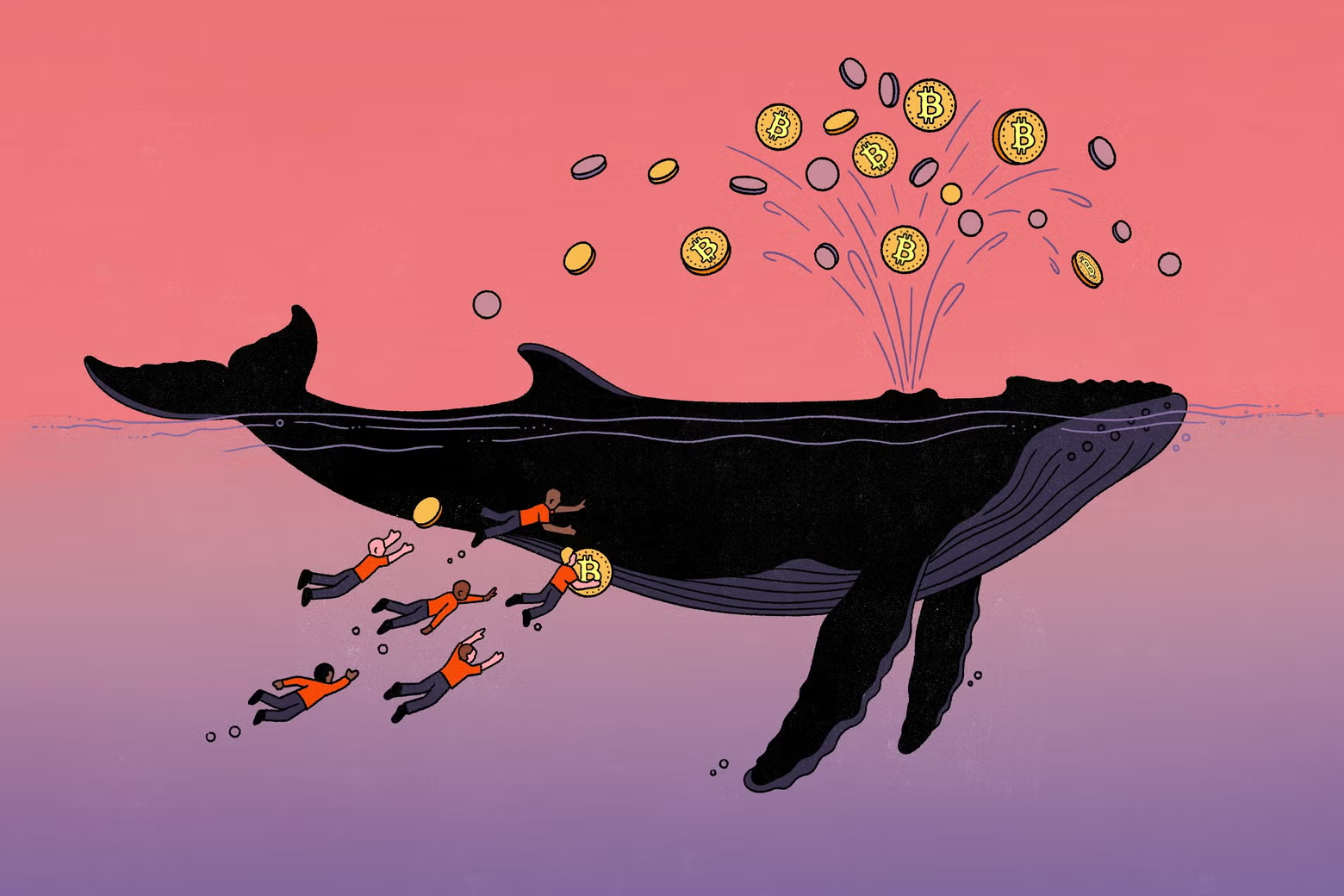
This optimistic atmosphere was no small achievement. Bitcoin had lost nearly half its value over the previous year. After the cryptocurrency was first released, back in 2009, its price had fluctuated between nothing and $1 for over two years. But in the 15 years since, the price of one Bitcoin had skyrocketed as high as $126,000, in 2025, only to fall back down to about $76,000 at the time of the conference. This fluctuation is due in part to Bitcoin having no intrinsic value: Like gold, it is worth whatever someone is willing to pay for it. Unlike gold, however, its ownership is concentrated in a relatively small group of large holders (“whales,” in Bitcoin jargon). Because these whales own so much of the world’s Bitcoin, their large buy and sell orders can drive sharp changes in the price. As a result, Bitcoin is far more volatile than gold, and tomorrow’s price is as difficult to predict as the next viral meme.
The people I met dismissed this volatility as the price of working with a tool as new and powerful as Bitcoin. One young man observed that even the way I’d characterized the change in Bitcoin’s price as a loss of value was unnecessarily pessimistic. “If you think about it,” he corrected me, “Bitcoin is half-priced compared to last year.”
There was a catastrophe that loomed over the convention, but it wasn’t Bitcoin’s newly discounted cost. It was the pain of trying to get by in this economy. That was the ill that needed remedy, the same ill that has weighed down two very different presidencies. Lonnie Walker, a 54-year-old Bitcoin hopeful who works in insurance in Tampa, could have been speaking for the group when he described economic life for ordinary people: “If you go to Disney World,” he said, “the mouse smiles at you while picking you up by the ankles, holding you upside down, and shaking out every nickel. That’s what the world does to you.”
He spoke from experience. He’d come from a very poor family and had struggled all his life for financial stability. After getting burned by Amway, the notorious multilevel marketing company, he’d had to work 18-hour days to get by. In the late 2010s, he went through a hard divorce, lost the little he had managed to save, and found himself living in his car. “The stress was like being in a war zone,” Walker said.
Unfortunately, he’d come to Bitcoin late. A guy he knew had told him to invest early, but Walker had ignored him, only to watch from the sidelines as the price went up and up and up. Finally, in 2025, he got tired of missing out. “Because the financial system is in shambles and I can’t trust my banker anymore,” he said, “I felt I needed to evolve. Now the smart move is for everyone to get Bitcoin. A friend of mine sold his house to put it all in Bitcoin, but I’m just hoping to be out of debt by November.”
“For most people, pain is going to be the thing that brings them to Bitcoin.”
These were men who by and large no longer trust bankers, if they ever did. These days, Bitcoin and other cryptocurrencies offer an appealing alternative because they are not issued or managed by a central bank. Instead, crypto exists on the blockchain, a kind of shared spreadsheet that anonymously records every transaction, and is “mined” digitally through the solving of complex math problems. Every Bitcoin transaction is public, and the number of Bitcoin that will ever circulate has been arbitrarily capped at 21 million. This enforced scarcity, according to enthusiasts, will protect Bitcoin’s value from inflation and mismanagement. Traditional currencies, on the other hand, have no such built-in limitations. With the U.S. dollar, what protects its value is the restraint of the government officials who manage it. Most of the men I met at the convention had long since lost such faith in American institutions.
Indeed, Walker’s Bitcoin origin story hewed closely to a common template in the Bitcoin community. First, a guy hears about the currency from a friend. The guy then ignores said friend—only to learn that those crypto holdings are going to the moon while his own investments are going nowhere. When this frustration peaks, the guy gives in and buys some Bitcoin of his own. If this investment goes well, he then tries to persuade other struggling people that they should invest in Bitcoin, and the cycle begins anew.
Crypto fans call this conversion process “orange pilling.” It is well known within the industry that it is easier to orange-pill someone when he is feeling low. Or, as Peter McCormack, one of the experts presenting on the main stage, put it: “For most people, pain is going to be the thing that brings them to Bitcoin.”
Many convention attendees echoed this belief. “People find Bitcoin when they need it,” Brittany Sjoder told me. For her, that moment of need had come after years of financial struggle. She and her husband were working harder and harder but weren’t managing to spend time with their kids, let alone get ahead financially. “We were slaves to the fiat system,” she said, “but Bitcoin brought hope back into my life, hope that I can retire someday.”
The “fiat system” is what crypto people call the economy driven by so-called fiat currencies (the American dollar, the British pound, the euro), which are backed by nothing more than trust and confidence. The government simply asserts that the currency has value, which remains true so long as we all agree (which, in the case of the American dollar, most of us have happily done since the 1970s). Still, this arrangement means that savings in any fiat currency are vulnerable to the decisions of the central bank that manages it. Responsible central banks aim for steady, controlled inflation (usually 2 percent annually), while irresponsible ones implement policies that can drive hyperinflation and leave your money worthless. To prove that this risk is not just an abstract threat, an activist at the convention was handing out Venezuelan banknotes, worthless now after years of economic mismanagement and a resulting inflation rate in excess of 10 million percent.
Sjoder believed neither that the American fiat system was run responsibly, nor that it could be made to do so through reform and activism. “If you want to make change,” she said, “you have to go outside the system, because the system works for itself.” Indeed, if there was a central conviction animating the convention’s diverse crowd, it was that the powerful people in charge of America’s different systems—healthcare, agriculture, government, you name it—had already proved that they were not to be trusted. Instead, they had shown, over and over again, that they were going to put their own interests ahead of the people who trusted them.
This sense of betrayal surfaced even in conversations with people who had done well in the fiat economy, such as former NBA athlete Tristan Thompson, whose career earnings exceed $120 million (excluding endorsements). He told me his Bitcoin origin story, which was occasionally interrupted by young boys asking him for an autograph. “My adviser told me that Bitcoin was too volatile for me to buy, and then I found out that big institutions like his were buying it for themselves,” he said. “With traditional finance, you have to trust a complete stranger not to screw you over, but with Bitcoin we can take back our financial freedom.”
This concept of financial freedom—not having to trust anyone else—is the logical end point of the belief that the systems of American life cannot be mended, only circumvented. Bitcoin, I was told again and again, was safe wealth specifically because of its distance from central bankers. Though the currency’s value was susceptible to the day’s memes, it ultimately required confidence only in code. Bitcoiners call this perceived freedom “self-sovereignty,” and its emergence as a primary value signals how fully people have lost trust in national institutions.
In fact, American life had come to seem so hopeless that many Bitcoiners were looking to make their divestment from America official. Among the convention’s big winners were companies promising to help people buy citizenship elsewhere or, as one such company advertised, “diversify your passport portfolio.” The business model was simple: You tell them how much you’re willing to invest in your new “home country,” and they tell you where you can afford to buy citizenship. “Business is good,” Alex Recouso, of CitizenX, told me. “The Americans buying Plan B passports are the same as the demographic buying Bitcoin.”
Just what event would necessitate a Plan B depended on whom you asked, but the predicted scenario usually involved some combination of runaway debt and hyperinflation. This is not currently happening in the U.S., but since it has devastated other countries, I was eager to speak with someone who had experienced that worst-case scenario firsthand.
Evan Mawarire is a Zimbabwean pastor and activist, and since 2008, his home country has experienced a kind of inflation and economic instability that is hard to fathom. After the government printed money to finance its deficits, people lost faith in the currency. Prices doubled every day, goods vanished from shelves, and, at its worst, the monthly inflation rate reached 79 billion percent. Mawarire told me a story about going to buy bread at the local shop with a hundred-trillion-dollar bill in his pocket. When he joined the back of the line, he said, the note could purchase two loaves of bread; by the time he got to the front, it bought him half a loaf. His parents’ retirement savings went from being worth the equivalent of $80,000 to 25 cents in just one week.
“The sense wasn’t just of complete loss,” Mawarire said, “but of betrayal. The experience robbed people of economic dignity: the ability to look at your life’s work and know that it can put a meal on the table, put a kid through school, pay medical bills. People in Zimbabwe had worked honestly, but they lost their sense of self-worth and hope in the future.”
I observed to him that his language resembled the ways the American Bitcoiners talked, and asked if he felt they were right to fear a fate similar to Zimbabwe’s. He smiled and hesitated, then said slowly, “To hear Americans talk about not being able to achieve their dreams, it’s confusing for me. Everyone wants to come and participate in this economy because if you put in the work, you get the result.”
He gestured out at the crowd. “There was a time in Zimbabwe when we could have stopped the slide,” he said. “We could’ve done something, but we didn’t. Backing away from a problem and doing nothing about it [is] as bad as the problem itself. It’s important to find the place in the broken wall you’re going to claim and say, ‘I’m going to fix this.’ You show up with whatever you have, even if you think you have nothing, and you’ll find that doing so digs solutions out of you that you didn’t know you had. It even provides you with a sense of purpose.”
Mawarire understood this because he had walked the walk. He had never intended to become an activist; he found himself in the role by accident. In 2016, when he was the pastor of a 40-member church, he sat down and recorded a four-minute video expressing his frustration with the country’s economic mismanagement. To his surprise, the video struck a nerve, and before long Mawarire was leading a protest movement of 12 million people. This led to his arrest for sedition and, ultimately, his ongoing exile in America.
He had come to the convention, he told me, because he wanted to help the most vulnerable people in the world secure financial freedom. Back home, he said, nobody trusts the local currency, but citizens are required by law to use it anyway. The poorest populations can’t access the technology required to use Bitcoin, so he had a message for the crypto developers present. “You have solved for the richest among us—well done. If you solve for the least among us, those who can never thank you, you have changed the world.”
As I talked to Mawarire, it became apparent that one common dismissal of crypto—that its only true function is to aid in criminal enterprise that must take place outside the regulated economy—sounds damning merely to people who have faith in the state and in the legitimacy of its decisions about crime. The Human Rights Foundation had organized numerous panels at the convention to make clear that such faith is a privilege of the developed world. Afghani activist Roya Mahboob stressed that women who live under oppressive regimes like the Taliban can secure financial independence only with tools, like Bitcoin, that circumvent the law. For his part, even Eric Trump emphasized Americans’ privilege in his presentation: “America is the country that needs Bitcoin the least.”
To make sense of these claims, I reached out to Zeke Faux, the author of Number Go Up and a journalist who has been chronicling Bitcoin’s rise and fall and rise for years. I wanted to know if cryptocurrency actually offered a solution to the kinds of disastrous inflation and economic disenfranchisement the people I’d met had told me about. Faux explained that, theoretically, yes, there are many ways that Bitcoin could serve the marginalized and oppressed: It could be used in international remittances; it could protect wealth against irresponsible governments. In practice, however, hardly anyone wants to use it. Even in El Salvador, which made Bitcoin a national currency and offered citizens $30 to get started with the cryptocurrency, adoption remains very low. People spent their bonus and went back to using the U.S. dollar. “Though people give a lot of reasons for why they like Bitcoin and you can get caught up in the genuinely interesting stuff of how it works,” Faux said, “I think interest in Bitcoin boils down to a desire to get rich.”
My experience at the convention supported this more cynical view. Though El Salvador was frequently cited as a beacon of Bitcoin’s success, nobody talked about how the country is run by a dictator. Out of the 25,000 people in attendance, only a few dozen showed up for the presentations of activists like Mawarire and Mahboob.
Indeed, the man who commanded the biggest audience at the convention was not Kash Patel, Afroman, Jack Dorsey, the head of the Securities and Exchange Commission, or any other of the celebrities present. No, the man of the hour, the man whose name came up in nearly every interview, the man who commanded a level of devotion I’d seen exceeded only at a Trump rally, was Michael Saylor, a man who, in the words of one admirer, had “orange-pilled more people than anyone else in the world.”
Saylor is not an obvious candidate for jaded people to revere. He’s a billionaire with a checkered past and no gift for oration. In 2000 the SEC charged him with fraud in a case he settled without admitting wrongdoing, agreeing instead to pay a $350,000 fine and disgorging $8.3 million. In 2024 the District of Columbia sued him for tax fraud in a case Saylor settled for $40 million, making it the largest recovery the city has ever claimed. Today he is the executive chairman of Strategy Inc., which bills itself as “the world’s largest Bitcoin Treasury Company.” That is, Saylor uses investors’ fiat currencies to buy Bitcoin. He has received so much money from hopeful investors that Strategy is now the world’s largest Bitcoin holder, with about 650,000 BTC in its coffers. Indeed, Saylor’s purchases were thought to be the primary force behind Bitcoin’s modest rise in price in the weeks leading up to the conference.
His most impressive achievement, however, has been persuading people to pay more for his stock than his holdings of Bitcoin are worth. Rather than buy Bitcoin directly, people are paying a premium to purchase Strategy’s securities—securities whose value comes only from the company’s Bitcoin holdings. In other words, as Alex Kirshner explained for Slate, Saylor was selling $4 worth of exposure to Bitcoin for $5. He was then able to use that extra money to buy more Bitcoin, driving up its price and giving himself a chance to sell more securities to investors.
According to classical economics, arbitrage opportunities like this should not last long. However, listening to Saylor make his sales pitch to the men filling the expo hall, I understood why people kept giving him money. Stretch, Strategy’s main security—80 percent of which is held by ordinary retail investors—sounds like a dream investment vehicle for someone looking for financial stability.
“With Stretch, you have the best of the credit world and the best of the equity world within a single instrument,” Saylor told the crowd. What does Stretch do? The better question is: What doesn’t Stretch do! It yields 11 percent! It pays out every month! With low volatility! But with high liquidity! It’s outperforming huge companies like Nvidia and Google on some metrics, while besting gold and the world’s dominant currencies on others. (These performance claims are true only over a brief period of time.)
What’s powering this incredible, unprecedented run is Bitcoin, Bitcoin, and more Bitcoin. Bitcoin is the one solid asset behind these promises. This scheme works, Saylor says, because Bitcoin has been increasing in price. (Again, this is true only on a limited time horizon.) It will continue to work, he predicts, because someday Bitcoin will be $10 million apiece. The real reason the scheme works, however, is that people are overpaying him for Bitcoin, which enables him to buy more Bitcoin and sell more securities at favorable terms. Bloomberg’s Matt Levine calls this the “infinite money machine,” and the only reason it keeps going is because these men believe in Saylor himself.
Which meant that he had to answer an obvious question: Why should we believe in him? What did we need him for when we could just buy the Bitcoin ourselves and deprive him of the arbitrage? Saylor’s answer was that his involvement minimizes risks and swings. “We have created a ‘crypto reactor’ to create credit to serve a group of people who simply want to put their money in a bank account, collect 10 or 11 percent, and not worry about it,” he said. “Stretch is built for them.”
In other words, Saylor was promising financial security in the form of passive fixed income. You pay him your dollars now, and you get more dollars back, every month, without risk. Actually, every two weeks, thanks to a recently approved initiative: “You guys get paid every two weeks by your employer,” he reasoned, “so why shouldn’t your assets pay you every two weeks?”
The obvious question he did not answer was this: What did he need us little people for? If he’d found an asset in Bitcoin that brought such reliable returns, why was he looking to share his scheme with millions and millions of retail investors? Because, he informed us with a generous air, “there’s a massively powerful generational wealth transfer opportunity here.”
Saylor never specified whose generational wealth will be transferred to whom, but the hope he was offering proved too much for most attendees to resist. After all, wasn’t American life saturated with rich men who seemed to get richer without doing any real work? Obviously such financial freedom was possible—but only if you were a guy who knew how the crooked game was played. Saylor made clear that he knew the game perfectly well as he asked these people, whose trust had been routinely abused, to trust him with their money.
It is possible that Saylor is right about the future price of Bitcoin; it’s amazing that the price has climbed as high as it has. Faux, who has been covering the currency much longer than I have, told me he has “given up predicting what’s going to happen to Bitcoin’s price.” But in order for Saylor to be right, new money has to keep entering the system—and that money has to come from someone. As I looked around at the hopeful, orange-clad men filling the convention hall, eager to give their dollars to Saylor, it seemed that Strategy’s real asset was not its crypto holdings but the faith of these men.
And even if somehow they did all get richer together, that would still leave out the rest of the country—everyone too poor or cautious to stockpile Bitcoin. All of these attendees were following the example set by those at the top: looking out for themselves and trying to swell their own stash. It was so much energy getting channeled into one big opting-out. “What people who hoard will finally realize,” Mawarire said, “is there’s an emptiness that comes where a sense of purpose should go.”