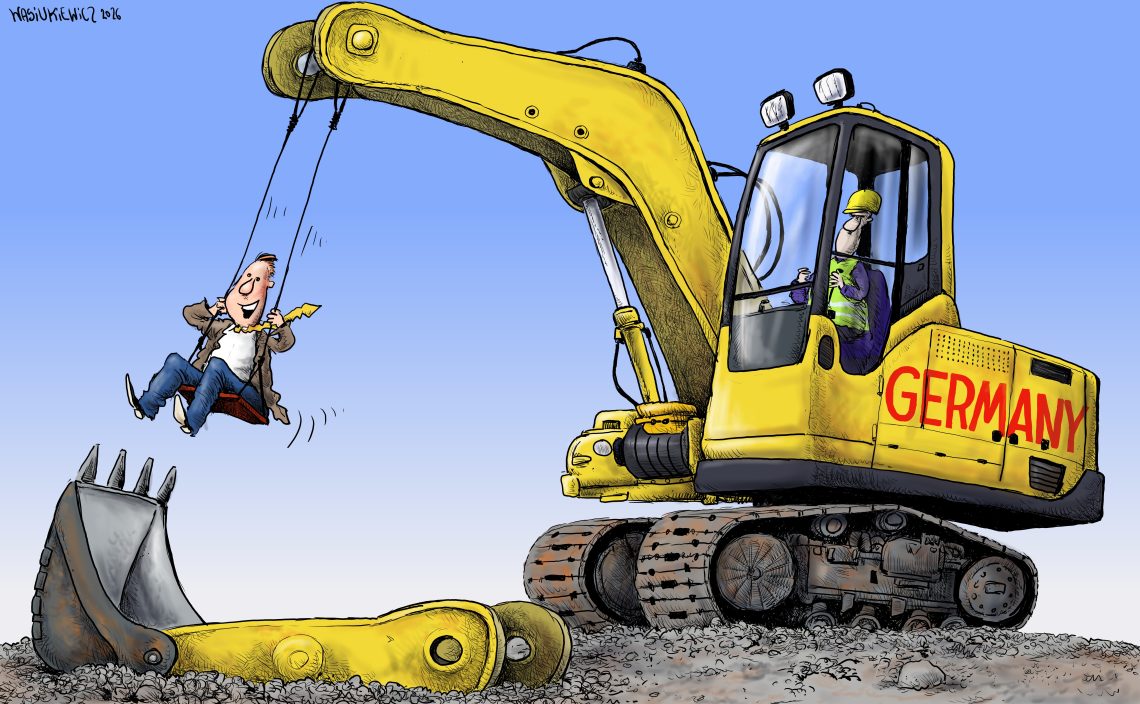
Germany’s political decline is rooted not only in economic weakness, but in a broader shift from responsibility toward redistribution and resentment.

The German philosopher Arthur Schopenhauer once said: “The highest form of recognition in Germany is envy.” I have always tended to disagree with this. Over the past 80 years, Germany has been an extraordinarily successful country, rebuilding itself from the ashes of World War II and developing one of the world’s most efficient economies.
That success rested on a market economy, respect for entrepreneurship and strong social protections, together with the principles of the Ordnungspolitik. The state established broad rules within which the economy could function, while placing limits on government intervention in society, business and economic life. Through hard work in the postwar decades, Germany became Europe’s economic engine and created one of the world’s most stable currencies, the Deutsche Mark. For decades, Germany appeared to disprove Schopenhauer’s observation.
At one point, however, something changed. It is difficult to identify a precise moment or a single cause. Socialism, an ideology rooted in envy, started gaining ground. Germany began to lose momentum socially, politically and economically.
At the same time, the country’s major political parties drifted away from their traditional principles. For the Social Democrats, this meant protecting workers’ interests while retaining a sense of responsibility for society as a whole. For the Christian Democrats, this meant taking a broader view of the common good, the res publica. A smaller liberal party complemented both by ensuring that the populist instincts of the larger parties did not undermine business and the economy.
Patriotism and the rise of the AfD
Somewhere along the way, the parties lost their soul and politics became increasingly dominated by backroom dealings. In trying to capture a greater share of the vote, the political spirit shifted from a positive drive to advance society as a whole toward one of redistribution and envy. Expectations of what government could provide rose beyond what the state could realistically deliver, while infrastructure deteriorated and a more pessimistic mood took hold. Germans began to feel that the future might not be better than the past. Unfortunately, Schopenhauer’s observation has become reality.
Excluding movements entirely from political cooperation will inevitably strengthen them further, while giving their most radical elements greater influence.
In September, there were three state elections in different parts of Germany, all of which were disasters for the traditionally dominant parties, the Christian Democrats and Social Democrats. They revealed a highly fragmented political landscape. In Berlin, an essentially communist party, Die Linke, became the strongest force, with demands including reversing private ownership of real estate and reducing the role of the police in favor of social projects. This is surprising, given that crime, including organized crime, is a major problem. Nevertheless, Die Linke is gaining ground, including among more radical elements, and not only in Berlin.
Die Linke has built much of its appeal around negativity and envy, and it has found fertile ground in Berlin. The AfD is different, and emerged as the principal beneficiary across all of the elections. Its message is more strongly rooted in patriotism and in the idea that Germany should recover its confidence, prosperity and national purpose. In an environment in which many voters perceive the established political class as managing national decline, that message has proved effective.
For many years, there has also been a widespread sense in Germany that healthy patriotism is unwelcome or too easily confused with nationalism. Yet successful countries need patriotism. Patriotism need not mean arrogance or a sense of superiority. It can mean identity, responsibility and pride in one’s country.
German politics largely neglected this sentiment, leaving space for the AfD to make it central to its political appeal.
More by GIS Founder and Chairman Prince Michael of Liechtenstein
New political movements inevitably attract some undesirable elements as well. This does not, however, mean that the established parties are entirely free of such elements. But excluding movements entirely from political cooperation will inevitably strengthen them further, while giving their most radical elements greater influence.
The Christian Democrats, in particular, have struggled to incorporate a credible form of healthy patriotism into their political program, while the Social Democrats abandoned it much earlier. This has contributed to the growth of the AfD. Its voters are not fascists, as they are frequently labeled; most are concerned citizens.
It is a mistake to bar the AfD from political responsibility. The established parties appear to ignore what people’s real concerns are, and which issues urgently need to be addressed. If they take those challenges seriously, they will be able to work with the AfD and include the party in the political process.

Sign up for our newsletter
Receive insights from our experts every week in your inbox.