Cregger’s film is on track to become the most profitable movie in the entire “Resident Evil” series, grossing sixty million dollars domestically in its opening weekend. GQ and Esquire have declared it the best video-game adaptation ever, and it probably is. But, in the context of Cregger’s œuvre, this thrilling, well-crafted film still feels slightly disappointing, which is less a knock on the movie than it is a recognition of how we engage with auteurs.
I went to see “Resident Evil” because I’m a Zach Cregger fan, and I enjoyed it less than I otherwise would have because I’m a Zach Cregger fan. The director is one of the most exciting filmmakers today, known for his structurally and tonally audacious—and also genuinely fear-inducing and hilarious—movies. He is operating at a level matched only by Jordan Peele and Ari Aster. His 2022 film, “Barbarian,” has one the cleverest setups of any horror movie I’ve seen: A woman arrives at a house rental in the middle of the night only to discover that a strange man is already staying there. They must have been double-booked; does she want to come inside so they can figure out what to do? Cregger had said that he was inspired by “The Gift of Fear,” a 1997 self-help guide by the security expert Gavin de Becker, which encourages women to trust their subconscious and to pay attention to subtle red flags in their interactions with men. (The movie began as a creative exercise, in which Cregger set out to write a scene that included as many of these red flags as possible—ones that women would notice but men would miss.) As the movie continues, we switch between different characters’ perspectives, and move back and forth in time. The film is uneven, but also relentlessly innovative.
“Weapons,” released in 2025, was both much more ambitious and far more disciplined. It follows a suburban town in the aftermath of a tragedy: seventeen children, all from the same class, vanish from their homes on the same night, sparking a community-wide witch hunt initially aimed at the children’s teacher. (The real witch responsible, played by Amy Madigan, won an Oscar for her performance.) “Weapons” has been widely interpreted as an allegory for mass shootings. There’s the title, of course, and then the concept of an entire classroom disappearing at once. The seventeen children—the same number of kids and adults who were murdered in the Parkland shooting—disappear at 2:17 A.M., which viewers speculated might be a reference to the number of members of the House of Representatives who voted, in 2022, for a ban on assault weapons that never became law. At one point, a grieving father, played by Josh Brolin, dreams of an assault weapon floating over a neighbor’s house: an AR imprinted with 2:17. Cregger has denied that the movie is about shootings, saying that he was mostly interested in exploring how alcoholism can destroy a family. But what about the dream? “I don’t know,” Cregger said, when an interviewer asked him what it meant. “It’s a very important moment for me in this movie, and to be frank with you, I think what I love about it so much is that I don’t understand it.”
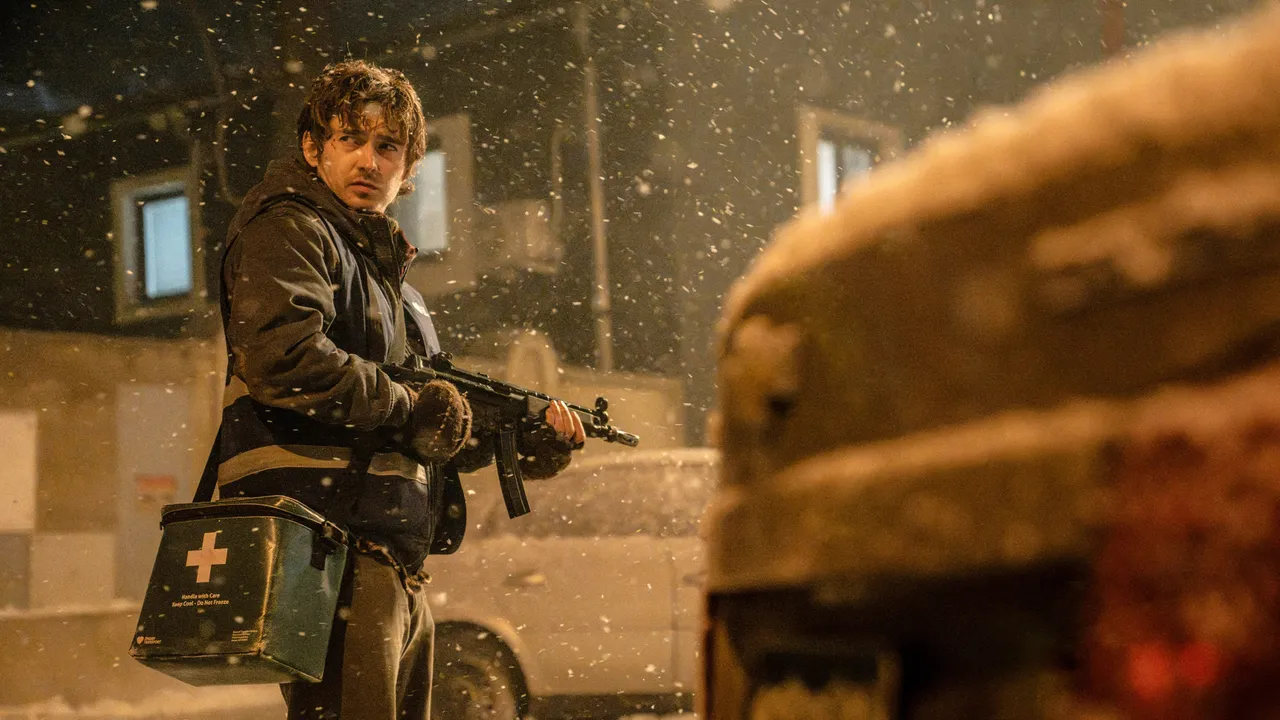
I believe that “Weapons” is about guns, regardless of whether that was Cregger’s initial intention. But I don’t blame him for not actively embracing that interpretation, seeing how it might get in the way of, say, rebooting a video-game franchise with guns. One of the running gags in “Resident Evil” is Bryan’s ineptitude with firearms. “I’ve only used guns in video games. It’s confusing in real life,” he says, before accidentally firing off an MP-5 submachine gun inside a car. Just as a player grows in proficiency as she makes her way through a game, Bryan’s narrative arc largely consists of him becoming a more competent marksman.
In one of the film’s most memorable scenes, Bryan, newly armed with a shotgun, ventures into an R.V., where he encounters a young girl. She’s beginning to mutate; one of her legs has sprouted tentacles. He tries to save her, but she turns hostile, at which point, he blows her head off. The scene offers a double shock: it’s rare to see a child killed in a horror movie (notably, in “Weapons,” none of the children died), and it’s rarer yet for a child to be killed by the protagonist. Even Bryan doesn’t believe it. “I didn’t just shoot a little girl in the face,” he tells himself. “I like kids.” The sequence is one of the more disturbing—and, yes, funny—set pieces in the movie, and it felt deliberate, as if Cregger were taking aim, so to speak, at the discourse around his previous work. I didn’t read the scene as a disavowal so much as a pointed reminder that “Resident Evil,” unlike “Barbarian” and “Weapons,” isn’t that interested in mining the psychological depths of its characters. What Cregger has created here is a ninety-five-minute romp, a reboot that’s meant to be considered alongside a different canon than his own.