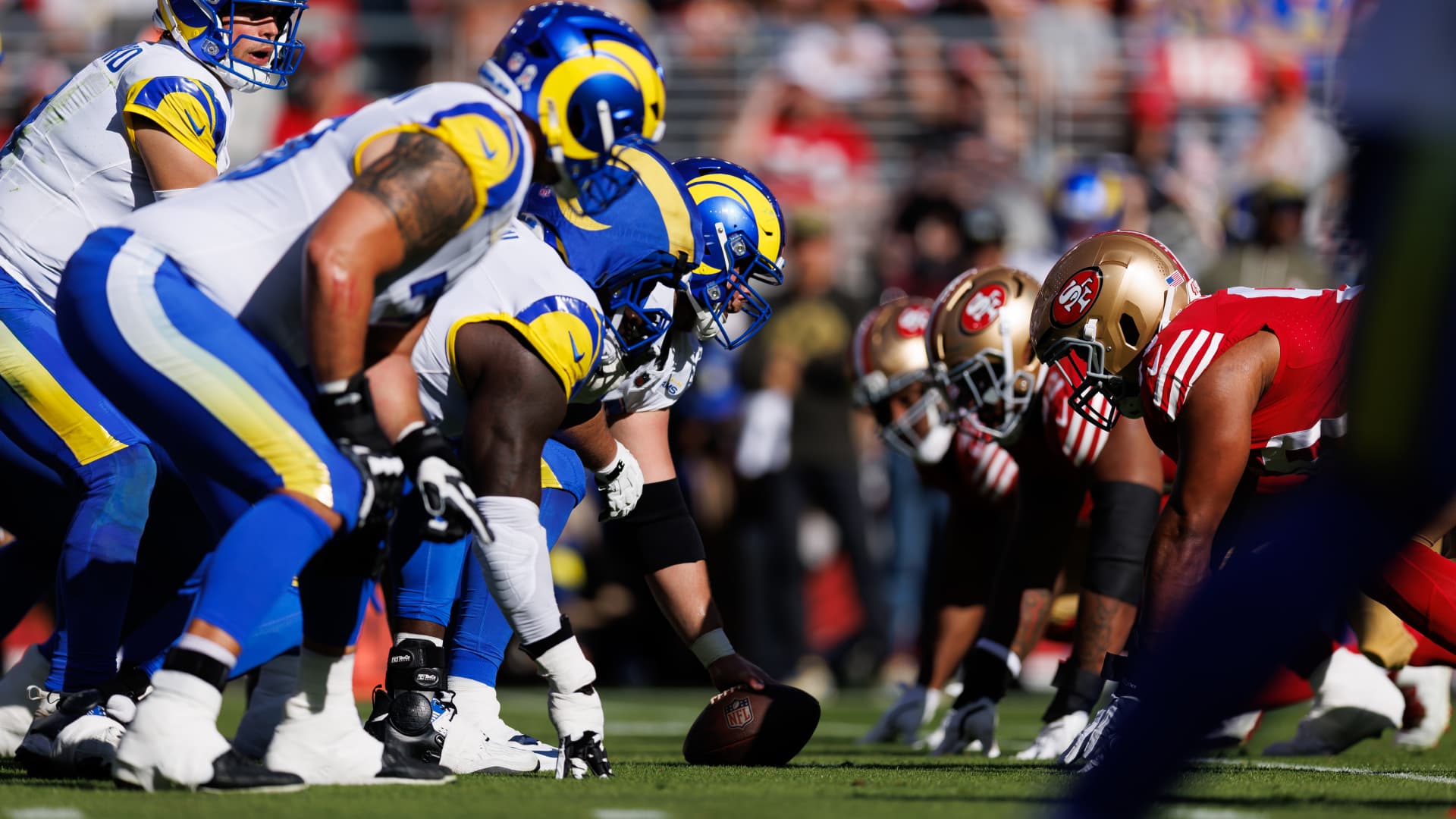

The NFL is taking its fight over prediction markets regulation to the Supreme Court and urging justices to issue a ruling about whether states should maintain control over sports betting.
In an amicus brief supporting New Jersey regulators in their battle against Kalshi, the National Football League argues sports prediction contracts are effectively gambling, not financial swaps that should be regulated exclusively by the federal government as Kalshi has consistently argued in court.
The NFL says on the first Sunday of the season, football accounted for $1.8 billion in prediction markets trading, more than half the total volume.
The NFL says it isn’t opposed to prediction markets. “In the end, we believe that given the current resource constraints of the CFTC, this is a job better left to the states,” the league told CNBC.
The league is concerned about contracts that are vulnerable to manipulation, like field goals where a kicker could intentionally miss or a wide receiver intentionally fumbling a pass. The NFL is also concerned about bets tied to injuries, officiating and other information insiders could know in advance.
The NFL wants a minimum age of 21 for bettors, as most states mandate for sports betting. On Kalshi, customers can be as young as 18.
In a statement to CNBC, the NFL says, “Neither the CFTC nor the prediction market companies themselves— despite our persistent urging — have banned categories of bets susceptible to manipulation or set a 21 age limit.”
Meanwhile, Kalshi spokesperson Elisabeth Diana in a statement to CNBC said that the CFTC’s ongoing rulemaking regarding prediction markets will address many of the NFL’s concerns, and that the federal agency has the ability to police sports-related event contract markets.
NFL says it’s about integrity of game
The NFL has taken a consistently strong stance against prediction markets in defense of the integrity of the game. It maintains an advertising ban on prediction platforms.
In an interview with CNBC Sport on September 10 in Australia, Commissioner Roger Goodell emphasized the league wants stronger protections before entertaining the possibility of a tie up with the new markets. “We don’t feel like we have to be the first in this. We feel like we’re going to be right, and the best thing to do is be patient,” he said.
Other leagues are taking a different approach. The NHL has partnerships with Kalshi and Polymarket. MLB, Major League Soccer and UFC have deals with Polymarket. The NFL, NBA, and PGA have not signed prediction market partnerships.
Kalshi said that it has tried to work more directly with the NFL, but that the league hasn’t engaged.
“We have consistently tried to engage proactively and constructively with the NFL to collaborate on market integrity with no response,” Diana, the spokesperson, said. “We hope they change their position and start engaging to help ensure the integrity of sports.”
Federal appeals courts have issued split decisions over whether states can enforce their gambling laws and supercede the federal regulator, the Commodity Future Trading Commission.
“It is well established, however, that regulating gambling is among states’ sovereign police powers,” states the NFL’s brief. “What constitutional power allows Congress to override states’ traditional police powers to regulate intrastate gambling?”
Disclosure: Kalshi and CNBC have a commercial relationship that includes a minority investment and customer acquisition.