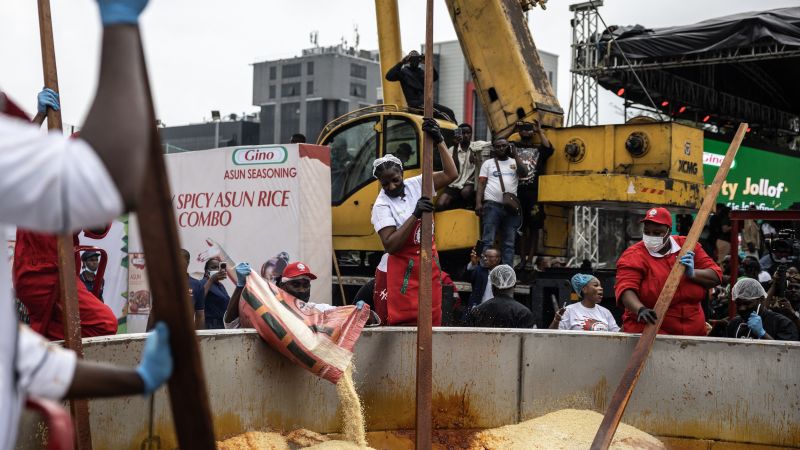
Hilda Baci has a bold vision. The chef, restaurateur and Guinness World Record holder for cooking achievements including the largest serving of Nigerian style jollof rice, wants to see a future where Nigerian restaurants are as commonplace internationally as Chinese ones.
It’s an audacious objective. Chinese cuisine spent generations spreading across continents, becoming one of the world’s most recognizable food cultures. In 2025 the International Supply Chain Conference of Chinese Cuisine estimated that there were about 700,000 Chinese restaurants outside of China. Yet Baci believes Nigerian food could follow a similar path without sacrificing its flavors, ingredients and traditions.
“My goal is that, any country that you go to, the way you would almost always find a Chinese restaurant, you would almost always find a Nigerian restaurant,” Baci told CNN’s Larry Madowo.
Now she’s trying to turn that vision into reality. While she doesn’t have a timeline, she plans to take her restaurant, My Food by Hilda, beyond Lagos, Nigeria, starting with Dubai, South Africa, the United Kingdom and the United States.

Baci wants to change the notion that Nigerian food is defined as merely spicy.
“How spicy our food is, is not what makes it what it is,” she said. “It’s the building of the flavors, our local Indigenous ingredients that go into it.”
While spice levels can be adjusted for different palates, Baci insists the ingredients at the heart of Nigerian cooking should remain untouched.
“I think it’s important that it maintains its originality and its authenticity and its appearance, its aroma,” she said.
“I’m not going not to put locust beans inside my ofada [rice] because it smells so strong,” she said. Ofada rice gets its signature flavor from seasoned fermented locust beans commonly used in Nigerian cooking, known for their aroma and deep, savory flavor.
It will be up to whether diners accept these new flavors to determine how popular Nigerian food can become.

If Baci’s vision sounds ambitious, Ozoz Sokoh believes it’s achievable. The Nigerian culinary anthropologist and James Beard Award winning cookbook author said Baci’s global Nigerian restaurant dream is “more than realistic.”
Sokoh points out that there is no single “Nigerian cuisine.” There are hundreds of ethnic groups in the country each of which has its own food traditions including suya — a smoke-grilled skewered meat, and kilishi — West African beef jerky, regional soups, stews, and swallows — dough-like veggies or grains.
According to Sokoh, the success of her cookbooks is part of a broader shift in how people view Nigerian food worldwide.
Sokoh noted that Nigeria’s population, estimated at 242 million in 2026, its diaspora and social media — all contribute to the spread of Nigerian food globally, and she said more people are familiar with Nigerian cuisine than they may realize.
Many enslaved Africans taken from the continent resettled in South America and the Caribbean had roots in what is now Nigeria.
“You’ll see traces of Nigerian cuisine dishes, drinks that feature in these places,” she said.
“There’s a bean fritter called akara that exists everywhere across the Black Atlantic; you see slight variations in the names, so you’ll see some called akala, acra, kara, kala, calis, but all of them speak to that origin,” she explained.
“So both historically and today, Nigerian food is present, it’s evident.”
Signs that Nigerian food is going mainstream
According to Sokoh, it is becoming much easier to find Nigerian food in other countries.
Nigerian and West African grocery stores are growing more widespread, both in physical form and online; Nigerian ingredients are more common in supermarkets, and she has noticed an increase in the number of Nigerian restaurants and food festivals, as well as more media attention.
In London, Nigerian-born Adejoké Bakare made history in 2024 at her restaurant Chishuru, becoming the UK’s first Black female chef to receive a Michelin star.
For Sokoh, these developments point to a broader shift: growing curiosity about Nigerian culture and a growing appetite for its food.
The fact that Nigerian food has many similarities with other global food traditions is an advantage, she noted.
“The best way to convince them is to show all of the ways we’re similar despite our differences,” she said. Sokoh added that the goal is to help people see that Nigerian food “isn’t foreign.”
More than branding

But Sokoh said that it will take a great deal more to make Nigerian food as popular as Chinese food: “There’s a whole pipeline that we have to consider.”
Nigeria needs a more defined national food identity, improved records of its regional food history, tighter connections with agriculture, and government support promoting its cuisine, she said. This support could include food festivals, books, cultural events, and educational resources to help people in Nigeria and around the world learn more about Nigerian cuisine.
Baci hopes Nigerian entrepreneurs can help take Nigerian food global, and she believes there’s plenty of room for others to join her in making it happen. “I don’t think about the competition,” she said. “I focus on what I’m doing and what I’m trying to offer.”