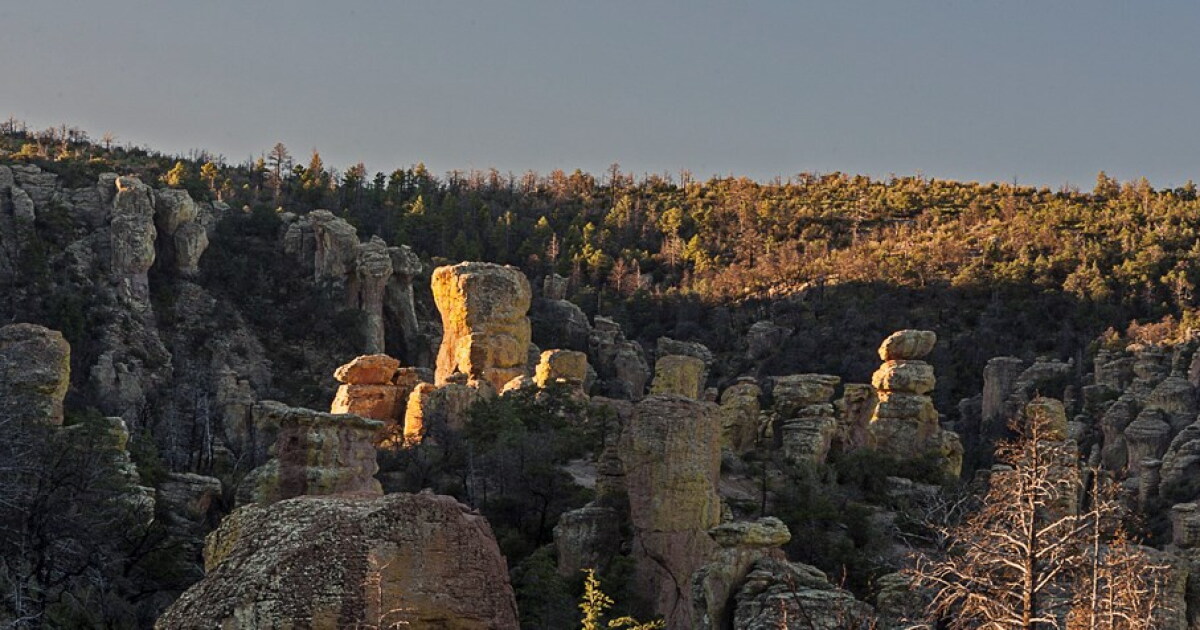
Chiricahua National Monument — Arizona’s so-called “Wonderland of Rocks” — is officially the newest national park in the United States. It is Arizona’s fourth national park, famed for its volcanic stone pinnacles that dot the 12,000 acre site.
The move will undoubtedly bring more attention — and more people — to what has long been known as a hidden gem off the beaten path in southeastern Arizona.
And, with a staffing and funding shortage at the National Parks Service, that has some folks nervous.
Chiricahua National Monument in Cochise County is now a new national park. President Trump has signed a bipartisan bill making the 12,000 acre site, Arizona’s fourth national park.
Roger Naylor is a longtime Arizona travel writer who calls the Chiricahuas his favorite corner of Arizona and he’s in studio now to tell us more. Good morning, Roger.
ROGER NAYLOR: Good morning.
LAUREN GILGER: Tell us first, just what’s special about the Chiricahuas? I’ve never been there, like a lot of Arizonans, right?
ROGER NAYLOR: Right. Well, these are mountains wrapped in fantasy. It’s a skyline of wilted castles, equal part majestic and weird. I mean, there’s just these waves of serrated pinnacles that just spread across the landscape, columns and towers and spires, but no two are exactly alike. They’re like fossilized snowflakes. It’s just a place that steals your heart.
LAUREN GILGER: And this was formed by like a massive volcano a long, long time ago, right?
ROGER NAYLOR: Volcanic event about 27 million years ago spewed this lava and ash skyward. It rained back down and formed this rhyolite crust that’s been chipped away at by the soft chisel of erosion all these eons and created some masterpieces of rock here. So it’s a wonderful place.
LAUREN GILGER: As I mentioned, this is sort of a lesser-known park in the state, now a national park. Underappreciated, I think a lot of folks would call it. But you found this really early in your Arizona exploring, it sounds like.
ROGER NAYLOR: Yeah, I arrived in Arizona in 1975 to go to college in Northern Arizona University, fell in love with the state, dropped out of college because I had no interest in that. But Arizona intrigued me, so I was rambling around. I found Chiricahua when I was 19, and so I’ve been visiting for half a century now. It’s an amazing place.
LAUREN GILGER: It sounds like you think this new designation, making this the highest form of protection from the federal government, is well deserved for the Chiricahuas.
ROGER NAYLOR: Absolutely. It’s certainly worthy of national park attention, and I understand the concern about that it doesn’t allocate more resources. They’re already stretched thin. But, see, that’s the way all the national parks are. They’re all underfunded, they’re all understaffed, they’re all in jeopardy. But the ones that are most in danger are the ones in rural areas, with low visitation and lesser designations: the monuments, the historic sites, historic trails and stuff.
That’s just exactly where Chiricahua sat. Some of these national monuments have already been trimmed back and others are threatened with extinction to begin with. So I much prefer having Chiricahua as a national park. That’s locked-in designation. You just can’t roll it back by an executive order or something like that.
LAUREN GILGER: Right, this had to go through Congress, signed by the president, the whole thing.
ROGER NAYLOR: Exactly. Yeah.
LAUREN GILGER: So let me ask about the Indigenous history in this place. I know it’s very sacred to some tribes in the region, and that history goes back millennia, right?
ROGER NAYLOR: Yeah, this was the home of the Chiricahua Apache, and they fought for years and years to save it and protect it. And it is a very special place, as are so many of our Arizona locations and stuff. They called it the Land of Standing-Up Rocks.
Once, after the surrender of Geronimo in 1886, pretty soon the immigrants started pouring out this way. The Swedish immigrants in 1888 first arrived and settled in the ranch, and their oldest daughter became instrumental in attracting the attention that made it a national monument, which it received that designation in 1924. That was Lillian Riggs, who built the Faraway Ranch there as a guest ranch and ran it. Even though she lost her vision in 1942 and was almost deaf, she still ran it as the boss lady of the Faraway Ranch until 1970.
LAUREN GILGER: Wow, so almost 100 years since it became a national monument, it becomes a national park. What does this mean for the park itself? We talked about staffing concerns, funding concerns. It doesn’t come with more resources, this designation. But it’ll also probably bring a lot more attention, a lot more people. Are you excited for more people to be able to see this?
ROGER NAYLOR: Well, I am, and I say this as a cranky curmudgeon who values his privacy. I like having places to myself. But again, I understand. I want more people on my side. I want more people to fall in love with this place. I want more people to see how special it is so that they’ll go, “Oh, yeah, we do need to protect these places. They do have value. We need beauty and wonder in our lives.”
And the more people that get out and experience it, the more that will want to discover other places like it. Fort Bowie National Historic Site is right next door. Coronado National Memorial is right down the road. There’s so much cool stuff in the area, so I hope that it leads to more exploration.
There will be a spike in visitation. It’s not going to be overrun because it’s, again, too far off the beaten path. It’s 40 minutes south of Willcox, is the biggest town, and Willcox is a lovely little town, a great wine destination, but not a thriving metropolis. It’s not huge. So you really have to seek it out. One of the reasons it did stay under the radar for so long is you just didn’t stumble across it. You had to really go there.
LAUREN GILGER: OK, last minute here, Roger. Tell us your favorite place, moment, trail in the Chiricahuas. Where should we go if we go?
ROGER NAYLOR: The Heart of Rocks is the little loop, a 1-mile loop in the heart of the formations, the most beautiful formations. It’s about a 7.3-mile hike no matter which way you come at it. They’re all interconnected trails, but very much worth it.
LAUREN GILGER: OK. Roger Naylor, longtime Arizona travel writer, joining us to talk about our newest national park here in Arizona. Roger, thank you so much for coming on The Show. Appreciate it as always.
ROGER NAYLOR: My pleasure.
KJZZ’s The Show transcripts are created for audience accessibility. Transcripts are created on deadline with the assistance of AI tools and then edited, and may not be in their final form. The authoritative record of KJZZ’s programming is the audio segment.
-
After an outdoor workout left a student on life support, ASU replaced its hockey coach. But that likely won’t be the end of the story. Other universities have faced major lawsuits in similar cases.
-
The Phoenix Suns ended last season at No. 8 in the Western Conference and got swept out of the playoffs by Oklahoma City. Despite the result, many observers considered the season a success. So how do they follow that up?
-
There were flash floods, mystery illnesses and low water levels. But despite all that, river rafting companies say they had a decent season.
-
The Phoenix Suns, Phoenix Mercury and the Valley of the Sun YMCA plan to build $60 million, three-story, 55,000 square foot sports, workforce and housing hub.
-
There’s an open call for Indigenous artists from the U.S. and Canada to submit their portfolios before a juried committee. Three semifinalists will then draft and present their concepts before a finalist is named.