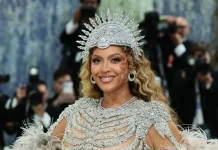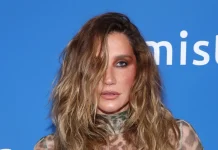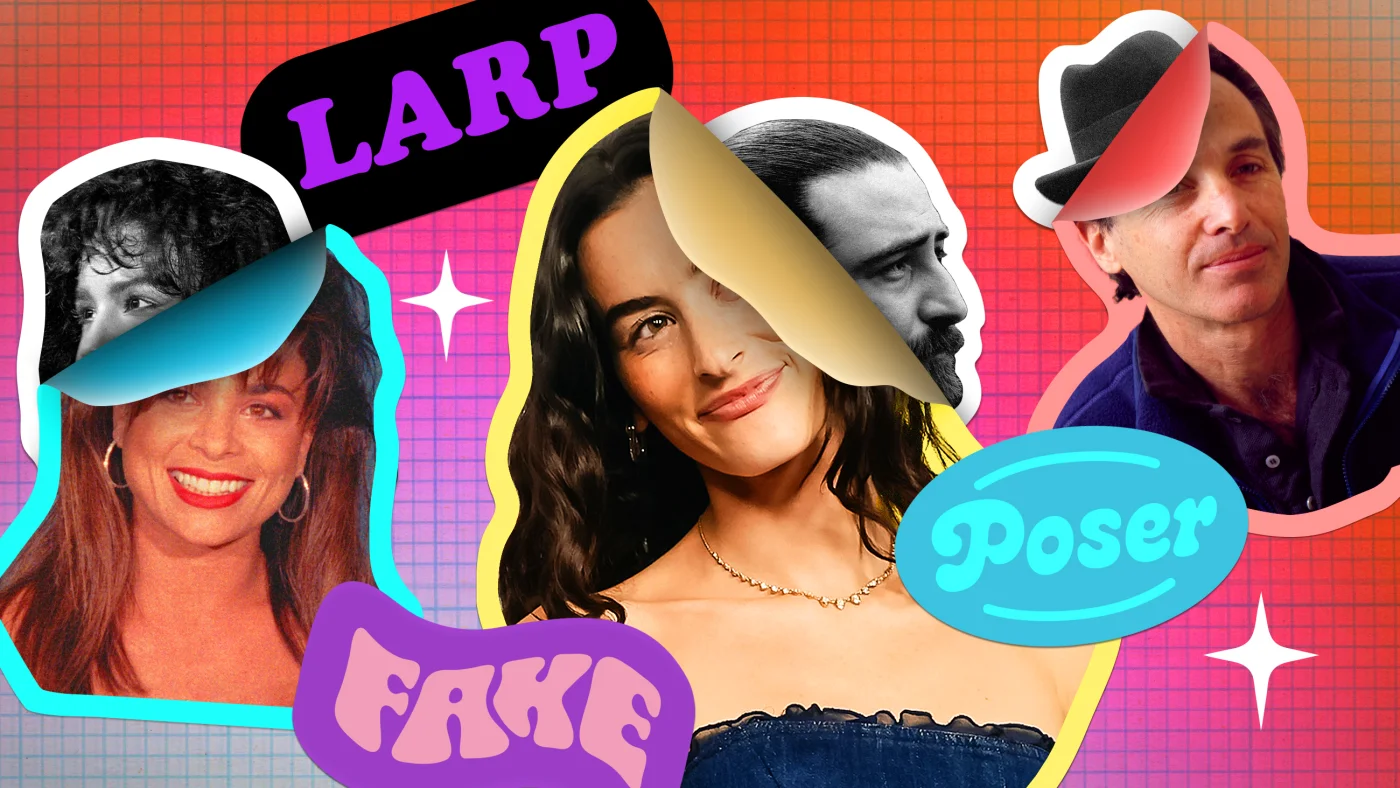

The vocal stylings of Paula Abdul (left), the similarities between Stella Lefty and Noah Kahan’s music and the work of artist Ry Cooder have all sparked debates about what makes music “real.”
Photos by Bob Riha, Jr. / Greg Doherty / Michael Putland / Getty Images. Illustration by Jackie Lay.
hide caption
Photos by Bob Riha, Jr. / Greg Doherty / Michael Putland / Getty Images. Illustration by Jackie Lay.
From manufactured fans to AI artists and “industry plants,” 2026 is one wild year for figuring out what’s authentic and what’s not in the music industry. For more, check out a catalog of the year in musical fraudulence, a historical survey of fakes and a conversation about why it feels harder than ever to know what’s real in our podcast.
In one of the most clamorous, messy and transcendent little songs of 2026, Caspian Hollywell of the New Orleans-based rock band Twisted Teens offers a shout toward the heavens: Is it real? He’s singing about a vision of salvation, or maybe the need to go back on his meds. He asks the question that also serves as the song’s title in a voice that’s disheveled, joyous, pleading, insistent, ridiculous. Is it real? The phrase threatens to destroy the song’s magic, its incipient empowerment. Music is the realest thing, “the angel trumpet loud”; it’s making Hollywell bigger and better than he’s ever been before. But it might be a trick. The anguish that Hollywell and the band whip up until it turns into grace is all in the service of making it okay to believe.
“Is it real?” That’s the most pressing question in music right now, and it’s one that feels impossible to adequately answer, in almost any context. Mainstream pop, seemingly falling out of fashion though it still fills stadiums and streaming playlists, is riddled with stories of chicanery and poison artifice. Every week a new scam seems to surface, making fans feel like they can’t trust what they hear, or see or buy — emerging stars allegedly benefitting from plagiarism or nepotism, viral successes that turn out to be rigged, faked musical identities, counterfeit vinyl, The Rolling Stones de-aging themselves in a video, the list goes on. It feels very chaotic, and not at all good.
In response, a new wave of artists are turning to raw, confrontational sounds and D.I.Y. methodologies, whether it’s the punky retro garage sound of Twisted Teens, Westside Cowboy and other new indie bands, the noise rock of Mandy, Indiana, the self-dismantling hyperpop of underscores or the oozing jazz-funk of GENA. These artists are winning the most acclaim this year partly because they are engaged in a battle that, to serious music lovers and many musicians themselves, feels momentous: a fight for the very soul of music as it drifts toward the black hole of AI slop.


The battle feels bloody right now, and as always, music’s vanguard is ready to make it even bloodier. When Hollywell tells an interviewer, “You can like us or you can hate us, but you can’t say we’re not real,” he’s claiming a lineage that extends back to the beginnings of American music culture. (Real is always relative: Hollywell loves a stage name and has used a bunch over the course of his music career, including CPN, C-Bird and Cas P. Ian. He’s also spelled his last name Holywell and Halliwell.) Since before the turn of the 20th century, when Black brass bands brought noisy authenticity to the streets of New Orleans while orchestras played “real” European music in its concert halls, debates have raged about authenticity in music. They intensify with the advent of new technologies, shifting demographics and surfacing political anxieties. Something upends the feeling of authenticity that music so often communicates; then somebody finds a new way to ask Hollywell’s question, and answer it with a bang.
Authenticity tests
Nearly half a century ago, an authenticity debate arose when the guitarist and songwriter Ry Cooder took music into what one reviewer half-jokingly called a “robotized” age. A sought-after session man known for inventive, wide-ranging takes on everything from blues to Hawaiian slack-key guitar, Cooder focused on early R&B for his 1979 album Bop Till You Drop, enlisting friends like Chaka Khan to make sure he did the genre justice.
Surprisingly for a roots-oriented guy, Cooder recorded the album digitally — the first case, in fact, of a major label artist using a computerized system to achieve a sound that was cleaner and more precise than analog tape. Many feared that digital recording would be the death of music’s authentic feel; though more accurate in capturing every note, it robbed the process of its ambiance, eliminating the sounds of the room and its human inhabitants. Cooder himself was impressed with the clarity, but later felt something was lost in the process of going digital. While he loved the accuracy of the master tape, he later admitted that when transferred to disc the product came out “thin” and “cold.” No amount of funky energy could make a digital recording sound as “real” as the session that produced it.

In the ’80s, Paula Abdul was accused of beefing up the vocals on her hit “Opposites Attract” by using computers to create a “composite voice” that blended session singer Yvette Marine’s guide vocal with her own.
picture alliance/picture alliance via Getty Image/picture alliance
hide caption
picture alliance/picture alliance via Getty Image/picture alliance
Just over a decade later, a different conversation erupted about what makes music real, this time focusing on a different kind of target, the choreographer-turned-pop star Paula Abdul. The session singer Yvette Marine accused Abdul and her producers of beefing up the vocals on her hit “Opposites Attract” by using computers to create a “composite voice” that blended Marine’s guide vocal with her own. (Marine sued, but lost her case.) In The New York Times, critic Simon Reynolds defended Abdul against detractors using her as a scapegoat in a “campaign for real music.” He stood up for her as a star devoted to “showbiz” — the sleek construction of palatable sounds using synthesizers and other studio tools. While Reynolds had no problem with this approach, he did concede that Abdul’s music was “louder than life but lacking in resonance,” more like junk food than a substantial meal.
These examples are particularly rich ones in the long history of people worrying about whether the sounds they were embracing were somehow fake — either enhanced beyond recognition or robbed of some essential spark via the tricks of mechanization. Every decade since the dawn of recorded music has produced crises of faith like these. In 1929, the Christian Science Monitor correspondent Volney D. Hurd encouraged listeners to accept music played on the radio as a “true miniature of the event” — better, he argued, than trying to stuff a 96-piece orchestra into a tiny apartment — and to seek out genuine live performances whenever possible. Forty years later, Washington Post critic William C. Woods cast scorn on both the album and the film Woodstock, writing that though these documents brought a taste of the festival to the general public, they were both “a treasure and a fraud,” inevitably misrepresenting the gathering both through questionable audio fidelity and the necessary omissions of the editing process. And so the story goes — new sounds, new suspicions.
The average listener’s ears tend to adjust to innovation, finding pleasure in what Reynolds calls “the immediacy and effervescence of the product.” Few people now question the verity of Donna Summer’s performance of sexual excitement within a cloud of synthesizers in disco’s crowning achievement, the song “Love To Love You Baby,” for example, or care that The Monkees didn’t always play their instruments in the studio. They just enjoy the shiny joys of those songs. The public’s idea of authenticity was adjusted to credit the TV band for their charisma onscreen and on tour, and to acknowledge the artistry of both Summer and producer Giorgio Moroder in melding human emotions and synthetic grooves.
Technology’s seductions are extremely difficult to resist, not least because new tools usually serve pop’s profits as much as its pleasures. This is as true in the 21st century, when the holograms representing the band in London’s ABBA Voyage have become beloved by the wholesome crowds who’ve flocked to the show since 2022, as it was in 1947, when Bing Crosby’s croon comforted the masses tuning into a radio show playing on reel-to-reel tape while he took time off to play golf.
New technologies are the flashiest signals causing listeners to question music’s authenticity, but social factors always also feed the conversation. Back to Cooder and Abdul: notice that both of these artists were crossing lines of identity as well as trying out new tools. Cooder is a white artist who has freely traveled within others’ communities and traditions, sometimes even adopting the vocal intonations of the Black or brown musicians with whom he often collaborated. As a man and an acknowledged virtuoso, he was largely accorded the right to roam in those spaces. His admirers trusted his choices and his ethics. Abdul, a Jewish woman whose father was born in Syria and who began her career as a Los Angeles Lakers cheerleader, had more to prove: As a dancer first, a woman, and a white artist with Middle Eastern roots, she was an interloper in the Black-dominated R&B realm, with a complicated identity. She had to prove her worth.
The historical moments each of these artists occupied also helped determine whether they could claim authenticity. Cooder was coming off a string of highly respected releases that secured his place as an artist’s artist. He was respected for taking a chance on digital recording despite some listeners’ doubts about the outcome. Abdul had huge commercial success in the early ’90s while being scorned by most critics as a Madonna wannabe — the esteemed critic Robert Christgau called her “less imitator than imitation.” With synthesizer-dominated pop still earning scorn from the rock-loving media, she didn’t stand a chance.

In 1990, German pop duo Milli Vanilli returned their Grammy award for best new artist after the two confessed to lip-synching their songs.
William Nation/Sygma via Getty Images/Sygma
hide caption
William Nation/Sygma via Getty Images/Sygma
In Faking It, their 2007 book about the quest for authenticity within popular music, Hugh Barker and Yuval Taylor identify three ways that the goalposts are set for something feeling real. Representational authenticity is the easiest to grasp — that’s the Milli Vanilli question, about whether an artist actually performed or composed a work bearing their name. Cultural authenticity requires verifiable ties to certain communities or legacies — Cooder, for example, could claim it because of his commitment to collaborating with artists from those scenes he mined. Personal authenticity can connect to cultural authenticity, but it also raises more intimate questions: Is a confessional song actually based on an artist’s experience? If not, do they have the depth and empathy required to tell another person’s story? These distinctions establish the rules for the authenticity tests that every artist faces as their career progresses.
Even faker than usual
The question facing us now is: Have we entered a new phase, where authenticity seems unachievable? Today, concerns about what’s real in music — and culture in general — are pervasive and free-floating, extending beyond the startling effects of new recording techniques or the scrutinizing of any one artist’s bona fides. There’s something more urgent in the tone of the discourse. In his famous 1972 lecture Sincerity and Authenticity, the critic Lionel Trilling intimated that the pursuit of the real self may have gone too far; a commitment to freedom of choice and self-expression had overcome the need to respect social norms. (David Bowie was the rock star of that moment.) Today, the opposite can feel true. With so many aspects of daily life compromised by scams, unseen algorithms and other forms of exploitation, it’s hard to know what is real and how to behave authentically.
Musicians and fans share this disturbing sense of instability. Fandom itself sometimes feels like it’s under siege. That song you love might have been wholly created by code; the artist who wins your heart could be a stand-in for the person who really made the music. For artists, the playing field feels beyond rigged — it’s constantly remaking itself. Scammers are taking over streaming platforms, dumping scores of AI tracks into systems that have no powerful way to regulate such actions. Artists can’t trust their fans, either, nor can fans trust each other, with the “bandwagon” phenomenon leading people to play-act interest in scenes or communities for online clout. Every week brings a new deception; it’s no wonder that conspiracy theories are starting to take over. Did Usher or Shakira clone themselves for their recent big performances? Such preposterous conversations indicate that knowing what’s real has become not just a moral quest but an existential one.

There’s still a lot of room for lighthearted play when it comes to what’s real or what’s fake in music, like the rise of comical costumed bands like Angine de Poitrine.
Matthew Baker/Getty Images/Getty Images Europe
hide caption
Matthew Baker/Getty Images/Getty Images Europe
Underlying today’s authenticity debate is a fundamental queasiness, the feeling that the very ground of cultural experience has given way. One way to think about this is in future-dystopian terms: It’s all related to the advent of AI, which violates the boundaries of the self in such profound and incomprehensible ways that its ripples extend everywhere. As is often the case with anxieties triggered by new technologies, though, other fears lurk in the background. Often they have to do with those intersecting categories of race, class and gender. In the 1910s, when Black performers began to find a place on New York stages, their music challenged the hierarchies of “real” music — up to that point, selections from the classical European canon were considered more authentic than these unvetted sounds. (Actual headline, 1901: “Ragtime and The ‘Real’ Music Meet.”) Half a century later, rock and roll would get the terms of authenticity all mixed up — this startlingly “real” music was actually a reinterpretation of Black sounds created by mostly white young men replacing women (also mostly white) at the top of the pop charts. In the 1980s, the college rock groundswell that led to Nirvana’s 1990s triumph formed in part because young middle-class kids with bohemian aspirations felt alienated by massive pop stars of that blockbuster decade, who were mostly women like Madonna, Black musicians like Prince and Michael Jackson or both, like Whitney Houston.
What’s haunting people right now, causing them to seek the safe space of imagined authenticity via bands like Twisted Teens? Recent surveys show that Americans are more anxious than ever, and that worry is mixed with anger. People feel exploited, broke and unable to protect themselves from the looming catastrophes of war and environmental disaster. They are afraid of AI, afraid of getting sick or getting deported, afraid of having to work until they die.


These heavy anxieties have changed the tenor of talk about what’s real and what’s fake. While there’s still a lot of room for lighthearted play (witness recent online exchanges about what Phoebe Bridgers “really” did onstage during her current phone-free shows, or the rise of comical costumed bands like Angine de Poitrine) many controversies focus on exploitation and money grabs — artists’ reps concocting fake fans, crooks gaming streaming platforms, bots vying for concert tickets with fans and inflating prices. These stories differ from past controversies, which were grounded in beliefs about purity and immediacy. Often, flagging something as inauthentic was a way of saying, “Stay out.” Now it’s more about identifying something negative that’s already taking over. There’s a feeling that fakeness has already won, that it’s everywhere, and all we can do is expose its many mutations.

A TikTok star before signing her record deal and scoring one of the biggest hits of the year with “Boston,” Stella Lefty epitomizes the paradoxical “accidental” success of viral stars who become famous by doing little beyond being “themselves.”
Jim Bennett/WireImage/WireImage
hide caption
Jim Bennett/WireImage/WireImage
In light of this, the much beleaguered Stella Lefty, who has glided to the top of the country charts on a song that many feel isn’t her own, is the Paula Abdul of 2026. A TikTok star before signing her record deal and scoring one of the biggest hits of the year with “Boston,” Lefty epitomizes the paradoxical “accidental” success of viral stars who become famous by doing little beyond being “themselves.” According to her own interviews, Lefty’s entryway into music was counterintuitive; she suffers from stage fright, and though she wanted to become a songwriter, only put in a short amount of time in Nashville before decamping to the influencer capital of LA. She never labored anonymously in Music Row writing rooms or played covers on Lower Broadway. On shaky ground out of the gate, Lefty has found herself hounded by multiple accusations of plagiarism, most notably for copping the chorus from Noah Kahan’s multiplatinum “Stick Season” for her own biggest song. Interpolation is common in pop songwriting and a time-honored tradition in country — some of the genre’s biggest hits, from Brad Paisley’s “Old Alabama” to Cole Swindell’s “She Had Me at Heads Carolina,” openly rewrite older songs. While the country bros rest on their royalties, though, Lefty is watching her reputation go up in smoke.
The tragicomic thing about Stella Lefty’s descent into notoriety is that she’s just so bad at faking it. Wealthy young people are all over the pop scene in the 2020s, whether they’re ex-Disney stars or children of Hollywood producers, but most of these privileged strivers diligently display their hard work in their promotional material, through interviews and in their songs. Lefty, on the other hand, has cultivated her own damnation by blithely speaking about how everything’s come easy for her. In the few interviews Lefty has given, she’s offered little insight into her creative process; “I was literally thinking about nothing at all,” she’s said about writing “Boston” without realizing she was taking from “Stick Season,” a song she’d covered in her own viral videos. The haplessness that the inexperienced Lefty displays eerily recalls the serviceable obliviousness of a chatbot. She’s the scapegoat standing in for the inhuman menace that threatens us all.
I’m not asking for sympathy for “Stella Thefty”; her music is pretty damn unremarkable, and in the ways that matter to a mainstream artist, she’s doing just fine. It’s likely that her success will buy her the time to find a way to claim her own version of authenticity, as other demons of fake, from accidental YouTube star Rebecca Black to lip-synching Ashlee Simpson to Abdul herself, who went on to a successful television career, have done. She’ll go live in Texas or North Carolina for a while; she’ll master the acoustic guitar. And there will be some new version of fake that will show up on the charts. What I hope is that when that happens, people will focus on the serious problems behind the trickery and the fear, and have some real conversations about what people need to make art, share it and survive.