For agents in the tightest states, that means fewer carriers to place with and more exposure to any one insurer’s change of heart

In Rhode Island, one insurer collects almost 40 cents of every dollar spent on private auto insurance. Progressive held 39.6% of the state’s private auto premium in 2025, more than three times the 12.8% of Allstate, the next largest writer, according to the latest National Association of Insurance Commissioners’ 2025 market share reports.
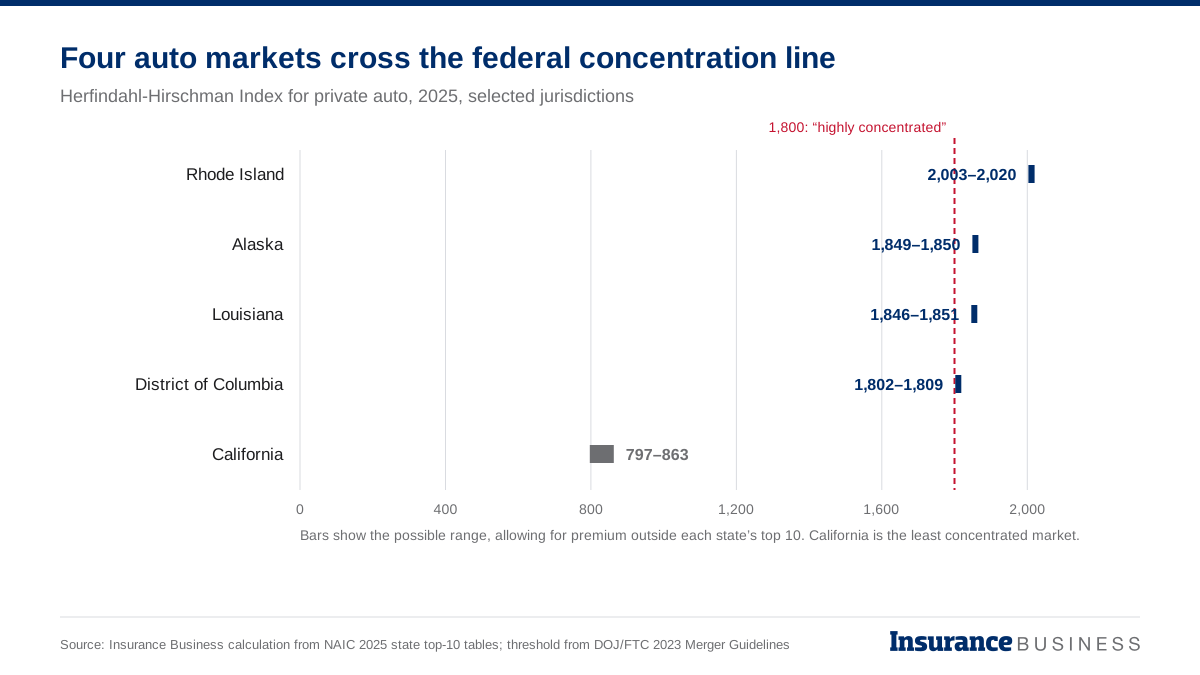
Rhode Island is the extreme case, but it is not alone. Insurance Business calculated the Herfindahl-Hirschman Index, the standard measure of market concentration used by federal antitrust agencies, for every state from the NAIC‘s top-10 tables. Four markets score above 1,800, the level the 2023 Merger Guidelines describe as highly concentrated: Rhode Island (2,003 to 2,020), Alaska (1,849 to 1,850), Louisiana (1,846 to 1,851) and the District of Columbia (1,802 to 1,809). The ranges allow for premium written outside each state’s top 10. California, at 797 to 863, is the least concentrated.
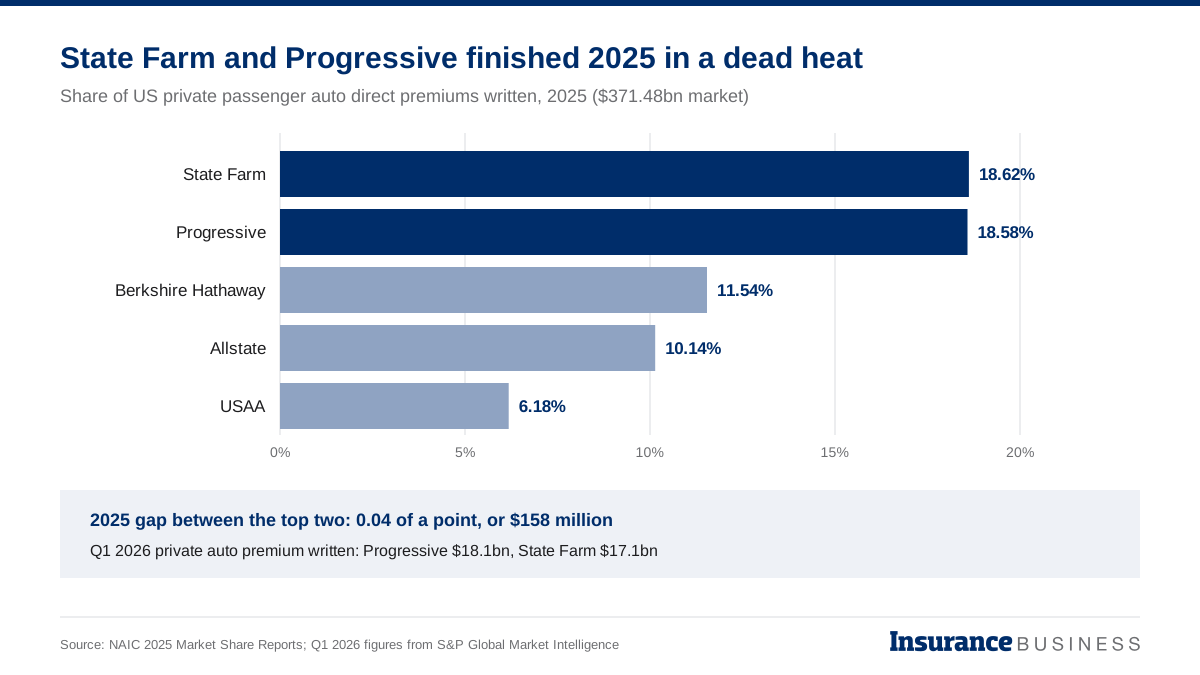
The national picture points the same way. State Farm and Progressive together wrote 37.2% of US private auto premium last year, up from 35.5% in 2024, according to S&P Global Market Intelligence. Add Berkshire Hathaway (11.54%), Allstate (10.14%) and USAA (6.18%) and the five largest groups write 65.0%. The top 10 write 76.8%. No other line with at least $20 billion of 2025 premium is as concentrated: the 10 largest homeowners groups hold 62.4%, and in other liability, the biggest commercial line, the figure is 38.6%.
Much of the attention this year has gone to the race at the top. State Farm finished 2025 with $69.16 billion of private auto premium to Progressive’s $69.01 billion, a gap of 0.04 of a point, and Progressive has since moved ahead on a trailing 12-month basis, S&P estimates.
The bigger shift for producers is underneath that race. As share piles up with a handful of carriers, an agent’s options in many states come down to a short list, and a single carrier tightening its appetite can change what is available to clients within a renewal cycle. The HHI figures are a market snapshot rather than an antitrust finding, but they also show where any future deal between large auto writers would face the closest scrutiny.
Read next: Progressive posts strong results amid leadership shift
Who leads where
State by state, a few carriers dominate. In 22 of the 51 jurisdictions, the 10 largest writers hold 90% or more of private auto premium, and in Alaska they hold 99%. A single group writes at least 30% in five places: State Farm in Alaska, Illinois and West Virginia, Berkshire Hathaway in the District of Columbia, and Progressive in Rhode Island.
State Farm is the largest auto writer in 24 jurisdictions and Progressive in 20, and between them they hold the top two spots in 36. Berkshire Hathaway, whose group includes GEICO, leads in five, among them New York, where it holds 29.7% to State Farm’s 16.9%.
Allstate leads North Carolina and Mapfre leads Massachusetts. Progressive tops Texas with 23.1% of a $35.63 billion market and Florida with 25.8% of $31.95 billion. California, the largest market at $48.39 billion, is also the most open: State Farm leads there with just 13.83%, the smallest leading share anywhere. The tightest race is in Ohio, where State Farm’s 21.76% edges Progressive’s 21.49%.
For independent agents, which carrier leads matters as much as how concentrated a market is. State Farm sells through its own captive agents, while Progressive writes both direct and through independent agencies, where its auto policies grew about 10% in the year to early 2026, according to figures reported by the Motley Fool. Where Progressive is gaining, more of the market sits with a carrier independent agents can quote. Where State Farm leads, more of it sits behind a captive channel they cannot reach.
Same size, different books
The two leaders may be level on premium, but their books are not alike. Progressive is the larger liability writer, with 19.90% of that premium to State Farm’s 17.95%, while State Farm leads in physical damage with 19.50% to Progressive’s 16.84%.
Their results follow the same split. State Farm’s 2025 auto liability loss ratio, the NAIC’s measure of direct losses incurred against direct premiums earned, was 74.95%, against Progressive’s 59.87%. On physical damage the order reversed: State Farm ran 54.36% and Progressive 57.84%.
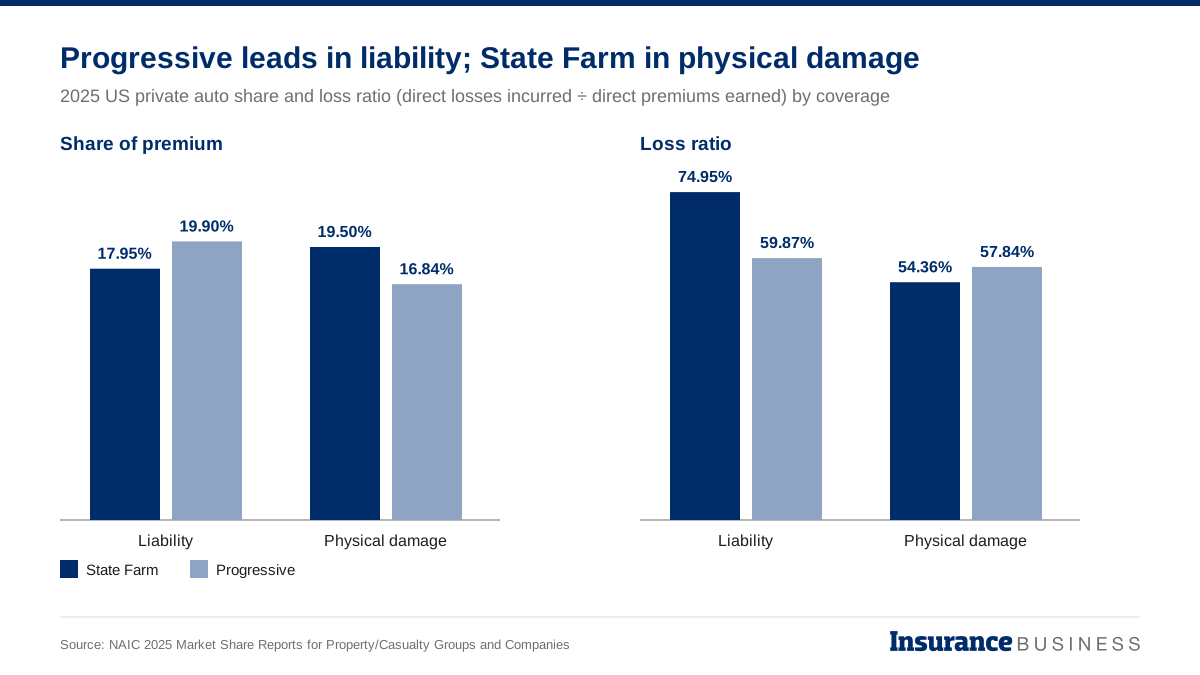
Liability accounts for the larger part of private auto premium nationally, so the difference matters at renewal. A liability loss ratio 15 points above its closest rival’s leaves State Farm with less room to cut liability rates, while Progressive has more room to compete on price. For agents comparing quotes, that is likely to show up most clearly on liability-heavy policies.
Cheaper on paper, mixed at renewal
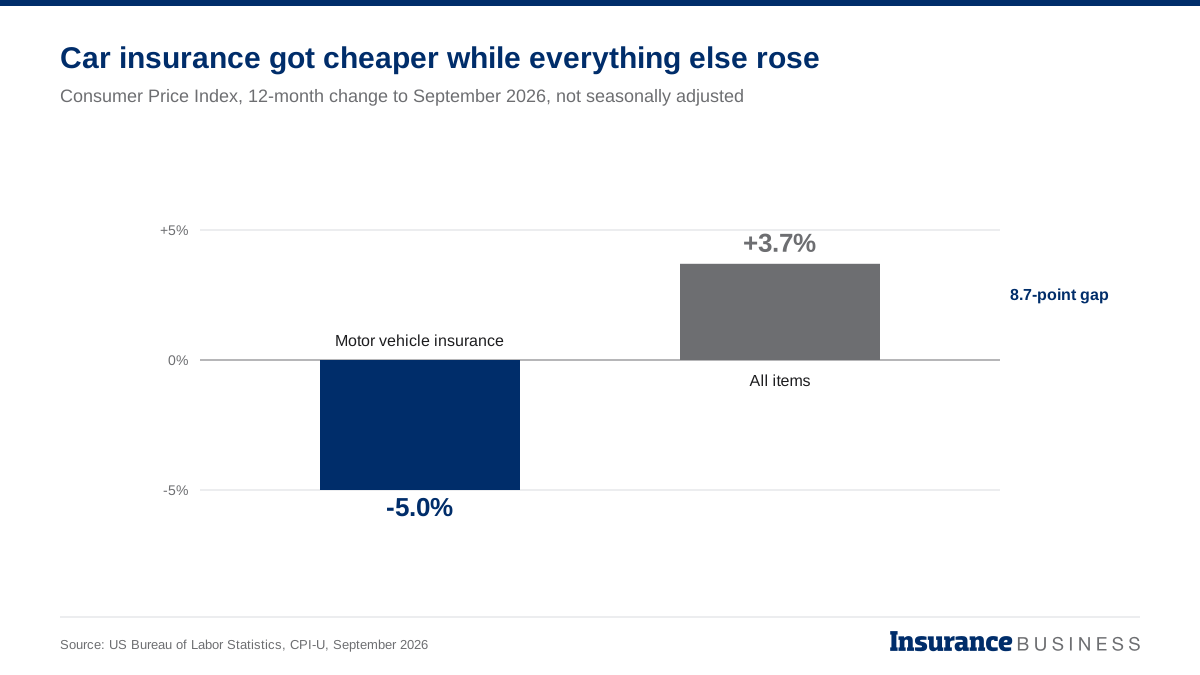
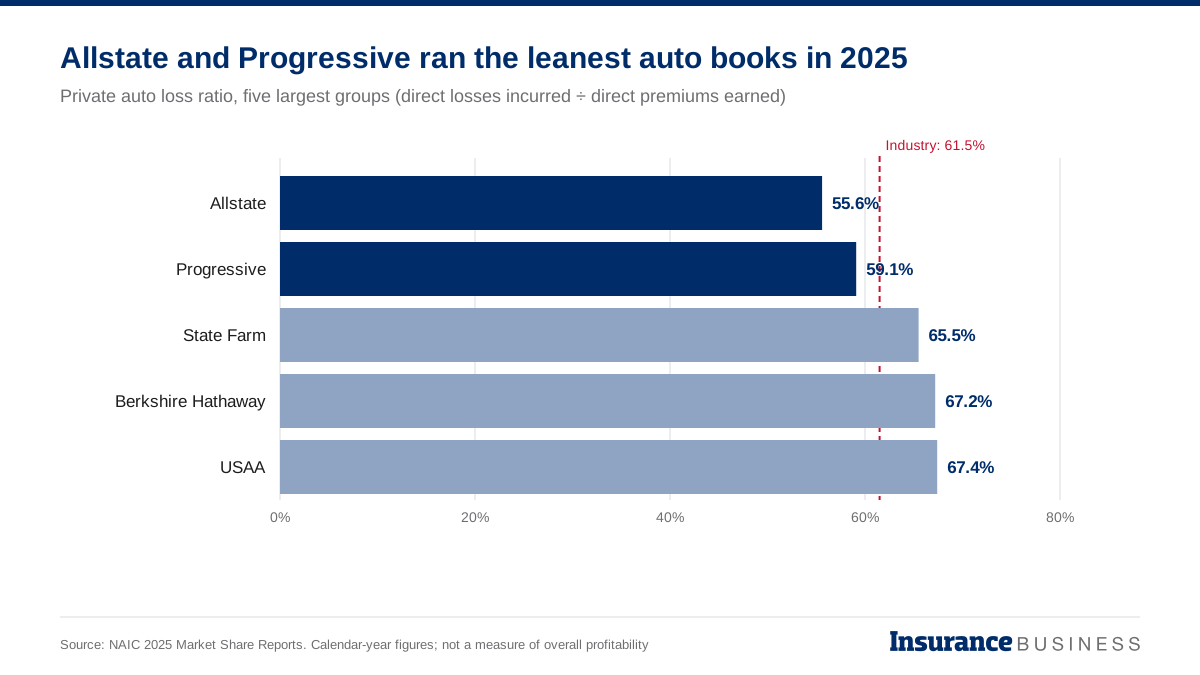
Nationally, the data point to a softer market. The Bureau of Labor Statistics’ consumer price index for motor vehicle insurance was 5.0% lower in September 2026 than a year earlier, while the index for all items rose 3.7%. Private auto direct losses incurred came to 61.5% of earned premium in 2025, down from 66.1% in 2024, S&P Global Market Intelligence reported. Among the five largest groups, Allstate had the lowest loss ratio at 55.6%, followed by Progressive at 59.1%, State Farm at 65.5%, Berkshire Hathaway at 67.2% and USAA at 67.4%. The NAIC cautions that these calendar-year figures are not a measure of overall profitability.
Not every measure agrees that the cuts are continuing. Insurify, which tracks quoted prices, found that the average full-coverage premium rose 1% in the first half of 2026, to $2,237, after a 6% drop in 2025, and The Zebra has projected increases in 19 states in the first half of this year. The two can both be right. The BLS index measures price changes for comparable coverage over 12 months, while quote data reflect what shoppers are offered now and can turn sooner.
For producers, a market that is softening in places and firming in others is a reason to re-market selectively rather than across the board. Accounts placed during the steep increases of recent years are the obvious candidates. Florida shows how far the softening can go where conditions allow: Root has cut its Florida rates 15%, and the NAIC data put Florida’s 2025 private auto loss ratio at 51.6%, the fourth lowest in the country.
Read next: Root cuts Florida rates 15% as the state’s personal auto loss ratio hits bottom level in 15 years
Where relief is least likely
The national averages hide some sharp differences. State loss ratios in 2025 ranged from 48.7% in South Dakota to 71.2% in Nevada. New York was second highest at 68.9%, and Berkshire Hathaway, the state’s largest writer, ran 77.1% there. In Michigan, USAA posted a private auto loss ratio of 124.7%, the only top-10 writer in any state with a reported loss ratio above 100%.
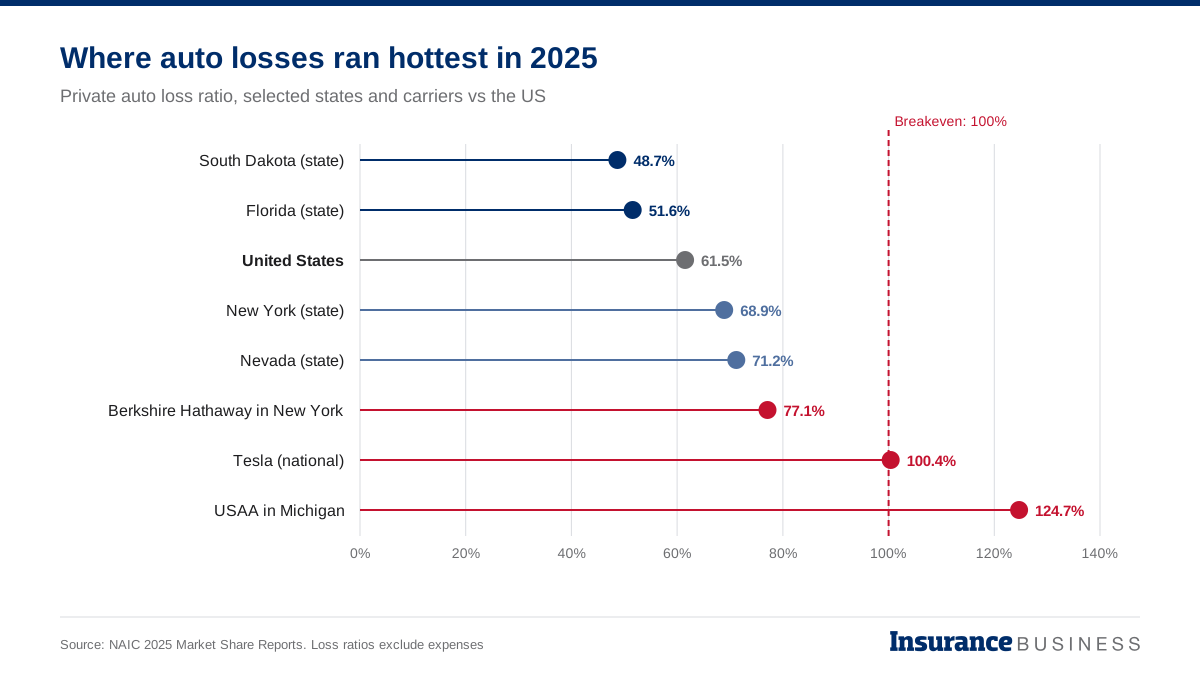
These are the markets where the national price cuts are least likely to reach clients. Agents with books in Nevada, New York and Michigan should plan for less relief at renewal, and possibly tighter terms from the carriers with the weakest results. In New York, where Berkshire Hathaway is both the largest writer and among the worst performers, any repricing would touch a large share of the market at once.
Read next: Driving change: How America’s auto insurance giants are rerouting for the future
A carmaker in the top 40
One newer name also appears in the national rankings. Tesla’s insurance group ranked 36th in 2025, with $1.04 billion of private auto premium and a loss ratio of 100.4%. On liability alone it wrote $421.3 million at a loss ratio of 137.5%. California accounted for almost 70% of Tesla’s premiums last year, S&P Global Market Intelligence reported.
Results have improved since. Tesla Insurance Co., which writes in California and Illinois, reported a loss and loss adjustment expense ratio of 94.5% for the first half of 2026, down from 133.6% a year earlier. The business is still small, but it is the clearest test so far of cover sold by a carmaker at the point of sale and priced on its own driving data. If that model works, it reaches customers before an agent ever sees them. Tesla’s insurance arm has had a mixed record with customers along the way.
What to watch
The concentration figures are unlikely to ease soon. With the industry loss ratio near 61.5% and Progressive still growing faster than its peers, the largest carriers have both the margin and the motive to keep taking share. Brokers should watch whether the monthly price index keeps rising after its 0.1% seasonally adjusted gain in September, reported by the BLS, and how carriers reprice in the hot-spot states. Agencies that keep more than one strong market open in their most concentrated states will be best placed whichever way the cycle turns.