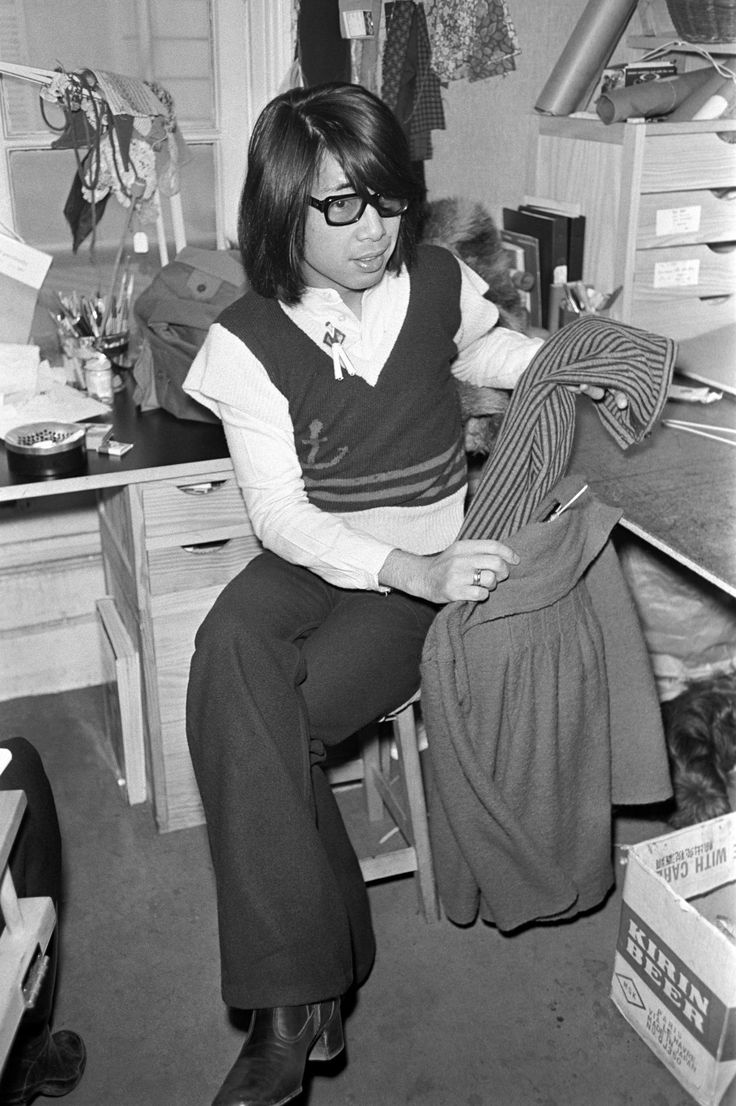
This was a time when French fashion remained largely dominated by the strict, classic codes of the major fashion houses. In this context, Japanese fashion had not yet found its place in the mainstream fashion landscape. When Kenzo Takada made his debut on the fashion and media scene, he brought with him a different way of thinking about clothing: bold, vibrant colors, exuberant prints, loose silhouettes, influences from around the world, and total freedom in mixing and matching. Beyond simply founding a fashion house, Kenzo Takada played a major role in firmly establishing the codes of Japanese fashion for years to come and paved the way for an entire generation of Japanese designers to later make their mark in the fashion capital: Issey Miyake, Rei Kawakubo, and Yohji Yamamoto…
The Land of the Rising Sun Conquers Paris
Born on January 27, 1939, in Himeji, Japan, Kenzo Takada grew up as one of seven siblings. At a very young age, he developed a keen fascination with fashion while leafing through his sisters’ magazines. As a result, he quickly developed a passion for drawing and designing clothes, even though the profession of “fashion designer” was still largely off-limits to men in Japan.
As a student, he enrolled at Bunka Fashion College in Tokyo, a prestigious fashion school that had just opened its doors to male students. During his studies, he learned design, pattern-making, and drafting techniques before beginning to work in the fashion industry. But Kenzo dreamed big; his goal? Paris.
The French fashion capital, which had given birth to great masters of haute couture such as Charles Frederick Worth and Paul Poiret, was waiting just for him. At that time, Paris was the nerve center of fashion design: Christian Dior, Yves Saint Laurent, Pierre Cardin, and André Courrèges were all shaping the international fashion scene and putting France on the map. For the young Takada, Paris was synonymous with success. In 1964, he left Japan and set sail for Europe with a one-way ticket. His voyage by ship lasted several weeks and allowed him to discover different cultures, notably in Hong Kong, Singapore, India, and Egypt. He finally arrived in France in January 1965, in Marseille, before heading to Paris. Upon his arrival, he encountered a Paris that was different from the one he had dreamed of: a dark, gray, almost austere city, quite unlike the one he had imagined. But his dream remained intact.