The Federal Aviation Administration said Friday night that airplane departures can resume after the agency lifted a nationwide ground stop that Trump administration officials blamed on “overloaded,” “outdated” systems.
Even with the order being lifted, the airlines will not be able to return to normal operations immediately because so many of their planes and crews are out of position.
The FAA had grounded all flights nationwide Friday afternoon, causing hundreds of flights to be diverted. Officials cited “extraordinary circumstances” caused by communications problems at regional air traffic control centers.
Homeland Security Secretary Markwayne Mullin told reporters at the White House that the introduction of some new technology into an old air traffic control system overwhelmed it. He couldn’t rule out another outage.
The nationwide ground stop was the first since January 2023, when a key FAA computer system malfunctioned, and the second since the aftermath of the Sept. 11, 2001, attacks.
There was no indication the communications failure was related to a cyberattack. The consequences were profound, disrupting potentially thousands of planned flights through at least late Friday night and upending travel plans for passengers.
“It’s frustrating. This certainly sounds like it’s going to be more than the usual run-of-the-mill delay. I look forward to finding out why,” said Jeff Dubner, a Washington attorney whose Alaska Airlines flight home from Los Angeles was already half an hour late and taxiing to the runway when the plane came to a halt.
International flights were being handled on a case-by-case basis, according to Mullin, with some seen taking off Friday evening.
Top official says no sign yet of nefarious act
Asked whether Mullin could rule out a cyberattack or rogue artificial intelligence incident, he said: “There’s nothing completely certain right now. It doesn’t appear that way.” He said there are no “footprints” showing an attack and that it appears to be “mechanically driven,” adding that officials were still looking for the cause.
At least 827 flights were diverted so far as a result. As of 7:05 p.m. EST, 670 flights were sent back to the airport from where they originally took off, while 157 were redirected to a different airport, according to Cirium, an aviation analytics company.
The airports where many of the flights ended up being diverted included Washington Dulles International Airport, Los Angeles International Airport, Cincinnati/Northern Kentucky International Airport and Nashville International Airport.
Some 11,000 flights carrying more than 1.5 million passengers were scheduled to take off from airports in the U.S. after 4 p.m. EST, raising the likelihood of more cancelations and flight diversions.
North Texas airports affected
The ground stop left travelers at Dallas Love Field scrambling for hotel rooms, rental cars and alternate transportation as delays and cancellations piled up throughout the day.
According to FlightAware, the airport recorded 175 flight delays and 50 cancellations.
Bob May, who was trying to get to Florida, found himself surrounded by other stranded passengers.
“Everybody’s in the same boat, and you’ve got plenty of people to talk to,” May said.
As travelers realized their flights might not depart as planned, nearby hotel rooms and other transportation options became increasingly difficult to find.
Darla Duke Smith, who booked a hotel, described the rush to make alternate arrangements.
“Everyone’s on the phone or computer. I heard some guy next to me trying to get a seat on a bus. All the rental cars are taken. So if you didn’t get that earlier like at 3 o’clock, you’re toast.” Smith said.
For some North Texas residents, the ability to return home offered at least some relief.
“I’m glad we live here so we can at least go home and sleep in our bed,” said Joel Whitman, who was headed to New Orleans.
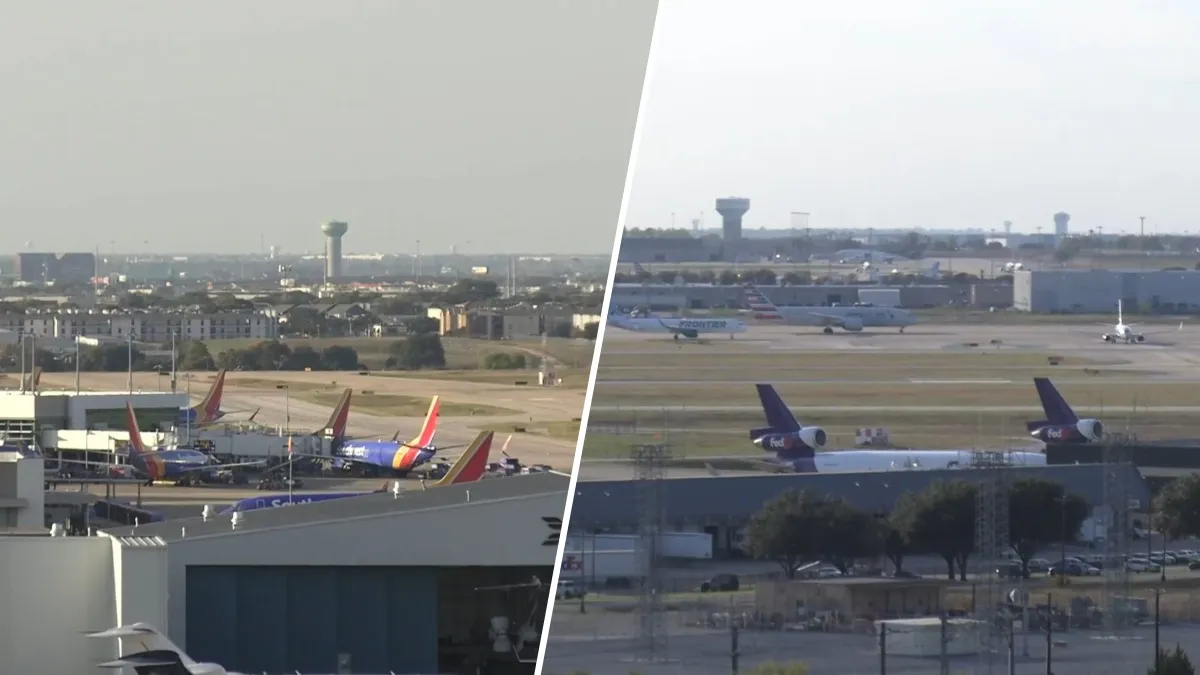
According to FlightAware, DFW Airport alone recorded nearly 600 delays and almost as many cancellations. The impact was visible both inside and outside the terminals.
Even after the FAA lifted the ground stop, passengers packed Terminal C, where a long line formed at the American Airlines ticket counter as travelers tried to rebook canceled flights. Another lengthy line stretched through the concourse.
Pete Schulte, a passenger who had just taken off from Denver when the ground stop began, landed at DFW Airport but spent about three hours waiting on the tarmac.
“We sat on the tarmac for several hours,” Schulte said.
Schulte said the captain eventually announced that the ground stop had been lifted. But after finally getting off the plane, he encountered crowds of passengers still trying to rebook their flights.
For travelers at DFW Airport and Love Field, the end of the ground stop did not necessarily mean the end of their travel headaches.
Flights may be back in the air, but the travel headaches are far from over. Following a nationwide ground stop, officials warned it will take time to work through a backlog of grounded aircraft, missed connections and unsorted baggage. With the busy holiday travel season approaching, NBC 5 Responds reporter Diana Zoga shares advice for passengers navigating the disruptions.
The government has been working to overhaul outdated technology
Mullin had said investigators will look at whether there is any link to the FAA’s nationwide rollout of a new artificial intelligence system to help identify problems and reroute planes. But that system operates out of one location near Washington, D.C., and just sends recommendations to the air traffic control centers.
The government has been working to overhaul the outdated technology that air traffic controllers rely on since Congress approved $12.5 billion for the project last year. Miles of old copper wires have been replaced with fiber optic lines and old radio systems are gradually being replaced at airports across the country.
But much work remains. Transportation Secretary Sean Duffy has said that another $30 billion will be needed to complete the work, and the White House has begun lobbying Congress to approve it.
The problem appeared similar to a regional air traffic control communication outage in September that snarled hundreds of flights across the Northeast, aviation safety expert Steve Arroyo said, except this time on a nationwide scale. It may be linked to the outdated technology used by air traffic controllers.
“If you don’t have that ability, whether it’s because the old wires that they have are just run down or for whatever reason, you’ve got to stop airplanes on the ground,” said Arroyo, who is a former United Airlines pilot. “And not put them in the air where you’re going to risk not being able to communicate with them.”
Friday’s ground stop was different than the one after Sept. 11 because planes were not being told to land immediately and pilots likely were able to communicate with ground controllers at airports, Arroyo said.