Dreams come easily when we speak of hope. Harder, perhaps, when we speak of fear. Yet in conservation, the two are inseparable.
At our Island Conservation Lab, we dream of endangered plants returning to the forests and savannas, of cultural connections strengthened, of species no longer balanced on the edge of extinction.
It is not my dream alone. It belongs to a team of biologists, natural resources crew leads, conservation technicians, accountants, social scientists, statisticians, and outreach specialists who carry it with them every day, and often, into the night.
Sometimes, that dream begins quietly. A long hike. A careful survey of the forest or savanna. And then, the discovery: a mother plant or a rare species. Resilient. Still holding on.
From there, the work unfolds with intention. We return to check for ripe seeds. We collect them, germinate them using carefully developed protocols by trial and error. We nurture the seedlings in our nursery. With time, we outplant them back into the wild, where they belong.
It would be comforting if the story ended there.
Weight of fear
But alongside hope live constant challenges.
Insect pests ravage plants, sometimes preventing them from producing seeds at all. Many of our fadang trees suffer from scale insect damage, their seeds aborting before they ever have a chance to develop. Finding healthy individuals becomes a mission in itself.
But our biologist developed protocols to take care of these plants. Khanh, who is our insect pest specialist, also passes on the knowledge to our interns on how to take care of the fadang at Atantåno.
We carry loss with us, too. When the last adult håyun lågu died, we mourned her, not just as a plant, but as a life, a lineage, a connection that once stood tall in our forests.
Even in the nursery, care never pauses. Seedlings demand daily attention, watering, monitoring, protecting, yes, even on weekends. And once planted back in the wild, the vigilance continues: soil health, water, wind, and ever-present pests.
Moments we share
And yet, if you scroll through our WhatsApp chat, you will see another side of this work.
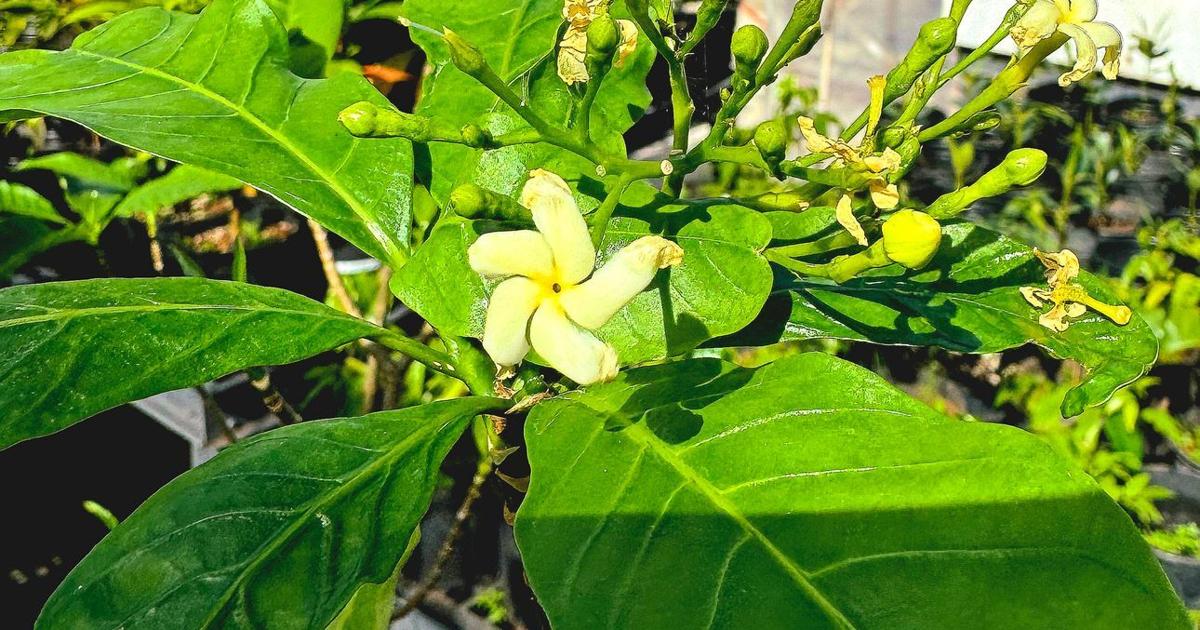
A message comes through: “It bloomed!”
A photo follows, Tabernaemontana rotensis, delicate and white.
Another message: an orchid, opened for the first time under the careful watch of an intern.
A quick update: “Two new leaves today”, Hedyotis megalantha, small but full of promise.
A before and after photo of the fadang after months of care. “Look how amazing they look.”
These moments ripple through the team. They are celebrations, shared instantly, carried in photos and short messages, reminders that the work is alive and moving forward.
Ingenuity, care
Our conservation technicians and biologists are endlessly ingenious, designing and building protective cages, adjusting materials, testing new ways to shield plants from insects and weather.
Each structure tells a story of trial, error, and persistence.
Behind it all is steady coordination. Our program manager, Vince Fabian, ensures that every day begins with the intention that caring for our listed species, alongside other native and endemic plants, remains at the center of our work.
Because here on Guam, many of these species exist nowhere else in the world.
That truth carries weight.
It creates a responsibility that is both heavy and deeply personal. These plants are not just rare. They are part of the identity of this island. Their presence is tied to stories, to place, to people. To lose them would be to lose something we cannot replace.
Returning what was lost
And yet, we are also finding ways to bring them back into everyday life.
Recently, we planted Serianthes nelsonii or håyun lågu in Atantåno, returning it, carefully and deliberately, to a place where people can see it, walk among it, and build a connection.
Not just as something rare and protected, but as something living, present, and part of the community again.
After mourning the loss of the last adult, this act feels especially significant, a quiet but determined step toward restoring what was nearly gone.
That is where hope grows stronger.
Between hope and fear
Still, fear remains.
There are nights I wake up thinking about the plants in our nursery, the mother plants in the field, the plants we outplanted back into the wild. When heavy winds and rains arrive, I hope the protective cages still stand.
Our biologists think constantly about new ways to outsmart insect pests, sketching ideas, testing solutions, refusing to accept loss as inevitable.
But dreams are not only where fear lives. They are also where solutions begin.
Each day brings new ideas, new designs, new ways of caring. And in between the worry, there is laughter, shared photos, and quiet pride in every small success.
I am deeply grateful to everyone at our Island Conservation Lab for their dedication, for the daily care, the ingenuity, and the quiet persistence that keeps these species, and their stories, alive.
This is the nature of our work.
To dream of what can be.
To fear what could be lost.
And to keep going, together, somewhere in between.