The sixth edition of the annual Cultural Deal for Europe Policy Conversation, entitled “When Culture Wins, Europe Wins”, took place on 3 February 2026 at BOZAR in Brussels, bringing together over 250 participants — policymakers, representatives of civil society, and cultural and heritage stakeholders from across Europe. The event reaffirmed the essential role of culture and cultural heritage in shaping Europe’s future, particularly in relation to democracy, social cohesion, resilience and long-term strategic priorities.
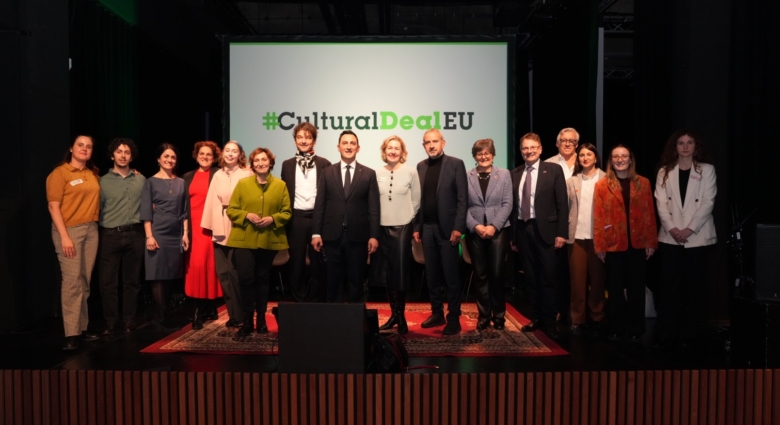
Photo by Chris Marchal
Co-organised by Europa Nostra, Culture Action Europe, and the European Cultural Foundation, the three founding partners of the Cultural Deal for Europe, the event continued the campaign’s call to place culture and heritage at the core of EU policies, to ensure the effective implementation of the Culture Compass for Europe, and to secure adequate and sustainable investment in culture — including the allocation of at least 2% of the EU budget in the next Multiannual Financial Framework (2028-2034).
The Annual Policy Conversation took place at a pivotal moment, as discussions continue to intensify regarding Europe’s future political priorities and budgetary framework. Exchanges throughout the event highlighted the need to move beyond a sectoral approach to culture and to recognise it as a cross-cutting strategic asset contributing to Europe’s democratic values, social cohesion and competitiveness.
The discussions also underlined the importance of cultural and civic spaces, heritage sites, independent media and cultural initiatives as environments that enable participation, dialogue and cooperation, thereby strengthening social cohesion and democratic engagement across Europe.
Glenn Micallef, European Commissioner for Intergenerational Fairness, Youth, Culture and Sport, stressed the importance of ensuring fair working conditions for artists and cultural workers across Europe, underlining that culture must provide sustainable livelihoods in order to thrive. He also addressed the impact of the digital transition and artificial intelligence, highlighting both the challenges and opportunities they present for the cultural sector.
“Culture is extremely vital in times of uncertainty. It is central to our identity, our democracy and the values we uphold in Europe,” stated Commissioner Micallef, emphasising the need to foster innovation and competitiveness while safeguarding artists, cultural diversity and creators’ rights.
This year’s discussion further explored how the Culture Compass for Europe can serve as a strategic framework to strengthen cultural ecosystems, support the cultural sector through ongoing transitions, and ensure that Europe’s cultural landscape remains diverse, representative and resilient.
In her closing remarks, Sneška Quaedvlieg-Mihailović, Secretary General of Europa Nostra, summarised the key message of the Policy Conversation: “Culture is not just a sector, it is a vector. There is no future for Europe without culture”.
She underlined that culture and cultural heritage must be recognised as strategic assets for democracy, social cohesion and resilience, and that they should be fully embedded across EU policies and firmly anchored in the next EU budget.
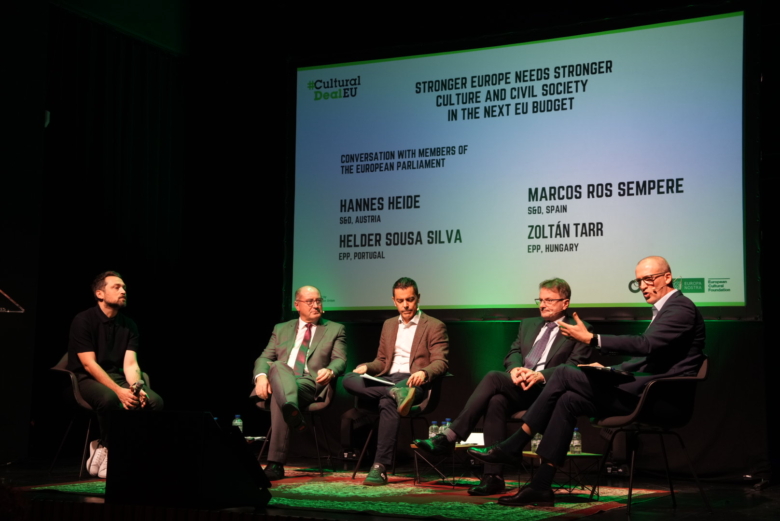
Photo by Chris Marchal
The event also featured contributions from the Members of the European Parliament Nela Riehl (CULT), Helder Sousa Silva (BUDG), Marcos Ros Sempere (REGI), Hannes Heide (CULT) and Zoltán Tarr (CULT), among others.
The 2026 Policy Conversation concluded with a shared commitment to advancing the objectives of the Cultural Deal for Europe and to ensuring that culture and heritage remain at the heart of Europe’s strategic vision.
Europa Nostra’s contribution to this event took place under the framework of the network project Europa Nostra Heritage Agora (2025-2028), co-funded by the Creative Europe Programme of the European Union.