By their very definition, epics are as big as movies get. That size doesn’t necessarily guarantee quality, but there’s undeniable ambition underlying every single epic film ever made. Say what you will about those epics that seem sloppy, overlong, or boring, but you cannot claim that they were easy to make. For all those epics that do fall short of their ambitions, there are also those that do achieve true greatness.
Epics are nothing new in cinemas, and in the last 80 years, there have been absolutely staggering films made on such a grand scale that are the very definition of awe-inspiring. Sweeping dramas, massive war films, and grandiose biopics all have more than a few grand representatives in the last eight decades. While some favorites are undoubtedly going to miss out on a spot on this list, we can still confidently proclaim these ten movies the greatest epics from the last 80 years.
10
‘Dunkirk’ (2017)

War movies are often epics by their very nature. World War II has provided particularly potent inspiration to filmmakers over the last 80 years, and it’s resulted in some truly epic classics. Dunkirk is an overwhelming visual and aural experience, much like Christopher Nolan‘s other epics, of which there are many. Just about any of his larger films would be deserving of a spot here, but there’s something so affecting and effective in how he crafts a cumulative narrative through interlocking stories told over different timeframes.
The film follows the real-life evacuation of Allied forces from the beaches of Dunkirk, in what would later be hailed as a miracle operation. The evacuation is told through three distinct perspectives: land, sea and air. On the land is soldier Tommy (Fionn Whitehead) who experiences the hammering efforts of German bombers over one week. In the sea is a civilian boat captained by Dawson (Mark Rylance) who heads into the fray to assist in the evacuation over one day. In the air is pilot Farrier (Tom Hardy), who engages in a daring dogfight to help the troops on the land in just one hour.
9
‘Malcolm X’ (1992)

Malcolm X represents the most epic film from maverick filmmaker Spike Lee, who brings the volatile life of the civil rights activist to the screen with fiery passion. It’s an exhaustive effort led by a powerhouse performance by Denzel Washington that captures the spirit of its subject in a way that perhaps no other combination of filmmaker and star could.
Chronicling the major events that would shape and define Malcolm’s life and legacy, the film tracks him from his early days of crime and incarceration to his conversion to the Nation of Islam, pilgrimage to Mecca, and rise as a civil rights leader. It’s a life that’s enthralling and fascinating all on its own, but Lee is no lazy filmmaker content with rote re-creation. He uses distinct visual styles to capture the different eras of Malcolm’s life, and maintains as much authenticity as possible, including getting actual location footage from Mecca. The film was, unsurprisingly, marred by controversy from its production through its release, but it’s an absolutely electric epic that does not sugarcoat or simplify the complex legacy of the man it represents.
8
‘Schindler’s List’ (1993)

Steven Spielberg chronicles one of the most horrific chapters in human history while also rendering with respect the effect that one person can have on the lives of many. Schindler’s List was seen by many as a major evolution of Spielberg’s talent, as he poured all of his passion into chronicling the life of Oskar Schindler during the Holocaust as a tribute to his Jewish heritage and a stark reminder of the evils perpetrated against his people.
Schindler (Liam Neeson) is an industrialist and member of the Nazi Party who sees opportunity during the war to make his fortune. It’s only after witnessing the widespread massacre of Polish Jewish citizens during the liquidation of the Kraków Ghetto that he suffers a crisis of conscience and begins a concerted effort to employ as many of the surviving citizens within his factories to save them from the horrors of the concentration camps. Spielberg uses all the skills he developed as a director of pulp entertainment to make the violence and brutality as visceral as possible without becoming exploitative. The director made a movie that thrust the Nazi genocide back into the cultural conversation, and did so with striking emotional devastation.
7
‘There Will Be Blood’ (2007)

Paul Thomas Anderson‘s sweeping tale of American greed and the lust for power, There Will Be Blood, has no complicated morals behind its protagonist. Oil monger Daniel Plainview, played by Daniel Day-Lewis in another Oscar-winning performance, is a villain, a contemptible, manipulative capitalist driven by single-minded ambition who’s also frighteningly compelling. It takes a director of Anderson’s nuance and an actor of Day-Lewis’ ability to make such a vile human being so captivating.
Plainview enters the film as an ambitious silver miner who sees a future in black gold and sets about procuring the land to mine it, which brings him into conflict with the religious Eli Sunday (Paul Dano). Their antagonism against each other forms the narrative spine of the epic film, and Robert Elswit‘s Oscar-winning cinematography captures the barren majesty of the southwestern landscapes. As essential a film as Citizen Kane, There Will Be Blood is a modern epic masterpiece, an uncompromising epic of the American Dream.
.
6
‘The Good, the Bad and the Ugly’ (1966)

Sergio Leone‘s definitive epic Spaghetti Western, The Good, the Bad and the Ugly, is just as concerned with the iconography of America as There Will Be Blood, but presents it through the stylized lens of its genre and the majestic European landscapes that stand in for the American West. It’s beautifully shot, features an iconic musical score and three equally memorable performances as the titular characters.
The Good, the Bad and the Ugly was the crowning achievement for Leone and the Spaghetti Western subgenre he’d helped create, and it set a standard so high that few epic Westerns since have come close to touching it. Clint Eastwood‘s laconic anti-hero (the Good) is joined by Lee Van Cleef (the Bad) and Eli Wallach (the Ugly). With the Civil War waging in the background, the three outlaws compete with one another for a stash of Confederate Gold, with their allegiances in constant flux. It’s a far more grandiose and outright operatic film than Leone’s previous two Westerns, and the director would continue with epics until the end of his career.
5
‘War and Peace’ (1966-1967)

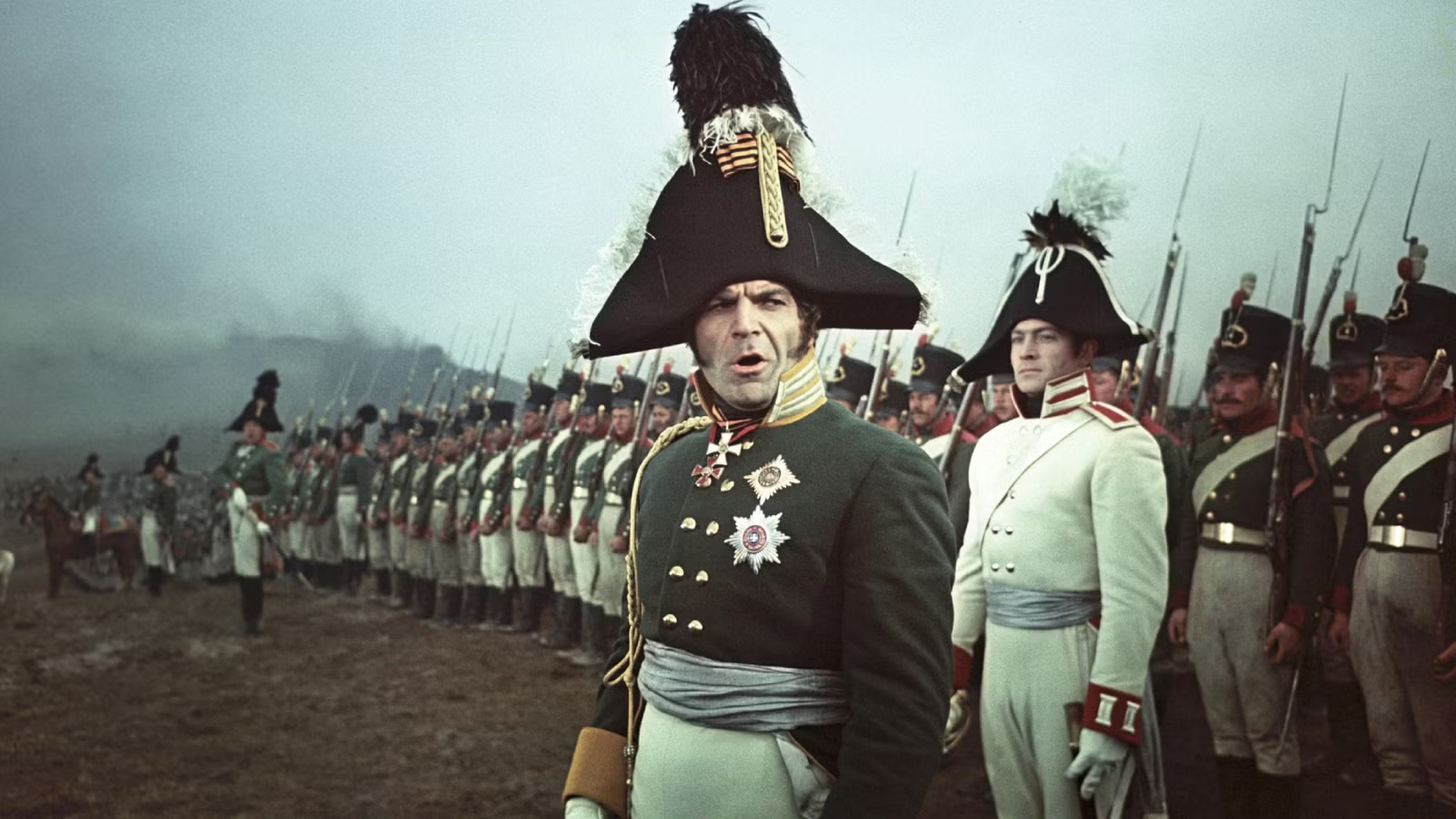
In terms of pure length, Sergei Bondarchuk‘s War and Peace is easily the most epic film on this list. Released in four parts and totaling a combined runtime of 431 minutes, it’s a monumental war epic worthy of the totemic novel by Leo Tolstoy on which it is based. With all four parts shot continuously over almost five years, the film is of a scale that cannot be replicated. Even modern epics which would seem to approach the film’s scope are diminished by their reliance on digital effects.
Set during the Napoleonic Wars, the film concerns the lives of Pierre Bezukhov (Bondarchuk), the illegitimate son of a nobleman; Andrei Bolkonsky (Vyacheslav Tikhonov), a prince and friend of Pierre; and Natasha Rostova (Ludmila Savelyeva), a young countess and the object of both Pierre and Andrei’s affections. The war embattles the characters as they experience love and loss on and off the battlefield in what is a sweeping epic in the truest sense of the word. There are sequences of truly astounding audacity and ambition balanced with moments of intimate emotion.
4
‘The Godfather Part II’ (1974)

The Godfather is a totemic American crime classic that is often in consideration as the greatest film ever made. That’s why it’s not insignificant to state that The Godfather Part II is even better, and certainly more epic. Director Francis Ford Coppola was given complete creative control for this follow-up, and he expanded into a sprawling multi-generational crime saga. It’s more emotionally complex and richly detailed than its predecessor, and together the two make for the most perfect cinematic crime saga.
Serving as both a sequel and a prequel, the film follows young Vito Corleone (Robert De Niro) as he comes to America and builds his empire while his son Michael (Al Pacino) struggles to maintain that empire decades later as the head of the family. The father and son storylines dovetail beautifully together as they chart the rise and fall of an American crime family, and many of the actors give career-best performances. As perfectly composed as the first film but far grander in its ambitions, The Godfather Part II is the perfect sequel that should have been the perfect end to this crime saga.
3
‘2001: A Space Odyssey’ (1968)

Sci-fi epics have come in all forms over the last 80 years. Whether it’s grand visions of dystopian futures in films like Metropolis or Blade Runner 2049, or fantasy adventures in far-off galaxies like Star Wars or Dune. That cosmic grandeur has inspired epics as varied as Interstellar, Solaris and this year’s Project Hail Mary, but they all stand in the shadow of the monolithic 2001: A Space Odyssey.
Stanley Kubrick‘s groundbreaking science fiction film, which he developed with Arthur C. Clarke based on the author’s work, is a testament to humanity’s achievements and potential, but also a dire warning of its hubris and violent nature. It follows humanity from its origins to its next evolution as they evolve, with the assistance of an alien monolith, from apes to spacefaring astronauts. It grapples with themes of artificial intelligence, technological advancement and human evolution. 2001 is the epic sci-fi film by which all other epic sci-fi films are judged, and it’s maintained that status for almost 60 years.
2
‘Lawrence of Arabia’ (1962)

David Lean knows epics. The British-born director helmed some of the most totemic epic films ever made, from The Bridge on the River Kwai to Doctor Zhivago to A Passage to India. He directed with a precision and artistry that influenced just about every other director previously mentioned. His films stand alone in the epic genre, and among them one stands tallest; the epic biographical war drama Lawrence of Arabia, a singular spectacle that has no parallel.
Based on the life and autobiography of T.E. Lawrence, played with steely-eyed star power by Peter O’Toole, the film follows the famous man through his experiences during World War I and the Arab Revolt. Shot on Super Panavision 65mm by Freddie Young in the countries of Jordan, Morocco and Spain, the film is visually stunning in ways that many films can scarcely aspire to. Lawrence of Arabia is possibly the most influential epic film ever made, full stop. It’s the most monumental film from one of the most monumental directors of all time.
1
‘Seven Samurai’ (1954)

How do you rank an epic masterpiece like Akira Kurosawa‘s Seven Samurai against epic masterpieces like Lawrence of Arabia or 2001: A Space Odyssey? You can’t. Films are subjective, and opinions will vary, even among a singular viewer. Today, Kurosawa’s grand, epic action classic takes the top spot, and no one can argue that it doesn’t deserve it. It’s a highly influential, perfectly directed samurai epic from one of the greatest directors of all time.
As much as any film on this list and likely more so, Seven Samurai changed the future of filmmaking. It’s been endlessly referenced, remade, spoofed, homaged and emulated, but no film that follows its path is of equal measure. Setting a template that action films continue to follow, the plot concerns a group of disparate samurai in 16th-century Japan who are hired to protect a village from thieving bandits. The emotional bonds that form between them are what give the film its narrative weight as it leads into the rain-soaked action climax. Kurosawa innovated new ways to shoot and edit action, and the climax is virtuosic.