Usually, any complaints or praise surrounding a cinematic literary adaptation produce the same recommendation: “you should definitely read the book.” It seems to be a commonly accepted fact that, in most cases, a book will always be superior to any movie based on it. Novels have more room for character, world-building, and detail, while films inevitably have to cut something. However, as widely accepted as this belief has become, it’s far from true.
There are plenty of movies based on books that do not simply live up to their source material; they surpass it. Several are even among the greatest films ever made, proving that some stories are simply better suited to the screen than the page. Not every book outdone by its cinematic adaptation is bad, far from it, and several are rightfully considered literary classics. Nevertheless, each found itself surpassed when filmmakers reshaped them for cinema.
Stardust (2007)
Matthew Vaughn Turns Neil Gaiman’s Dark Fairy Tale Into A Much More Satisfying Adventure

Neil Gaiman’s 1999 Stardust novel already felt like it had the foundations for a great fantasy movie almost a decade before it was adapted. Protagonist Tristan Thorn travels beyond the wall separating his English village from the magical realm of Faerie, searching for a fallen star that turns out to be a woman named Yvaine. However, the book is deliberately closer to an old-fashioned fairy tale than a modern fantasy adventure. Its episodic structure and understated ending are certainly intricate, but they make its story feel unimpactful.
Then, 2007, director Matthew Vaughn’s Stardust movie arrived, keeping the novel’s irresistible central idea but giving it considerably more momentum. Tristan (Charlie Cox) and Yvaine (Claire Danes) have a stronger romantic arc, and the already spectacular fantasy elements are woven into a more entertaining adventure. Most importantly, the movie builds toward a genuine climax rather than deliberately undercutting expectations. Gaiman’s version has fairy-tale authenticity, but the Stardust movie turns its source material into something warmer, funnier, and ultimately more satisfying.
Julie & Julia (2009)
Nora Ephron Crafts The Perfect Story That Julie Powell’s Book Was Missing

Julie & Julia has an unusual advantage over most literary adaptations: it does not restrict itself to adapting one book. Julie Powell’s Julie & Julia: 365 Days, 524 Recipes, 1 Tiny Apartment Kitchen, originally a blog, chronicles her attempt to cook every recipe from Julia Child’s Mastering the Art of French Cooking in a year. It is an amusing premise, but Powell’s memoir can become repetitive, and its introspective focus on the author’s personal frustrations means it doesn’t exactly flow or have a cohesive narrative.
Filmmaker Nora Ephron’s inspired solution for the 2009 movie was to combine Powell’s story with material from Child’s posthumously released 2006 memoir My Life in France. Consequently, the struggles of Amy Adams’ Julie are contrasted with the career of Julia Child (Meryl Streep), whose experiences in postwar France show how she discovered French cooking and became an author herself. Streep’s joyful performance is the movie’s biggest weapon, but the parallel structure is equally important. Two relatively modest memoir narratives become one story about ambition and creative fulfillment, giving Julie & Julia dimensions that Powell’s original book simply didn’t contain.
Howl’s Moving Castle (2004)
The Studio Ghibli Treatment Makes Diana Wynne Jones’ Magical World Bigger, Stranger, And More Emotional

Howl’s Moving Castle isn’t a book that needed fixing. The 1986 fantasy novel by Diana Wynne Jones is already funny, clever, and packed with imaginative ideas, while Sophie and Howl’s frequently combative relationship gives its fairy-tale premise a wonderfully unconventional center. However, the increasingly complicated plot can become difficult to untangle, particularly as its curses, family connections, and overlapping schemes begin piling up toward the conclusion. However, when adapting the story in 2004, Hayao Miyazaki didn’t so much streamline Howl’s Moving Castle as transform it into something distinctly his own.
Sophie and Howl remain central to the Howl’s Moving Castle movie, but Studio Ghibli’s film introduces a devastating war occurring around them and turns Howl into someone increasingly consumed by the violence he is trying to resist. The result sacrifices some of Jones’ wit and narrative intricacy, yet gains extraordinary visual storytelling and a stronger emotional throughline. The moving castle itself also becomes an unforgettable mechanical creature with just as much personality as any of the characters. Diana Wynne Jones created a brilliant fantasy, but Hayao Miyazaki made it feel genuinely timeless.
Jaws (1975)
Spielberg Cut The Novel’s Worst Subplots And Left Behind A Perfect Thriller

Steven Spielberg’s Jaws is perhaps the definitive example of improvement through subtraction. Peter Benchley’s 1974 novel supplied the killer-shark premise, Amity Island setting, and central conflict that made the 1975 movie possible. However, it also sinks pages into human melodrama that adds nothing to the core narrative. Most notoriously, Ellen Brody has an affair with Matt Hooper, creating a romantic subplot that makes the novel’s version of the characters considerably less sympathetic for no real reason.
The 1975 movie strips away those distractions to focus on what matters most in Jaws: the big shark. Martin Brody (Roy Scheider), Matt Hooper (Richard Dreyfuss), and Quint (Robert Shaw) become a superbly mismatched trio, while their extended hunt aboard the Orca transforms the second half into a masterclass building tension. Spielberg also makes the titular shark considerably more frightening by only drip-feeding audiences glimpses until the final moments. Benchley’s original novel is an effective but cluttered thriller, and the Jaws movie finds the nailbiting man-vs-nature story hiding inside it by discarding everything but the essentials.
The Godfather (1972)
Coppola Reshaped Mario Puzo’s Sprawling Crime Novel Into A Focused Family Tragedy

There is a reason The Godfather, considered by many to be the greatest movie ever made, feels so much more elegant than the novel that inspired it. Mario Puzo’s 1969 bestseller contains the Corleone saga that Francis Ford Coppola brought to the screen, but it also wanders into lengthy secondary stories that have little bearing on the downfall of Vito or Michael’s transformation into his successor. What’s more, a lot of the book’s more lurid material makes the story feel closer to a sensational crime bestseller than the solemn American crime tragedy the movie eventually became.
Francis Ford Coppola worked directly with Puzo to ruthlessly concentrate that sprawling material for The Godfather movie. Vito Corleone, played to perfection by Marlon Brando, remains the patriarch, but it’s Al Pacino’s Michael who becomes the dramatic center as an initially reluctant outsider gradually embraces his family’s criminal empire. Cinema also gives the story weapons prose cannot replicate: Gordon Willis’ shadow-heavy cinematography, Nino Rota’s score, Pacino’s restrained performance, and Coppola’s famous cross-cutting during the baptism sequence. The Godfather novel created the Corleones, the 1972 movie distilled their story into one of modern fiction’s most powerful crime sagas.
Jurassic Park (1993)
Steven Spielberg Added Heart To Michael Crichton’s Groundbreaking Ideas

Michael Crichton’s Jurassic Park arguably explores its scientific premise more thoroughly than Steven Spielberg’s adaptation. The 1990 novel digs deeply into chaos theory, genetic engineering, corporate negligence, and the inherent unpredictability of complex systems. That intellectual density is one of its greatest strengths, but it can also leave the characters and narrative feeling secondary to the concepts they represent. Crichton’s novel has some amazing ideas, but it took Spielberg’s vision to make audiences emotionally invest in them.
Steven Spielberg makes many improvements to Jurassic Park’s story, and perhaps the biggest is the reworked personality of Alan Grant (Sam Neill). The 1993 movie gives the initially child-averse paleontologist some simple but effective character growth through his relationship with Lex (Ariana Richards) and Tim (Joseph Mazzello). Not only does this make Grant more compelling, but it also adds an important emotional throughline to a story previously built exclusively from hard science and prehistoric terror. Combined with groundbreaking visual effects and Spielberg’s immaculate suspense, the changes make the Jurassic Park movie more emotionally satisfying than its source material.
Forrest Gump (1994)
Director Robert Zemeckis Finds Genuine Heart Inside A Cynical And Chaotic Novel

Anyone approaching Winston Groom’s 1986 Forrest Gump novel after seeing the 1994 movie may be surprised by just how different the two versions are. The book’s Forrest is more abrasive and its humor considerably more absurd, sending him through an increasingly ridiculous series of adventures that include professional wrestling, Hollywood, and even space travel. What’s more, the episodic structure makes the book’s narrative feel closer to an outrageous satirical picaresque than the sweeping emotional journey audiences associate with Tom Hanks’ lovable childlike witness to the key events of the 20th century.
When reshaping the story for the big screen, Forrest Gump director Robert Zemeckis kept the clever narrative device of Forrest repeatedly stumbling into major moments of American history, but grounded those encounters in his relationships. His devotion to Jenny (Robin Wright), friendship with Bubba (Mykelti Williamson), and complicated bond with Lieutenant Dan (Gary Sinise) give the story an emotional core that the novel lacks. Tom Hanks’ performance also softens Forrest without turning him into a joke. The film takes the same basic character of the novel but turns him into the center of an unexpectedly moving decades-spanning adventure.
Fight Club (1999)
David Fincher Makes Tyler Durden’s Philosophy More Seductive, And Its Consequences More Powerful

Chuck Palahniuk’s 1996 novel Fight Club was already provocative and stylistically distinctive before David Fincher adapted it in 1999. However, for all its status-quo challenging thematic brilliance, the novel’s deliberate abrasiveness and clipped prose structure can create emotional distance. Its ideas frequently matter more than its characters, while the intentionally disorienting writing styles makes the Narrator’s deteriorating psychological state fascinating but often at the expense of accessibility.
Rather than trying to rectify this, David Fincher embraced that instability while significantly improving the characters caught within it. The Narrator (Edward Norton) becomes an ideal exhausted everyman, while Tyler Durden is brought to life by Brad Pitt with exactly the kind of charisma necessary for his destructive worldview to seem dangerously attractive. Most significantly, the movie’s altered ending gives the story an astonishing visual payoff as buildings collapse to the Pixies’ “Where Is My Mind?” The ending is one of the most iconic things about Fight Club, and the fact it was created for the film speaks volumes about which version is better.
The Shawshank Redemption (1994)
Frank Darabont Expands A Great Stephen King Novella Into The Definitive On-Screen Exploration Of Hope

The 1982 novella Rita Hayworth and Shawshank Redemption is one of Stpehn King’s strongest non-horror stories, so Frank Darabont’s 1994 movie is hardly a case of crafting a strong film from weak source material. The original story already covered Andy Dufresne’s imprisonment, friendship with Red, secret escape, and the unforgettable promise of Zihuatanejo. Its shorter length, however, means decades pass relatively quickly, with characters and events sometimes serving as brief stops along Andy’s long journey through Shawshank State Penitentiary. The genius of the movie is that it gives that journey the breathing room it needs.
Thanks to the Shawshank Redemption movie creating a better sense of the passage of time, Andy (Tim Robbins) and Red (Morgan Freeman) develop a friendship that feels authentically like that of two men who’ve spent years together behind bars. What’s more, supporting figures gain expanded roles that become essential for demonstrating what institutionalization does to prisoners. Darabont also creates one of cinema’s most cathartic endings by showing Red reunite with Andy rather than leaving their meeting as a hopeful possibility. Essentially, Darabont’s Shawshank Redemption turns a compact story into an expansive theatrical exploration of friendship, freedom, and hope.
The Lord Of The Rings Trilogy (2001-2003)
Peter Jackson’s Trilogy Streamlines Tolkien’s Epic Without Losing What Makes It Special

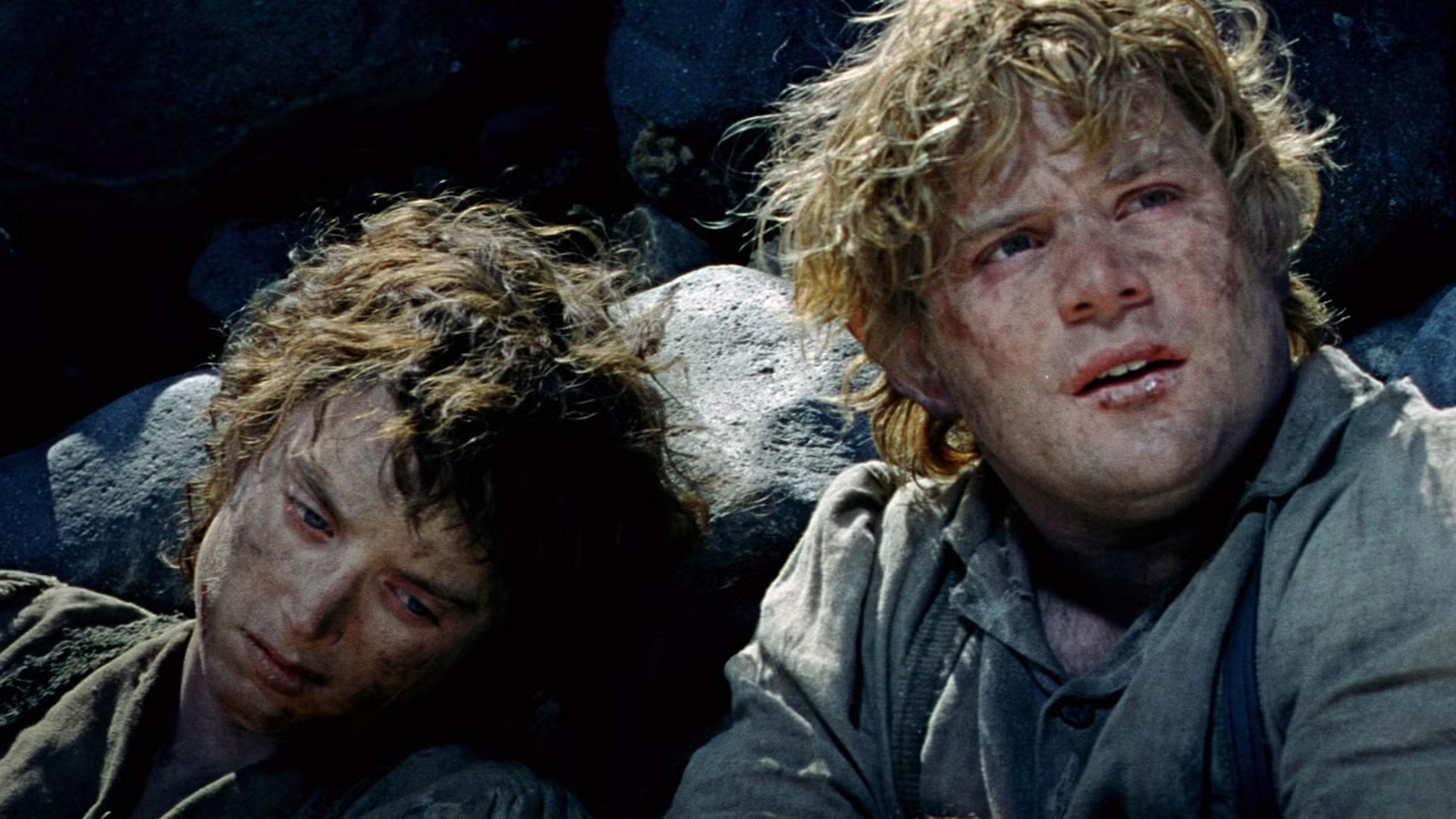
Calling J.R.R. Tolkien’s The Lord of the Rings flawed almost feels sacrilegious considering how influential it is to modern fantasy. However, Tolkien was building an entire mythology rather than constructing a tightly paced adventure. His enormous attention to lore and worldbuilding gives Middle-earth unparalleled depth, but it can also slow the narrative dramatically when, for example, he spends paragraphs describing a tree or history of an unimportant character. In the simplest terms, reading Lord of the Rings often takes much more effort than many anticipate.
This is why Peter Jackson’s The Lord of the Rings trilogy is such an achievement as a literary adaptation. It cuts through the noise while preserving the soul of the definitive fantasy saga of the modern age. The Fellowship’s individual journeys are hammered into clear cinematic arcs, while battles Tolkien describes surprisingly briefly become enormous dramatic set pieces. Peter Jackson created a far more accessible version of Tolkien’s story, and it’s hard to argue that experiencing it by navigating Tolkien’s prose is as satisfying as watching the movies.