In spite of a short and somewhat erratic career, producer and studio executive Robert Evans defined himself as one of the leading figures in Hollywood. His career was marked by brief, bright periods. It may never have happened at all if not for the fact that, while on a business trip selling women’s apparel, he was scouted by none other than Oscar winner Norma Shearer. This kicked off an acting career in 1952. He transitioned into producing in 1962, rocketing up the ranks so fast that he was the head of Paramount Pictures by 1967.
While he left Paramount just seven years later and had his career stall because of a cocaine trafficking conviction six years after that, during his short time as an executive and producer, he managed to bring quite a few iconic classics to the screen. These five titles in particular are the leading reasons he can be considered one of Hollywood’s greatest producers.
Rosemary’s Baby (1968)
Just five movies into his early tenure at Paramount (during which time he had already ushered The Odd Couple and Franco Zeffirelli’s Romeo and Juliet to the screen), Robert Evans oversaw the iconic horror title Rosemary’s Baby. The movie was an adaptation of the Ira Levin best-seller of the same name, directed by Roman Polanski, following a woman (Mia Farrow) who begins to suspect that her unborn child is the son of Satan after she and her husband (John Cassavetes) move to a new apartment complex.
1968 was a watershed year for the horror genre thanks to two major titles, both of which had deeper subtext, respectively addressing the racial and gender-based conflicts of modern America. The first was George A. Romero’s Night of the Living Dead, a violent indie production that pushed the envelope more than any other American horror hit before it, laying the groundwork for more taboo-busting horror to follow. The other was Rosemary’s Baby, which proved beyond all doubt that elegant, big-budget horror can simultaneously be respected by the cinematic establishment and tremendously effective at scaring the pants off of audiences nationwide. Along with Living Dead, it helped carve a path for auteurist horror cinema that directly led to the development of everything from The Blair Witch Project to It Follows to Backrooms. Not bad for an executive who was just starting out!
Fun Fact: As a producer, Evans had the habit of working with the same creatives time and again. This includes Ira Levin, who wrote the novel that was adapted into the Evans-produced movie Sliver in 1993.
Love Story (1970)
The second of six Best Picture nominees that Robert Evans had a hand in (after Romeo and Juliet) was 1970’s Love Story, a romantic drama starring Ali MacGraw and Ryan O’Neal that was No. 1 at the box office for 15 nonconsecutive weeks, became the highest-grossing movie of 1971, and was nominated for seven Oscars, winning one (Best Original Score).
The movie, which followed the doomed love between upper-class and lower-class Harvard students, helped pave the way for more hugely successful tragic Hollywood romances, including A Walk to Remember and James Cameron’s Best Picture winner Titanic.
Fun Fact: Robert Evans reteamed with Ryan O’Neal for the 1973 Peter Bogdanovich movie Paper Moon, which won an Oscar for the star’s 10-year-old daughter Tatum O’Neal, making her the youngest-ever Oscar winner in a competitive category.
Harold and Maude (1971)
Because it was a critical and commercial flop at the time, Harold and Maude might seem like an odd movie out on this list. However, the offbeat title – which follows a death-obsessed young man (Bud Cort) who falls for a 79-year-old woman (Ruth Gordon – who won an Oscar for playing nosy neighbor Minnie Castevet in Rosemary’s Baby) – is one of the most influential titles that Robert Evans ever brought to cinemas.
The offbeat Hal Ashby movie eventually developed into a cult favorite, turning a profit 12 years after its original release and continuing to grow into a respected classic from there. Its unusual, boundary-pushing story proved to be a huge inspiration for many of modern cinema’s most notable filmmakers and actors, including Alexander Payne (who programmed it as part of screening series for the production team behind The Holdovers to help inspire them when creating their period setting), Judd Apatow (who named his daughter after Maude), Cameron Crowe (who calls it “the greatest capsulized story”), and Jason Schwartzman (who had it on loop for inspiration while making Rushmore).
The Godfather (1972)
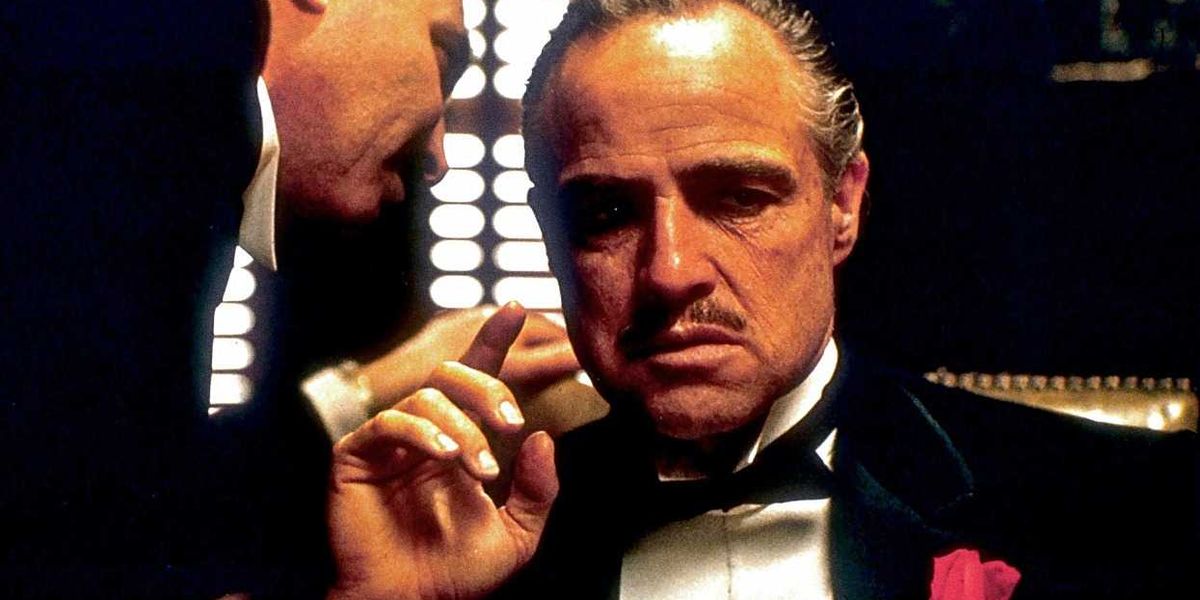
The crown jewel of Robert Evans’ filmography is also his first of his two Best Picture winners: the 1972 Mario Puzo adaptation The Godfather, which was directed and co-written by Francis Ford Coppola. The movie, which followed a mafioso’s (Marlon Brando) son (Al Pacino) finding himself drawn deeper and deeper into the crime family, put Love Story to shame with 26 nonconsecutive weeks at No. 1. Naturally, it was the highest-grossing movie of 1972 (it earned more than triple the domestic gross of the No. 2 title, Fiddler on the Roof).
The Godfather is widely regarded to be one of the greatest films of all time, landing at No. 2 on AFI’s Top 100 list, No. 2 on the IMDb Top 250, and No. 12 on the latest Sight & Sound poll.
Fun Fact: Robert Evans worked with Francis Ford Coppola over and over again, whether Coppola was directing (The Conversation, The Godfather Part II, The Cotton Club) or writing (1974’s The Great Gatsby).
Chinatown (1974)
The first movie produced by Robert Evans when he left Paramount proved that his string of massively influential movies was no fluke. That would be the 1974 Roman Polanski title Chinatown, which stars Jack Nicholson as a detective whose seemingly simple infidelity case leads him to uncover a dangerous Los Angeles conspiracy.
Chinatown is another influential, incontestable classic, earning the most Oscar nominations out of any movie from that year. While it was also one of the last major movies produced by Evans before his career took a downturn, it cemented his status as one of the leading lights of cinema of the 1960s and 1970s.
No Film School contains articles about a plethora of runner-up Robert Evans titles that did not make the list, including 1969’s The Italian Job and True Grit, 1973’s Serpico, and 1974’s The Conversation and The Godfather Part II.