Canada’s main stock index opened higher on Wednesday with broad-based gains after U.S. President Donald Trump said he would extend the Iran ceasefire indefinitely, even as Tehran’s seizure of two ships in the Strait of Hormuz kept investors cautious.
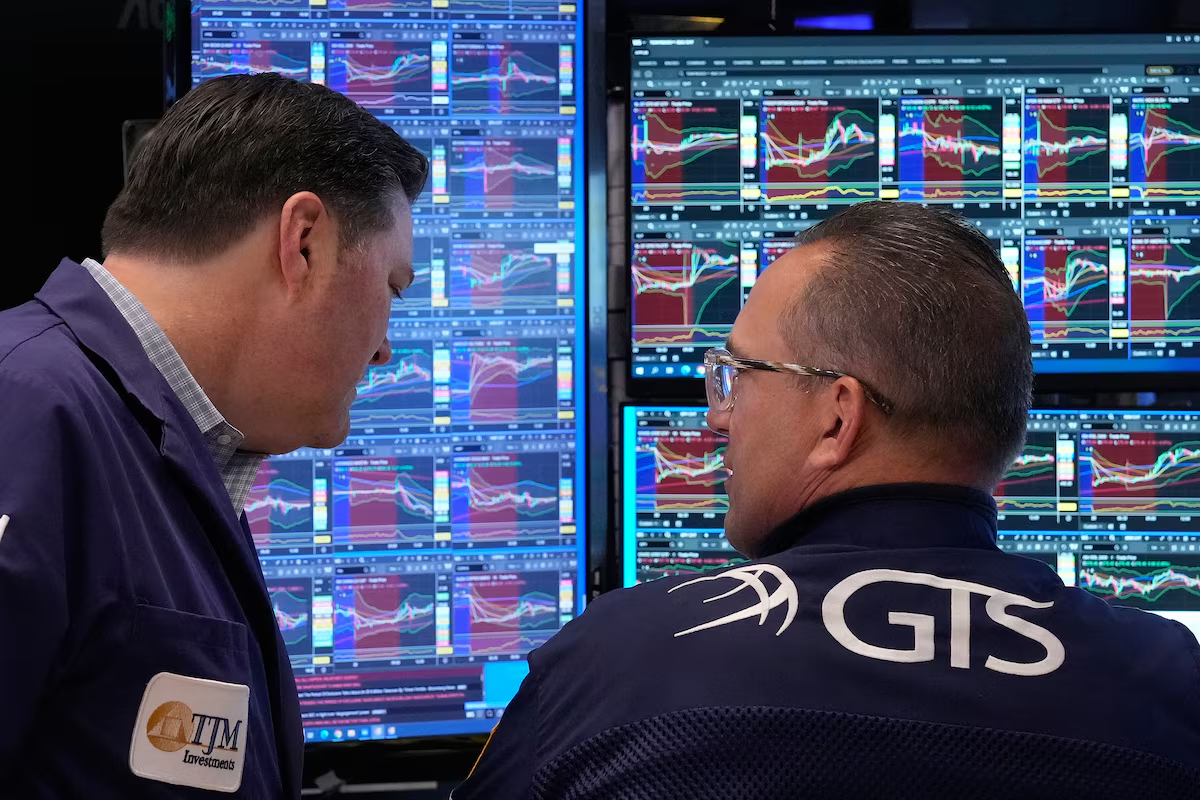
At 12:12 p.m. ET, the Toronto Stock Exchange’s S&P/TSX Composite Index was up 127.95 points, or 0.37 per cent, at 33,935.89.
Iran’s semi-official Tasnim news agency said the Revolutionary Guards had seized two vessels for maritime violations and escorted them to Iranian shores. It was the first time Iran has seized ships since the war began at the end of February.
Energy shares rose 0.7 per cent, mirroring higher oil prices amid supply concerns.
There’s tentative optimism among investors, but the oil market is trading as though the ceasefire is fragile, said Brian Madden, chief investment officer at First Avenue Investment Counsel.
The overall market will likely focus on corporate earnings in the next couple of weeks as the initial shock of the war is over, he said.
The U.S. stock market is rising toward more records Wednesday after GE Vernova, Boston Scientific and other big companies joined the list of those reporting fatter profits for the start of the year than analysts expected. But caution is still hanging over Wall Street, and oil prices are also rising on uncertainty about what will happen in the war with Iran.
The S&P 500 climbed 0.8 per cent and was on track to top its all-time high set on Friday. The Dow Jones Industrial Average was up 312 points, or 0.6 per cent and the Nasdaq composite was also heading for a record with a jump of 1.2 per cent.
GE Vernova flew 12.2 per cent higher after the company, whose products help generate about a quarter of the world’s electricity, reported profit for the first three months of the year that blew past analysts’ expectations.
Much like the broader stock market, GE Vernova is benefiting from the rise of artificial-intelligence technology, and its electrification business booked more equipment orders for data centers during the quarter, US$2.4-billion, than it did during all of last year. The company also raised its forecasts for revenue and other financial measures over the full year.
The vast majority of companies in the S&P 500 have so far been delivering results for the start of 2026 that have topped analysts’ expectations, even with the war in Iran driving up oil prices and uncertainty for the global economy. Such strong performances have helped the S&P 500 power higher, and the index is on track for a 13th gain in its last 16 days.
Boston Scientific rallied 8.9 per cent, Boeing climbed 7 per cent, and Philip Morris International rose 5.1 per cent after likewise delivering results for the latest quarter that were stronger than analysts expected.
Still, another rise in oil prices helped keep enthusiasm in check on Wall Street. The price for a barrel of Brent crude oil, the international standard, added 3.4 per cent to US$101.86 on uncertainty about when the war with Iran could let up and allow petroleum to flow freely to customers from the Persian Gulf again.
The war has restricted traffic through the Strait of Hormuz, the narrow waterway off Iran’s coast that oil tankers typically use to exit the Persian Gulf. Iran fired on three ships in the strait and seized two of them on Wednesday.
A day earlier, U.S. President Donald Trump extended a ceasefire but also said he was maintaining an American blockade of Iranian ports. The blockade keeps Iran from making money by selling its own crude oil.
The standoff over Iran’s closure of the strait and the U.S. blockade raised doubts about when or if talks would resume to end the crisis.
Brent crude has shot up from roughly $70 per barrel since before the war on worries about a long-term disruption to the flow of oil. But moves in both the oil and stock markets have become much more modest in recent weeks, following vicious swings where Brent’s price briefly topped US$119 and the S&P 500 dropped nearly 10 per cent below its prior all-time high.
On the losing end of Wall Street Wednesday was Best Buy, which fell 4.6 per cent after the electronics retailer announced the departure of CEO Corie Barry. She will be replaced by longtime insider Jason Bonfig, the company’s chief customer, product and fulfillment officer.
In stock markets abroad, indexes dipped in Europe following a mixed finish in Asia. Japan’s Nikkei 225 rose 0.4 per cent, while Hong Kong’s Hang Seng fell 1.2 per cent.
In the bond market, Treasury yields eased despite the gain in oil prices. The yield on the 10-year Treasury edged down to 4.29 per cent from 4.30 per cent late Tuesday.
That gave back some of its gain from the prior day, when Trump’s nominee to chair the Federal Reserve, Kevin Warsh, said he never promised Trump he would cut interest rates even though Trump has been angrily calling for lower rates.
Reuters and The Associated Press