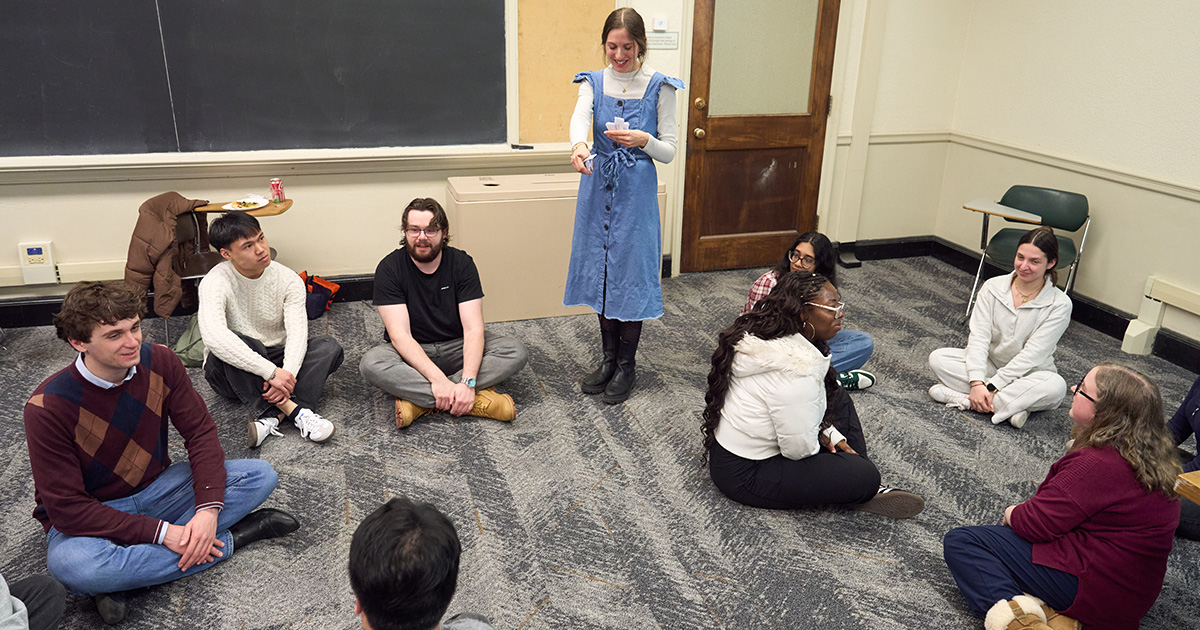
Steam rose from bowls of homemade soup as students settled into
their seats in the Moynihan Institute of Global Affairs. A presentation on
winter traditions in Turkey sparked conversation, drawing murmurs of
recognition and a few nostalgic smiles.
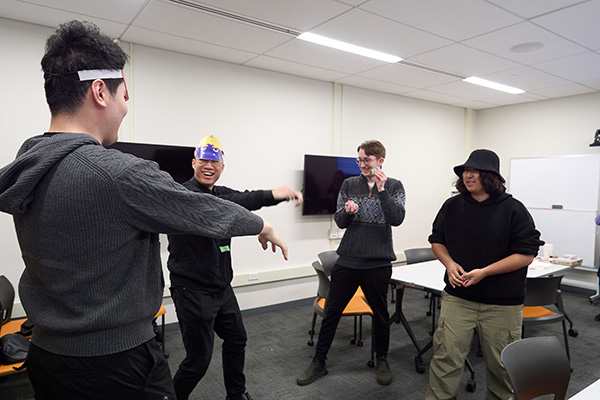
When the slideshow ended, attendees gathered in small groups for
a matching game connecting landmarks, customs and historical moments. Those
more familiar with the traditions offered hints while others brought fresh
curiosity to each pairing.
For an hour, Syracuse felt a little closer to Istanbul.
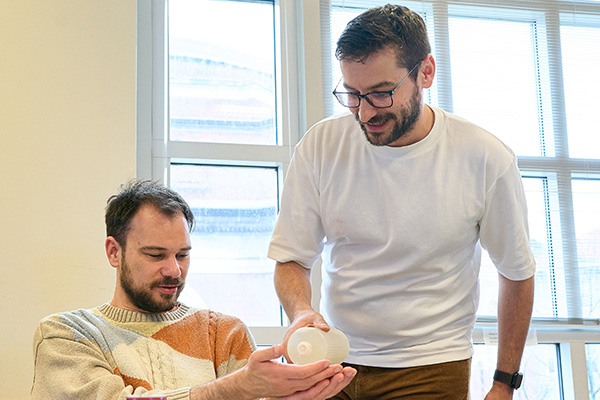
The gathering was part of the Maxwell School’s Culture and
Conversation Tables, a series hosted by the Moynihan Institute that brings
students and community members together to explore languages and cultures from
around the world. Held about once a month, each table takes a slightly
different approach, from language-intensive practice sessions to film
screenings and themed cultural presentations. All serve a shared purpose:
building community while advancing Maxwell’s mission of exposing students to a
wide range of perspectives and preparing them for an increasingly
interconnected world.
Moynihan is home to Maxwell’s seven regional centers, focused on
Latin America and the Caribbean, Europe, the Middle East, Africa, East Asia,
Central Asia and the Caucasus, and South Asia. Located on the third floor of
Eggers Hall, the institute supports teaching, research and programming that
prepares students to engage with the world’s most pressing challenges. The
Culture and Conversation Tables are a natural extension of that work.
“The
tables are one of the most accessible ways we connect students to the world
beyond the classroom,” said Brian Taylor, director of Moynihan and professor of
political science. “Whether
someone is preparing for fieldwork abroad, practicing a language they’re
studying or simply curious about a part of the world they haven’t encountered
before, these gatherings offer something genuinely valuable.”
Much of the tables’ day-to-day coordination falls to George
Tsaoussis Carter, event specialist, and Matthew Baxter, regional programs
manager for Asia. “What
stands out most is the enthusiasm students bring to these tables, both the ones
who help organize them and the ones who show up to learn,” says Baxter. “They leave with more
than vocabulary or cultural trivia. They gain a broader sense of the world and
a genuine connection to people from very different backgrounds.”
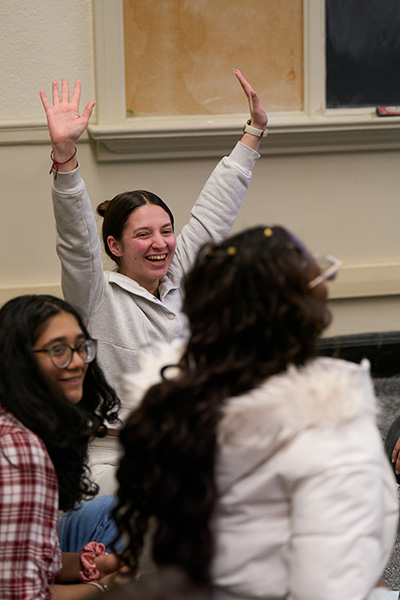
Baxter is also impressed by the care and commitment of table
hosts, which, on the Asia side, include faculty such as Darwin Tsen, Kenji Oda
and Tomoko Walker from the College of Arts and Sciences, as well as graduate
students and, on occasion, highly motivated undergraduates.
Originally known as Language Tables, the program was renamed to
reflect its broader emphasis on culture, conversation and connection, according
to Juanita Horan, associate director of the Moynihan Institute.
Over the years, the institute has hosted tables in more than 20
languages, many supported by U.S. Department of Education grants aimed at
strengthening international and language education. Currently, 16 tables are
offered, spanning languages from Arabic and Hindi-Urdu to Chinese, French and
Tamil.
The tables have at times reflected the urgency of world events.
For instance, visiting scholar Tatiana Hranchak hosted a Ukrainian table that
drew strong attendance from students across the University, some directly
impacted by the war with Russia. Hranchak, who fled her home in Kyiv after the
invasion, joined the Maxwell community through the Scholars at Risk program,
which supports academics displaced by conflict and persecution.
The tables also give international students a place to hear
their native language and share traditions from home. Open to all Syracuse
University students, not just those in Maxwell programs, the tables invite
anyone across campus to engage with new regions, customs and perspectives.
“The
tables definitely build a community and they inspire curiosity in those who
want to learn more—and also help people get together and spend some good time,”
said Atilla Kocabalcioglu, a
Fulbright foreign language teaching assistant who leads the Turkish table.
Kocabalcioglu organizes each session around a theme. The topic
in January was “cozy
winter.”
“The tables are one of the most accessible ways we connect students to the world beyond the classroom. Whether someone is preparing for fieldwork abroad, practicing a language they’re studying or simply curious about a part of the world they haven’t encountered before, these gatherings offer something genuinely valuable.”
Brian Taylor
director of Moynihan and professor of political science
The gathering drew students and staff from a range of academic programs and cultural backgrounds. Some were native speakers. Others had family ties to Turkey or were encountering the culture for the first time.
Dilara Sakici, a first-year political science student from Laguna Niguel, California, grew up with a Turkish father and an American mother. She said the table offers a way to reconnect with parts of her heritage while also learning something new.
“Even just looking around right now, there’s a bunch of different people—it’s not just Turkish people,” Sakici said. “I think it’s cool to spread cultures, especially for the languages that we offer here at the school, so then people can learn about programs and get involved.”
For Walid Ibrahim, a junior international relations major from Atlanta, attending the Turkish table was an opportunity to expand his global perspective beyond the classroom.
“I like to learn more about different countries, especially as an international relations major, and Turkish culture is not one that I’ve really been exposed to,” Ibrahim said. “I wish to learn more about it.”
He added that the informal setting has practical benefits for students preparing for international careers.
“It’s a great way for certain people to be exposed to different cultures they wouldn’t otherwise be able to explore,” he said. “And also, for people to learn some phrases of another language that may come in useful one day.”
Other tables take different approaches. The Arabic and Persian tables recently screened films to spark conversations about language, history and contemporary issues in the Middle East, while the Hindi-Urdu table emphasized cultural discussion. The Russian table is known for its language-intensive structure, offering students space to practice grammar and conversation in preparation for study or research abroad.
Michael Vargo, a graduate student in international relations from Pittsburgh, said he attends as many tables as he can.
“It’s just for many people to get together and learn culture and language, because there’s always a good mix of native speakers and people who don’t know anything about it,” said Vargo, who attended the Arabic table. “We’re all building up our own knowledge of different regions around the world.”
From film screenings to language activities, the Culture and Conversation Tables bring the world into Eggers Hall. For Maxwell students preparing for careers that cross borders, those conversations carry meaning well beyond a single afternoon.
“Now, when they meet with other Turkish people, they will say, ‘Oh, yeah, I know you do this,’ or they will want to learn more about the language and the culture,” Kocabalcioglu said.