Throughout history, Scandinavia has provided the world with some of the greatest films and filmmakers that Europe has ever offered. The region is typically defined to consist of Norway, Sweden, and Denmark, but some authors also consider Iceland and Finland as part of the area. Thus, we have five countries whose extraordinary filmographies have defined how Northern Europe approaches cinema for decades.
Auteurs like Ingmar Bergman and Thomas Vinterberg have influenced countless artists throughout not just Scandinavia, but the rest of the world as well. From aesthetic minimalism to dark and melancholic atmospheres, there are certain qualities that generally describe the region’s cinematic output, but the truth is that every country and each master filmmaker has a vastly different voice, and that’s what makes examining Scandinavia’s greatest films so interesting.
10
‘Godland’ (2022)

Throughout the 2020s, Scandinavia has offered some of the greatest European films of modern times. Case in point: Godland. Set at the end of the 19th century, this Icelandic-Danish co-production follows a young Danish priest who’s sent to a remote part of Iceland where he begins to lose his sense of reality, his mission, and his duty to God.
Studying themes like the destructive nature of colonialism’s legacy and the collision of cultures, Godland takes a near-overwhelming dark approach to its meditation on mortality. With a vast scope and some jaw-dropping direction by Hlynur Pálmason, this gem is one of the most poignant and profoundly immersive dramas that the decade has offered thus far.
9
‘Fallen Leaves’ (2023)

There’s really no debate about it: The immensely acclaimed Aki Kaurismäki is easily and by far the most celebrated and famous filmmaker in Finland’s history. He has been making movies since the early ’80s, and like any of the greats, he’s still producing some of the strongest work of his career today. No more proof should be needed than his latest outing, Fallen Leaves, a rom-com about two lonely souls in search of love who meet by chance in a karaoke bar.
Those expecting a simple romantic comedy are clearly not familiar enough with Scandinavian cinema. With a cold, overwhelmingly urban atmosphere, Fallen Leaves explores the redemptive power of love and cinema in a way that makes both seem like essential tools for survival in today’s world. The story is simple enough, but the warmth and emotion that it exudes are something truly remarkable.
8
‘Sentimental Value’ (2025)

There have only ever been 18 international movies nominated for the Best Picture Oscar. One of the latest is the Norwegian-Danish-Swedish co-production Sentimental Value. Directed by Joachim Trier, one of the most acclaimed Norwegian filmmakers working today, this psychological drama follows a pair of sisters who reunite with their estranged father, a once-renowned movie director who offers one of the sisters a role in what he hopes will be his comeback film.
Emotionally stirring and thematically complex, Sentimental Value is a gorgeously nuanced and layered analysis of how family legacies shape generations. Led by four transcendentally powerful and Oscar-nominated performances by Renate Reinsve, Stellan Skarsgård, Inga Ibsdotter Lilleaas, and Elle Fanning, Sentimental Value is a beautifully mature and complicated character study that proves Scandinavian cinema is still as vibrant as ever in the 2020s.
7
‘The Emigrants’ (1971)

Starring Max von Sydow and Liv Ullmann, two of the most acclaimed actors in the history of European cinema, The Emigrants is one of the most realistic cinematic epics ever made. Directed by Jan Troell, this Swedish masterpiece follows a 1840s Swedish farming family as they struggle on their journey to new hope in the United States. It was nominated for a Best Foreign Language Film Academy Award at the 1972 Oscars and then another four awards (including Best Picture) at the 1973 Oscars, making it one of the very few films to ever receive Oscar nods in different years.
The film is a slow-burn in its truest form, but those with the patience for a deliberately-paced 3-hour-long historical epic will be treated to one of the most defining cinematic masterpieces ever made about the American Dream. Incredibly well-acted and gorgeously shot by Troell at his best, The Emigrants is a beautifully lyrical and profoundly moving love letter to immigration.
6
‘Ordet’ (1955)

Ordet is one of those classic 1950s movies that’ll never get old, a Danish drama about a devout family wrestling with their inner demons while negotiating conflict with each other and the rest of their town. It was directed by Carl Theodor Dreyer, and although history has come to recognize him as arguably the greatest Danish filmmaker in history, Ordet was actually the only movie he ever made that was both a critical and financial success.
With a well-deserved 100% score on Rotten Tomatoes, Ordet is far and away one of the most intelligent and powerful movies ever made about religion. Masterfully blending aesthetic austerity with a profound sense of spirituality and an absolutely unforgettable climax, Dreyer’s masterpiece is a slow-paced arthouse gem that deserves far more praise from regular audiences nowadays.
5
‘The Hunt’ (2012)

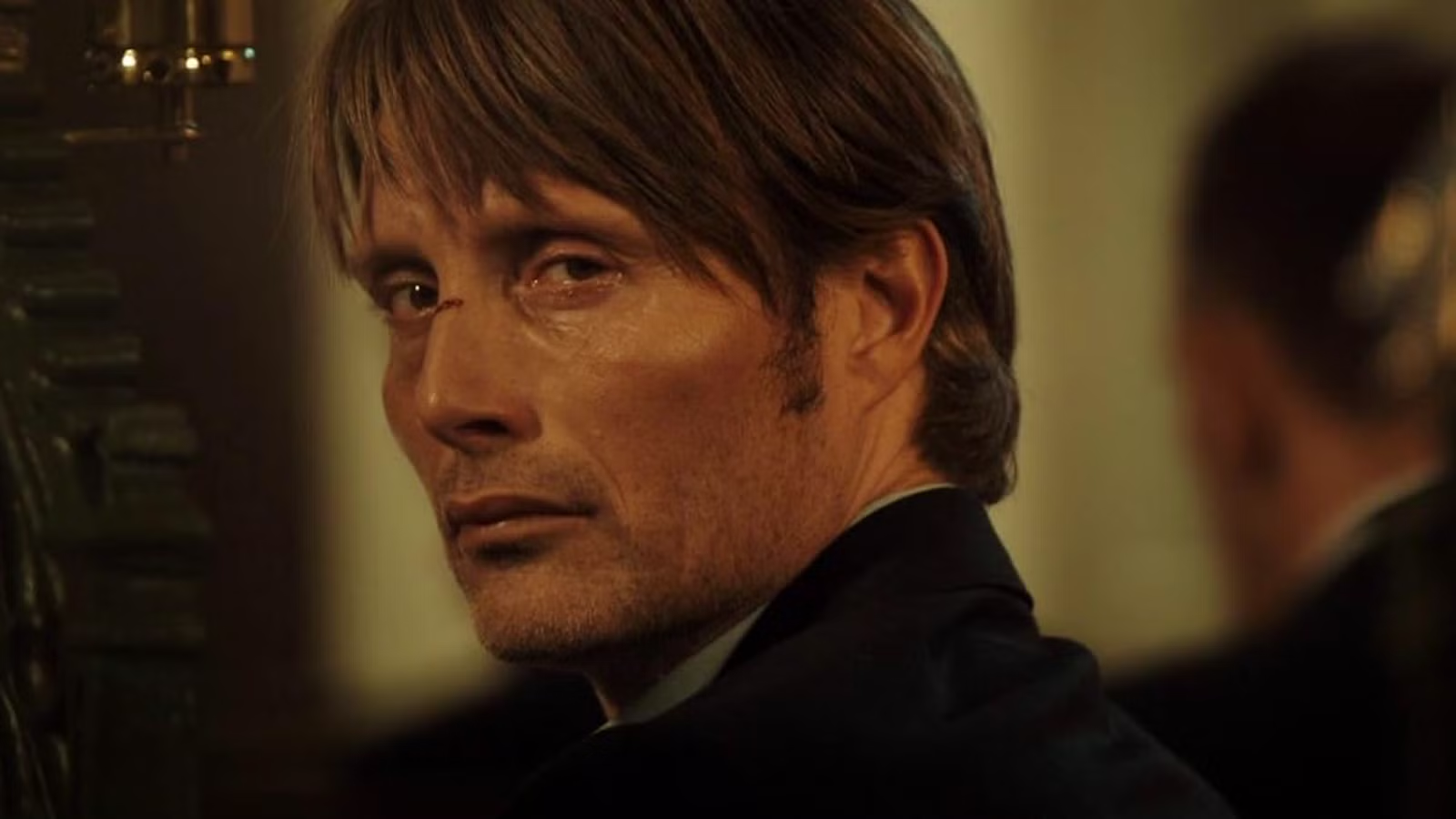
Nordic noir is a genre unto itself, a bleak and moody version of noir telling uniquely Scandinavian stories. The greatest Nordic noir movie of all time is arguably Thomas Vinterberg’s The Hunt, starring Mads Mikkelsen as a teacher leading a lonely life, which is turned upside down after an innocent little lie begins to shatter his world. This Danish masterpiece is a must-see for a number of reasons, not least of which is the fact that Mikkelsen delivers one of the strongest dramatic performances of the 21st century so far.
The Hunt brings up vital questions about masculinity, mob mentality, and collective hysteria.
The way Vinterberg carefully and harrowingly dismantles the fragility of community trust brings up vital questions about masculinity, mob mentality, and collective hysteria. As unflinching as it is psychologically intense in the way it exploits the dramatic juice at the heart of its story, The Hunt feels like it slowly builds up to one of the most emotionally complex and explosive third acts of any Scandinavian movie in history. If only to see what all the Thomas Vinterberg hype is about, it should be considered essential viewing.
4
‘Drifting Clouds’ (1996)

As great as Aki Kaurismäki’s modern output is, it’s his 20th-century work that remains his most exciting—in no small measure because that’s when he released his magnum opus, Drifting Clouds. This dramedy follows a Helsinki couple who lose their jobs during a recession, facing hardship and humiliation in their quest for survival. For those looking to get into Kaurismäki and Finnish cinema as a whole, this one is a fantastic introduction.
Drifting Clouds is definitely bleak, and it never pretends otherwise, but there’s also a glimmer of hope in how it executes its narrative, which is hard to resist. Surprisingly colorful and vibrant, considering how much minimalism has come to define its director’s style, the film finds power in both the neorealist drama and deadpan comedy of its premise. Though melancholic, Drifting Clouds is the kind of film that manages to be life-affirming despite its dark tone.
3
‘Edvard Munch’ (1974)

TV movies are undeniably cinema, too; any other kind of perspective on these unique movies would not only not make any sense, but also leave us without masterpieces like Peter Watkins‘ Edvard Munch. One of the best made-for-TV movies ever, this Norwegian-Swedish period epic (originally conceived as a two-part miniseries) is a biopic about the titular Norwegian Expressionist painter, best known for his 1893 work “The Scream.”
Here we have another movie fully deserving of its 100% Tomatometer score on Rotten Tomatoes, truly one of the greatest biopic dramas of the 20th century. Many films in this genre end up feeling like a Wikipedia article come to life, but not Edvard Munch. Instead, over its three-and-a-half-hour runtime, this masterpiece drills admirably deeply into the mind of its subject and the essence of his work. It’s a sensual, vast character study that doesn’t waste a single minute of its runtime.
2
‘The Seventh Seal’ (1957)

When the conversation is about Scandinavian cinema, it must always include the man who’s not only the greatest Scandinavian filmmaker of all time, but also one of the best movie directors ever in general: Swedish auteur Ingmar Bergman, whose The Seventh Seal is widely recognized as one of the most perfect fantasy movies of the 20th century. Starring Max von Sydow, a common collaborator of Bergman’s, it’s a psychological drama about a knight returning to Sweden after the Crusades, who seeks answers about the world as he plays a game of chess against the Grim Reaper.
Bergman addressed the theme of religion and God’s silence in the modern world across a significant number of his films, but never quite as successfully as in The Seventh Seal, which is easily one of his most powerful movies. Visually striking, symbolically potent, methodically paced, and wonderfully written and directed, The Seventh Seal is one of the highest peaks that European cinema has ever reached.
1
‘Persona’ (1966)

While The Seventh Seal may be Bergman’s most iconic and acclaimed film, his best is arguably Persona. Starring another two of Bergman’s frequent collaborators, Liv Ullmann and Bibi Andersson, this avant-garde psychological drama/thriller follows a nurse who’s put in charge of a mute actress and finds that their personae are melding together. It’s one of Bergman’s most potently surreal movies, anchored by Ullmann and Andersson’s tremendous work as co-leads.
Dealing with themes of identity, duality, gender, and sexuality, Persona leads up to one of the best endings of any international thriller. The way in which Bergman explores the human condition here is as thought-provoking as it is permeated with artistic merit, resulting in a film that some may argue is the best in the history of arthouse cinema. At the very least, Persona is the best Scandinavian movie ever made.