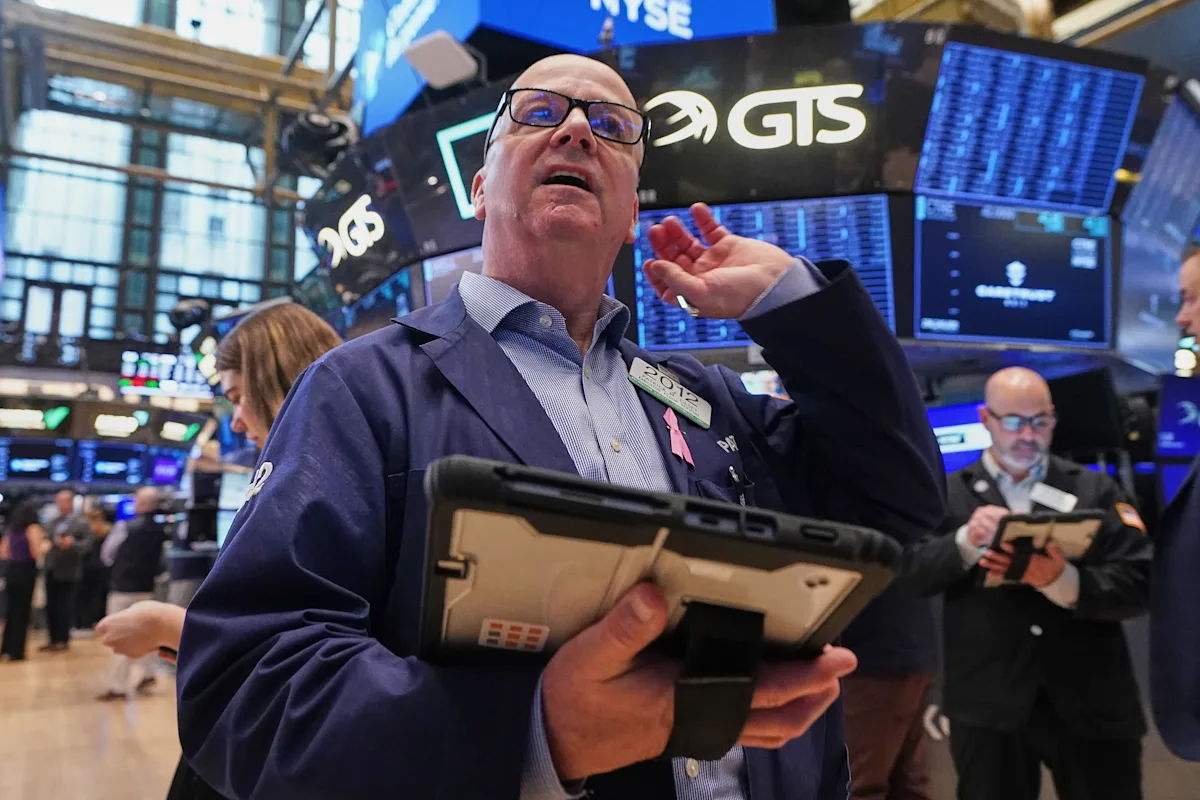
US stocks stepped higher on Thursday as the artificial intelligence trade came back into focus and after President Trump and his Chinese counterpart, Xi Jinping, began a high-stakes US-China summit.

The Dow Jones Industrial Average (^DJI) rose 0.9%, or more than 450 points, to climb above the 50,000 level for the first time since February. The S&P 500 (^GSPC) rose 0.8% to cross the 7,500 level for the first time, and the tech-heavy Nasdaq Composite (^IXIC) advanced 1%, as Nvidia’s (NVDA) stock rose amid signs of robust AI demand.

Trump and Xi called for better US-China ties on Thursday as they began a two-day summit likely to cover issues ranging from tariffs to AI.

Shares in Nvidia jumped over 4% on news that the US had approved sales of its H200 chips to several Chinese firms. That set the stage for Xi’s welcome to some of America’s top CEOs, including Nvidia’s Jensen Huang, Tesla’s (TSLA) Elon Musk, and Apple’s (AAPL) Tim Cook.

Xi reportedly told the business leaders their companies could be “deeply involved in China’s reform and opening up” and that “China’s door will only open wider.” Also in focus are hopes that China can help break the Middle East standoff between Iran and the US, as the war drives up oil prices and risks stoking inflation.

Higher prices likely helped drive a rise in US retail sales in April, as shown in data released on Thursday, as the Iran war lifted fuel prices.

On the corporate front, Cisco (CSCO) shares soared after its quarterly earnings beat expectations, and the networking giant laid out an AI-focused restructuring plan that will cut around 4,000 jobs.

LIVE 13 updates

  • Cerebras pops 99% at open in largest IPO of 2026

    Cerebras (CBRS) began trading on Thursday afternoon under the ticker symbol CBRS and popped over 99% in early trading.

    Shares of the AI chipmaker and Nvidia (NVDA) rival opened at $350 each, marking the largest initial public offering of 2026 so far.

    The AI chipmaker priced its stock at $185, giving the company an estimated valuation of roughly $40 billion based on outstanding shares disclosed in regulatory filings. On a fully diluted basis, the valuation approaches $49 billion, according to Bloomberg data.

    Cerebras has taken a different approach to advanced chips than other AI chip giants. As Yahoo Finance’s Dan Howley points out, the company makes the largest commercial chip ever produced, about the size of an iPad.

    Read more about the IPO here.

  • Dow retakes 50,000 level, nearing record high

    The S&P 500 (^GSPC) and Nasdaq (^IXIC) erased their losses from the Iran war by mid-April, hitting consecutive record highs in recent weeks as the artificial intelligence trade drove fresh gains.

    Now it’s the Dow’s turn.

    The Dow Jones Industrial Average (^DJI) retook the 50,000 level on Thursday, a milestone markets haven’t seen since Feb. 11 of this year. The blue-chip index currently stands a stone’s throw away from its closing record high of 50,188 on Feb. 10.

    A 14% gain for Dow component Cisco (CSCO) helped lift the index, as well as a 4% lift in Nvidia. The Dow’s three largest components by weight — Goldman Sachs (GS), Caterpillar (CAT), and Microsoft (MSFT) — also advanced.

    The Dow retook the 50,000 level on Thursday.
    The Dow retook the 50,000 level on Thursday.
  • Jake Conley

    Cerebras shares expected to begin trading at $350 each, 89% higher than the listing price

    Shares in the AI chip developer Cerebras Systems (CBRS) are expected to begin trading at $350 per share when the company enters the public market for the first time this afternoon, according to Bloomberg.

    If correct, the $350 pricing would represent an 89% jump over the listing price of $185 per share.

    Cerebras’ IPO is expected to be the largest so far this year, with a $5.55 billion fundraise. The figure also makes it the largest US semiconductor IPO on record, surpassing the $5.23 billion raised by Arm Holdings (ARM) in 2023.

    Cerebras is one of a growing number of companies looking to challenge Nvidia’s (NVDA) chokehold on the chip design market. Arm Holdings and its majority owner SoftBank (SFTBY) had staged a last-hour approach to try to buy Cerebras only weeks before the IPO, per Bloomberg, but the offer was denied.

    Cerebras focuses on inference speed, and claims its hardware runs AI models faster than Nvidia’s. The chips are already being used by OpenAI (OPAI.PVT), and Amazon (AMZN) has said it will begin using the company’s technology as well, per Bloomberg.

    “Fast inference will be a fundamental part of the inference market. We have a shot to take a meaningful portion of it. We have to execute. We have a great deal of work ahead of us,” CEO Andrew Feldman said.

  • Jake Conley

    William Blair: China’s chokehold on the rare earth market is ‘comparable to Iran’s hold over the Strait of Hormuz’

    China’s chokehold on the global supply of rare earth materials is “comparable to Iran’s hold over the Strait of Hormuz,” according to William Blair analysts Neal Dingmann and Bert Donnes.

    As President Trump meets with Chinese leader Xi Jinping in Beijing this week, rare earths are expected to be among the several topics discussed by the leaders of the world’s largest economies.

    Rare earths, critical throughout industries including weapons manufacturing, batteries, and EV development, have become the focal point of a tit-for-tat escalation of trade maneuvers between Washington and Beijing.

    China currently controls 70% of mining capacity, 90% of separation capacity, and around 92% of oxide and magnate production for rare earth minerals and metals worldwide, according to the Center for Strategic and International Studies.

    “We view China’s current hold on worldwide rare earths and its ability to halt supply whenever it deems advantageous as comparable to Iran’s hold over the Strait of Hormuz,” Dingmann and Donnes said.

  • Jake Conley

    BofA: The ‘K-shaped’ economy is showing up in Americans’ travel spending data

    As the war in Iran sends gasoline and jet fuel prices surging, the “K-shaped economy” is showing up in Americans’ travel spending, according to Bank of America economists Liz Krisberg and David Tinsley.

    While the war in Iran has only pushed about 10% of Americans to outright cancel a trip, higher-income Americans are spending more on travel at a faster rate than middle- and lower-income Americans, the economists said.

    The "K-shaped" economy is showing up in Americans' travel plans, according to Bank of America spending data.
    The “K-shaped” economy is showing up in Americans’ travel plans, according to Bank of America spending data. · Bank of America

    Where middle- and upper-income travel spending is increasing, 40% of lower-income households have no travel plans, and travel-related spending activity is down year over year for the income cohort, according to BofA data.

    And while most Americans aren’t canceling trips due to the war-driven price increases, many are looking to take fewer trips or cut back on items like accommodations — even as overall spending continues to largely hold up.

  • Jake Conley

    Initial jobless claim rise to 211,000, exceeding estimates

    Initial jobless claims rose to 211,000 in the week ended May 9, according to data released by the Department of Labor on Thursday, coming in above the previous week’s revised tally of 199,000 first-time claims.

    Economists had expected initial claims to be slightly lower at 205,000 for the week, according to consensus estimates compiled by Bloomberg. The four-week moving average of initial claims ticked up to 203,750 from the previous week’s 203,000 revised average.

    Continuing claims, which track the unemployed population still seeking work, rose to roughly 1.78 million in the week ended May 2, compared to the previous week’s revised count of roughly 1.76 million continuing claims.

    Economists had been looking for 1.78 million continuing claims.

  • Jake Conley

    US stock market opens in the green on Thursday as Trump and Xi meet

    The US stock market opened into the green on Thursday after President Trump and Chinese leader Xi Jinping concluded their first major sit-down in a high-stakes US-China summit.

    The Dow Jones Industrial Average (^DJI) rose 0.8%, while the S&P 500 (^GSPC) and tech-heavy Nasdaq Composite (^IXIC) each climbed 0.3% following a record-setting Wednesday for Wall Street stocks.

    Several leading American CEOs joined the US president on the trip, including Tesla’s (TSLA) Elon Musk and Nvidia’s (NVDA) Jensen Huang. Xi reportedly told the group that their companies could be “deeply involved in China’s reform and opening up” and that “China’s door will only open wider.”

    Nvidia shares rose more than 2% Thursday morning on news that the US had approved H200 chip sales to several Chinese companies.

    Cisco (CSCO) shares soared after its quarterly earnings beat expectations, and the networking giant laid out an AI-focused restructuring plan that will cut around 4,000 jobs. Klarna Group (KLAR) also popped after the company said it swung to a $1 million profit on the first quarter from a $99 million loss a year earlier.

  • Jake Conley

    Xi Jinping tells CEOs that ‘China’s door will only open wider’

    Chinese President Xi Jinping warmly welcomed a delegation of US CEOs on hand in Beijing for the two-day US-China summit as President Trump looks to extend US business interests in China.

    Our Washington correspondent Ben Werschkul reports:

    The business leaders were on hand for an arrival ceremony and a portion of a bilateral meeting held in China’s Great Hall of the People, where Trump proceeded to introduce them to Xi “one by one,” according to Chinese state media.

    Xi reportedly responded to US desires to do more business in China by saying the companies could be “deeply involved in China’s reform and opening up” and that “China’s door will only open wider.”

    The outreach received a positive reaction from the CEOs with Tesla’s (TSLA) Elon Musk, Nvidia’s (NVDA) Jensen Huang, and Apple’s (AAPL) Tim Cook all spotted by reporters leaving in good spirits.

    “It was awesome,” Musk said when asked how his talks with Xi went.

    Xi has offered similar promises in years past — often to little avail — but it was nonetheless a striking message from the Chinese leader to begin the two-day visit and echoed a message Trump himself has been delivering ahead of the trip.

    Read more here.

  • Jake Conley

    Trump-Xi summit offers little movement on the war in Iran

    In a closed-door meeting between the leaders of the world’s largest economies on Thursday, President Trump and Chinese leader Xi Jinping agreed the Strait of Hormuz must be reopened and remain free of any future militarization or tolling.

    Yet, beyond broad diplomatic statements, the first major sit-down between Trump and Xi appears to have yielded little progress on the war in Iran and no firm commitments from China, even as the White House had hoped to pressure Beijing into providing more aid.

    “I suspect the US would like to use the Trump-Xi meeting to push China to pressure Iran back to the negotiating table,” Jorge León, head of geopolitical analysis at Rystad Energy, told Yahoo Finance.

    “But unless China sees a clear benefit in doing so — for example, avoiding a much more severe energy shock or securing concessions from Washington — I doubt Beijing will be eager to fully exercise that leverage.”

    Read more here.

  • Cisco stock jumps on booming AI orders, job cuts

    Yahoo Finance’s Ines Ferre reports:

    Cisco (CSCO) stock jumped more than 15% in premarket trading on Thursday after the networking giant issued a stronger-than-expected revenue outlook and cut thousands of jobs as it sharpens its focus on artificial intelligence.

    Cisco’s fiscal fourth quarter revenue outlook of $16.7 billion to $16.9 billion came in well above Wall Street expectations of roughly $15.8 billion.

    CEO Chuck Robbins said the workforce reductions are part of a broader effort to position Cisco for the AI era. The layoffs are expected to impact fewer than 4,000 employees, or under 5% of the company’s workforce.

    Read more here.

  • The S&P 500’s earnings boom is facing a bond market warning

    Stocks are hitting records as earnings surge. Meanwhile, bonds are competing harder for investor cash, Yahoo Finance’s Jared Blikre writes in today’s Chart of the Day.

    He writes:
    The S&P 500 (^GSPC) is in the middle of one of its strongest earnings seasons in decades, with profit growth accelerating, beat rates running hot, and analysts lifting future estimates instead of cutting them.

    Profits are strong enough to justify the record highs that stocks keep hitting.

    But the bond market is making that climb harder.

    The chart below shows the S&P 500’s realized earnings yield minus the 10-year Treasury yield (^TNX), a version of a bond-stock valuation gauge recently highlighted by the Kobeissi Letter.

    The 10-year Treasury now pays more than S&P 500 earnings
    The 10-year Treasury now pays more than S&P 500 earnings · Bloomberg, Yahoo Finance

    … Right now, the S&P 500’s realized earnings yield is roughly 3.4%, below the 10-year Treasury yield near 4.5%. That leaves the gap at roughly negative 110 basis points — or 1.1 percentage points — the widest negative reading since 2003.

    Read more here about what that could mean.

  • Xi tells US CEOs accompanying Trump that China will open up more

    From Bloomberg:

    Xi Jinping signaled China is moving toward greater openness, striking an upbeat note during his meeting with US business leaders accompanying Donald Trump as the two presidents wrapped up morning talks that featured more divisive issues like trade and Taiwan.

    “American enterprises are deeply involved in China’s reform and opening up, a process from which both sides have benefited,” Xi told more than 10 business representatives gathered at the Great Hall of the People in Beijing, China Central Television reported. “China’s door to the outside world will only open wider.”

    Apple CEO Tim Cook, Tesla CEO Elon Musk, U.S. Defense Secretary Pete Hegseth and U.S. Treasury Secretary Scott Bessent attend the welcome ceremony for U.S. President Donald Trump by Chinese President Xi Jinping, at the Great Hall of the People in Beijing, China May 14, 2026. REUTERS/Maxim Shemetov/Pool
    Apple CEO Tim Cook, Tesla CEO Elon Musk, U.S. Defense Secretary Pete Hegseth and U.S. Treasury Secretary Scott Bessent at the welcome ceremony in Beijing. (REUTERS/Maxim Shemetov) · REUTERS / REUTERS

    Footage released by the state broadcaster showed executives including Tesla Inc.’s (TSLA) Elon Musk, Apple Inc.’s (AAPL) Tim Cook, Boeing Co.’s (BA) Kelly Ortberg and Nvidia Corp.’s (NVDA) Jensen Huang — who joined the trip as a last-minute addition — escorted by staff into the meeting room.

    The message sent by Xi reiterated a pledge frequently delivered by senior Chinese officials on the world stage over the years. It also appeared to be a response to Trump’s appeal to Xi “to ‘open up’ China,” which he’d promised to make as his first request on behalf of the business leaders accompanying him to Beijing.

    In his remarks on Thursday, Xi added that he believes US firms will have even broader prospects in China, CCTV reported.

    Read more here.

  • Oil steadies ahead of highly-watched Trump-Xi meeting

    Bloomberg reports:

    Oil steadied ahead of a meeting between US President Donald Trump and his Chinese counterpart Xi Jinping, which is being held against the backdrop of the Iran war that shows no signs of a near-term resolution.

    West Texas Intermediate (CL=F) traded near $101 a barrel after declining 1.1% in the previous session. Brent (BZ=F) crude closed below $106. Trump is scheduled to meet Xi on Thursday, and the US leader told reporters this week that trade talks will be prioritized rather than discussions about the Middle East conflict.

    The war has led to global oil inventories shrinking at a record pace, and the market will remain “severely undersupplied” until October even if the conflict ends next month, according to the International Energy Agency. Ahead of the Trump-Xi summit, the US threatened banks and sanctioned more entities over the sale of Iranian oil to China, the biggest buyer of its crude.

    The flow of crude and fuels through the crucial Strait of Hormuz fell by nearly 6 million barrels per day in the first quarter, following the start of hostilities at the end of February, according to the Energy Information Administration. Only a trickle of tankers have been able to exit the Persian Gulf during the war.

    Read more here.


Source link