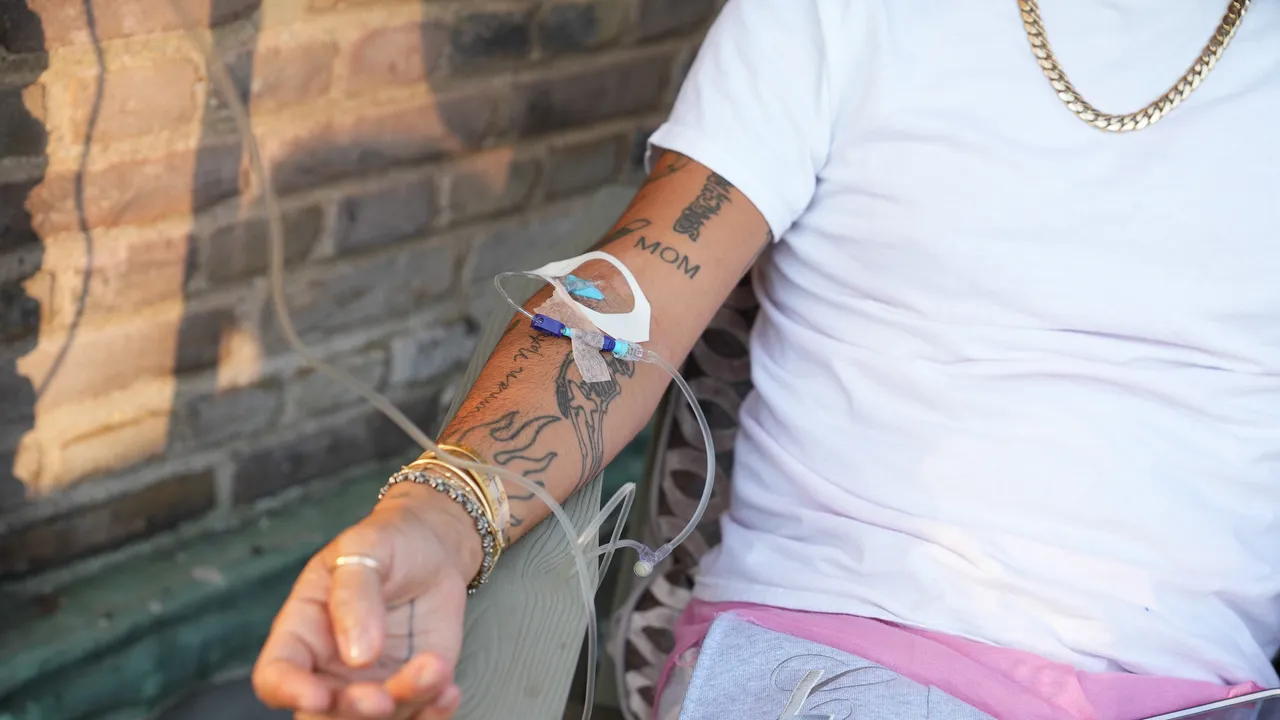
David Schlumpf knew he was depressed before he knew what depression actually was, living with it since adolescence, around the same time he realized he was gay. “I never realized I was functioning through life at a different baseline than other people,” says the 43-year-old actor, director, and stay-at-home dad who lives in Jersey City, New Jersey, with his husband and their three-year-old son. “I told my husband, ‘You can tell me all day long that the sky is blue. I’ve perceived it as green for 40 years.'”
The last decade was a pharmacological education he never wanted. Zoloft, Celexa, a medication that spiked his anxiety, another that gave him panic attacks on airplanes when he wasn’t afraid of flying. By early 2025, suicidal ideation, not an acute crisis, but a constant low voice, had been his companion his entire adult life. He found a clinic in Hoboken that he could walk to and started treatment.
He is now 16 sessions in, receiving Spravato, the FDA-approved nasal spray version of ketamine, once a week. Walking home from his first session, he noticed he was moving more slowly than usual. His brain offered calmly, “Yeah, we’re walking at the pace we want to go.”
“For me, that’s extremely complicated and a huge step forward,” he says. “Because it wasn’t complicated or haunted by all the other voices.” The shame cycles went quiet. He still has hard weeks, still notices when depression tries to creep back, but now he can see it coming. “It doesn’t lead me to the bottomless pit again. I can recognize it.”
Gregory never made it to a clinic. He looked at the prices and did the math. IV ketamine infusions are rarely covered by insurance, even as the drug costs a few dollars, but patients are charged hundreds to over a thousand per session. He’d looked into online providers and felt the same wall. “They want an obscene amount of money. I’ll just buy a bag and use a tiny spoon.”
In Canada, Andrea Kirincic, a ketamine therapist in Montreal, describes a patchwork of coverage that depends on province, insurance, and formulation. “If the setup is not good,” she says, “it’s not going to have the same result.” On both sides of the border, the system is structured less by need than by circumstance, by what you carry, what’s been approved, and whether you can afford to wait.
The experience Gregory returns to happened in Washington, D.C., in 2022. Club, laser lights, music. “I felt like a main character,” he says. “Everyone else was just background extras.” Time warped. Whatever he’d been angry about, stressed about, none of it existed. “I couldn’t tell you what I ate earlier or what I was angry about before. This was all that existed.”
This is almost exactly how ketamine therapy patients describe the relief they feel.
Hartman is careful about the word “cure.” But what queer people sought in 1999 and what patients seek in 2026 are not, at their core, so different. Connection. Presence. Relief from the mental noise that makes ordinary life feel impossible.