As June begins, communities across the country turn their focus to an important public health effort—National Stroke Awareness Month.
This annual observance is dedicated to raising awareness about stroke prevention, early recognition, and timely treatment. With stroke remaining one of the leading causes of death and long-term disability in Canada, education and awareness can make a life-saving difference.
But this year marks a significant milestone with the 20th Anniversary of the development of the first set of Canadian Stroke Best Practice Recommendations which were released 20 years ago, in 2006 by the Canadian Stroke Network and Heart & Stroke as part of the Canadian Stroke Strategy.
Stroke is a leading cause of adult disability in Canada
A stroke occurs when blood flow to the brain is interrupted, either by a blockage (ischemic stroke) or a burst blood vessel (hemorrhagic stroke). Without oxygen-rich blood, brain cells begin to die within minutes. Because of this, time is critical—quick action can significantly reduce the severity of damage and improve the chances of recovery.
“The first access point to the stroke system of care is always going to be recognizing those symptoms of stroke,” shares Kaitlyn Archibald, (RD, CDE) Specialist, Provincial Mission for Manitoba Heart & Stroke. “If we can’t recognize it, we can’t call it out for what it is. But the second step always is to call 911 because those paramedics are going to be able to connect you to the closest stroke center to you to help prevent any sort of delays.”
Almost one million people in Canada are now living with stroke
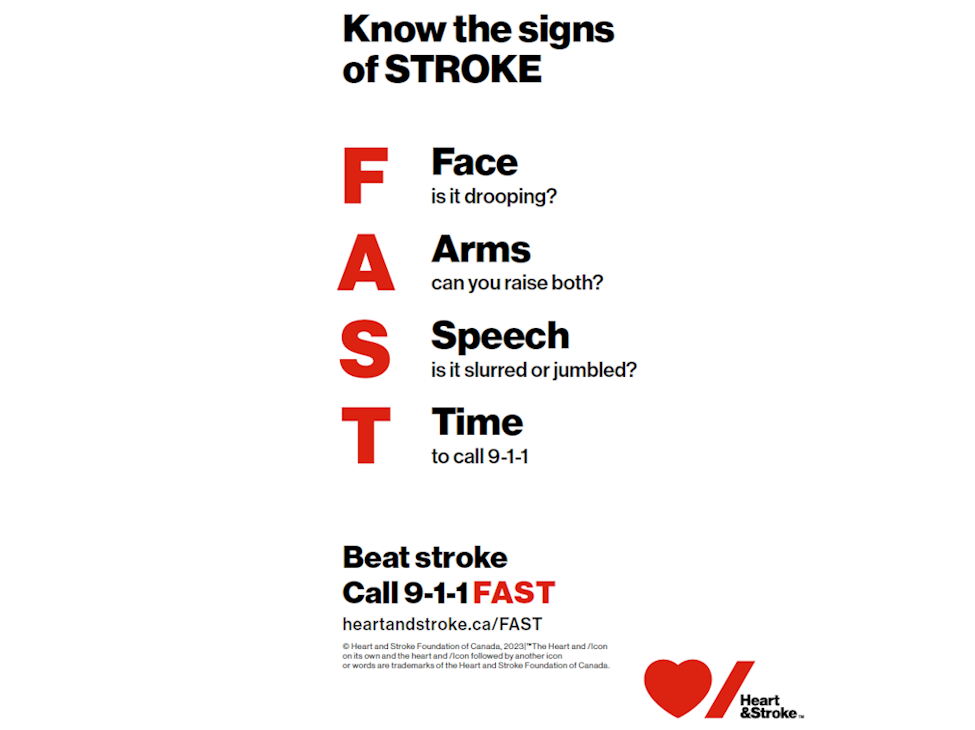
Health professionals emphasize the importance of recognizing the warning signs of a stroke. One of the most widely used tools is the acronym F.A.S.T.:
- F – Face drooping: One side of the face may droop or feel numb.
- A – Arm weakness: One arm may feel weak or drift downward when raised.
- S – Speech difficulty: Speech may be slurred or hard to understand.
- T – Time to call emergency services: Immediate medical attention is essential.
If any of these symptoms appear—even if they seem mild or go away—calling emergency services right away can save a life. Treatments such as clot-busting medications are most effective when administered within a narrow window of time.
1.9 million brain cells die every minute during a stroke
Just a few decades ago a stroke could be diagnosed but there were no treatments and very little recovery support. A major turning point occurred when the clot-busting intravenous drug (alteplase) was provisionally approved as treatment for ischemic stroke (the most common type, caused by a blood clot) by Health Canada in 1999 and fully approved in 2005.
Around the same time, the Canadian Stroke Strategy was initiated under the leadership of the Canadian Stroke Network and the Heart and Stroke Foundation of Canada (Heart & Stroke). The Canadian Stroke Strategy brought together stakeholders and partners to work toward a common vision of optimal access to integrated, high quality, and efficient services in stroke prevention, treatment, rehabilitation and community participation across the country in the development of the Canadian Stroke Best Practices program.
The Stroke Best Practices provide up-to-date, evidence-based clinical practice guidelines across the continuum of care from public awareness to emergency diagnosis and treatment, rehabilitation and recovery, and prevention of a subsequent stroke.
More than 108,000 strokes happen in Canada every year. That is one stroke every five minutes
“When we think about, and it wasn’t that long ago that we didn’t have very many treatment options for stroke – if somebody were to present a stroke, there was not a lot of options for them. So, seeing how our research has been able to take us in the last 30, 40 years, and even looking at time,” explains Archibald. “Time is of the essence with stroke. Oftentimes we say that ‘Time is brain’ because we know that 1.9 million brain cells die each minute with stroke.”
One of the important supports for rural Manitobans through the integrated stroke system of care has been the development of the Telestroke program, says Archibald.
“Living in rural Manitoba, Telestroke is a program that was designed to help connect patients with stroke who are living rurally,” she says. “We can connect them virtually with their local physicians to a stroke specialist to actually help prevent those delays when somebody’s having a stroke – and just really try to connect those dots of care more quickly to preserve the time that they may have.”
Stroke can happen at any age
The first set of Canadian Stroke Best Practice Recommendations were released 20 years ago, in 2006 by the Canadian Stroke Network and Heart & Stroke as part of the Canadian Stroke Strategy.
The aim of the Canadian Stroke Best Practice Recommendations is to make stroke care more consistent across the country and promote the rapid application of new knowledge and evidence in practice, to improve care, reduce death and disability, promote recovery and community participation for individuals with stroke, support families and caregivers, and save healthcare costs.
“One of their big advocacy points is just making sure that we’re really focusing on the whole picture with integrated stroke care, because we know when that’s implemented, we actually have the potential to see a 20% decrease in death from stroke,” shares Archibald. “So that’s pretty huge when we look at how far even stroke care has come over those 20 years.”
Nine in 10 people in Canada have at least one risk factor for stroke or heart disease
My health is my responsibility. So, how do I protect myself from stroke?
Knowing that a stroke can happen at any age is critical to taking your health seriously.
“A lot of it can be managed through lifestyle. And we know that actually nine in 10 Canadians are living with at least one risk factor for either heart disease or stroke,” says Archibald. “But we can also look at that and know that up to 80% of that actually can be prevented through healthy behaviors, healthy lifestyle changes. So, knowing your risk factors are important.”
“But there are also things that we can do to reduce that risk. So, for example, knowing lifestyle risk factors like smoking or vaping, low or physical activity levels, unhealthy diets … all of these would be lifestyle risk factors, but we can also have medical conditions that would include like high blood pressure or cholesterol, diabetes, for example.
So, again just the important parts of that are knowing what your own independent risk factors may be.
As many as 8 in 10 cases of premature stroke or heart disease can be prevented through healthy lifestyle behaviours.
Heart & Stroke Foundation has developed a new risk screening tool that can help determine if you’re at risk for a stroke. A quick online questionnaire to create a risk profile helps you understand what your risk may be for either heart disease or stroke, and the lifestyle changes can be made to lower your risks.
“It’s online, it’s free, it’s about 5 to 10 minutes, and it also creates an action plan for you where you could potentially take that to your primary care provider and talk through …”okay, here are my risks, what can we do about them? I want to try and manage these as best I can.'”
Visit the Heart and Stroke website for the Risk Screening Tool page.
“Being aware of our own risk is a really great first step, just in terms of know what can I do to help manage my health and prevent a stroke from happening, right? Aside from knowing what to do, should we witness one.”
Those important facts to consider:
• Stroke is on the rise in Canada due to an aging population and more younger people having strokes, but more people survive.
• Almost one million people in Canada are now living with stroke.
• More than 108,000 strokes happen in Canada every year. That is one stroke every five minutes.
• As many as 8 in 10 cases of premature stroke or heart disease can be prevented through healthy lifestyle behaviours.
• Nine in 10 people in Canada have at least one risk factor for stroke or heart disease.
• Stroke can happen at any age.
• 1.9 million brain cells die every minute during a stroke.
• Stroke costs the Canadian economy more than $3.6 billion per year in direct costs.
• Stroke is one of the 10 most expensive causes of acute care hospitalization in Canada, with an annual cost of $146 million. xi
• Stroke is a leading cause of adult disability in Canada.
• Heart & Stroke has invested $1.73 billion in world-class research to promote health, prevent disease, save lives and enhance recovery