

Canadian economy posts stronger start to second quarter as GDP rises in April
The Bottom Line:
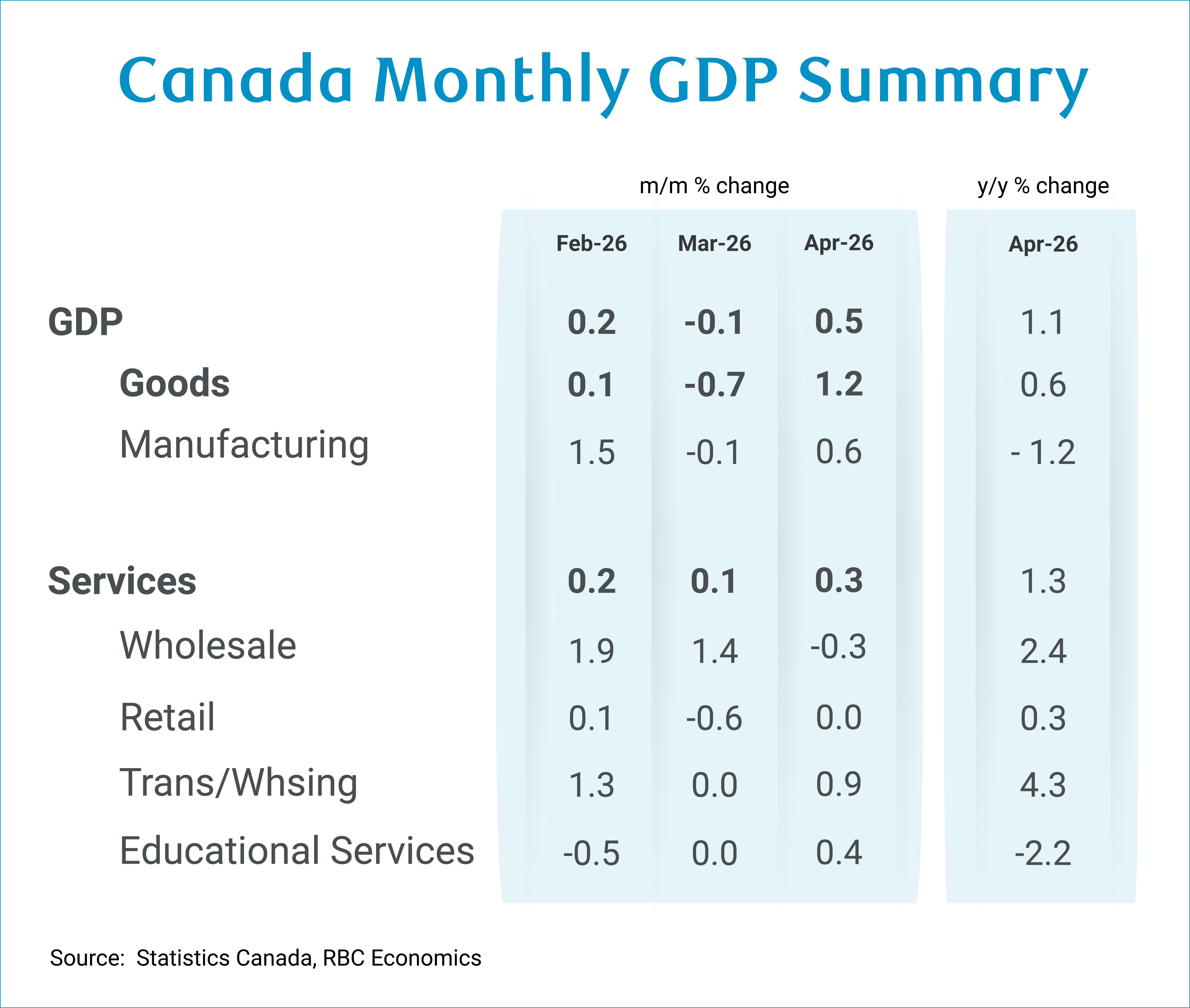
Canadian economic activity increased 0.5% in April, slightly higher than Statistics Canada’s 0.4% advance estimate and marking the strongest monthly gain since July 2025. As expected, the increase was driven primarily by stronger activity in goods-producing industries, particularly mining, quarrying, and oil and gas extraction, alongside a pickup in manufacturing output. Service-producing industries also expanded, though at a more moderate pace.
The stronger April reading points to a firmer start to the second quarter after growth stalled over the winter. While uncertainty surrounding U.S. trade policy continues to weigh on the outlook, the latest data are broadly consistent with our view that underlying economic conditions continue to improve modestly on a per-person basis rather than signaling a material shift in underlying momentum.
Statistics Canada’s advance estimate indicated real GDP increased 0.1% in May. While preliminary and highly revision-prone, other available indicators also suggest economic activity remained relatively stable following April’s gain. Manufacturing and home resales strengthened in May, with the latter posting its largest monthly increase since October 2024. Those gains were partly offset by weaker wholesale activity, suggesting trade-related headwinds continued to weigh on parts of the goods sector. That said, as-reported today’s data is tracking some upside risk to our forecast for a 1.7% (annualized QoQ) increase in Q2.
Overall, the April report points to a firmer start to the second quarter following a weak first quarter. While trade uncertainty continues to cloud the outlook, the latest data remain consistent with our expectation that the Canadian economy will continue to grow at a modest pace in the months ahead.
The Details:
-
Real GDP increased 0.5% in April, a tick higher than both Statistics Canada’s advance estimate and our own expectation of 0.4%.
-
Goods-producing industries increased 1.2%, led by mining, quarrying, and oil and gas extraction (+2.9%), while manufacturing output rose 0.6%. Together, those industries accounted for most of the increase in overall economic activity.
-
Services-producing industries grew 0.3%, marking their third consecutive monthly increase, mainly supported by gains in transportation and warehousing and the public sector, partially offset by weakness in wholesale trade.
-
Statistics Canada’s advance estimate indicated real GDP increased 0.1% in May, with gains in finance, insurance, and real estate partially offset by declines in wholesale trade and agriculture.
-
Early indicators for May were mixed but generally pointed to continued stability. Manufacturing sales (nominal) rose 1.1%, led by motor vehicle production, seasonally adjusted home resales increased 5.1%, the strongest monthly gain since October 2024, and total hours worked rose 0.6%.
-
Offsetting some of those gains, wholesale sales excluding petroleum and related products declined 0.7%, suggesting activity remained softer in parts of the goods sector.
About the author:
Abbey Xu is an economist at RBC. She is a member of the macroeconomic analysis group, focusing on macroeconomic forecasting models and providing timely analysis and updates on economic trends.
This article is intended as general information only and is not to be relied upon as constituting legal, financial or other professional advice. The reader is solely liable for any use of the information contained in this document and Royal Bank of Canada (“RBC”) nor any of its affiliates nor any of their respective directors, officers, employees or agents shall be held responsible for any direct or indirect damages arising from the use of this document by the reader. A professional advisor should be consulted regarding your specific situation. Information presented is believed to be factual and up-to-date but we do not guarantee its accuracy and it should not be regarded as a complete analysis of the subjects discussed. All expressions of opinion reflect the judgment of the authors as of the date of publication and are subject to change. No endorsement of any third parties or their advice, opinions, information, products or services is expressly given or implied by Royal Bank of Canada or any of its affiliates.
This document may contain forward-looking statements within the meaning of certain securities laws, which are subject to RBC’s caution regarding forward-looking statements. ESG (including climate) metrics, data and other information contained on this website are or may be based on assumptions, estimates and judgements. For cautionary statements relating to the information on this website, refer to the “Caution regarding forward-looking statements” and the “Important notice regarding this document” sections in our latest climate report or sustainability report, available at: https://www.rbc.com/community-social-impact/reporting-performance/index.html. Except as required by law, none of RBC nor any of its affiliates undertake to update any information in this document.