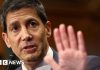
In his first testimony as the new chairman of the Federal Reserve, Kevin Warsh shared his views on a range of topics from artificial intelligence to immigration.
Transcript
LEILA FADEL, HOST:
The new chairman of the Federal Reserve took questions from lawmakers this week for the first time since taking over the central bank. The topics included artificial intelligence, immigration and inflation. Kevin Warsh said the Fed is determined to bring rising prices under control. NPR’s Scott Horsley was watching the testimony so you didn’t have to, and he joins me now to discuss. Good morning, Scott.
SCOTT HORSLEY, BYLINE: Good morning, Leila.
FADEL: So what did Warsh say about inflation and the big swings we’ve seen in energy prices?
HORSLEY: Yeah. There have been some big swings. Gas prices jumped sharply just as Warsh was sworn in as Fed chair back in May, as a result of the U.S. war with Iran. That pushed annual inflation to its highest level in more than three years. Then we had the ceasefire, and gasoline prices fell. And, of course, now that ceasefire has unraveled, and gas prices are climbing again. They jumped another nickel a gallon just overnight. Warsh told senators there’s not a lot he and his Fed colleagues can do about any individual price, but if they do their jobs right, Warsh says, overall inflation will come down.
(SOUNDBITE OF ARCHIVED RECORDING)
KEVIN WARSH: When prices go up, I know it hits your constituents every day. I’m not trying to sound dismissive of it, but I also don’t want to say that there’s much that we can do about cattle prices or milk prices today. But there’s a lot we can do to make sure that the entire grocery aisle doesn’t have higher prices, and that’s what we’re committed to do.
HORSLEY: Warsh has been deliberately vague about what he wants to do with interest rates, but his tough talk on inflation sounds like someone who wants to keep rates relatively high for now. And that’s what investors are betting Warsh and his colleagues will do when they meet in a couple of weeks.
FADEL: Now, artificial intelligence is driving a lot of spending. How is Warsh reacting to it?
HORSLEY: Yeah. Big tech companies are investing huge sums of money in AI, and that has the potential to affect two things the Fed watches very carefully – inflation and the job market. Right now, for example, computer chip prices are going up because of all the data centers. But we’re also seeing a lot of construction jobs. Warsh says over time, the impact of AI could be different.
(SOUNDBITE OF ARCHIVED RECORDING)
WARSH: In the near term, I think this investment is probably quite good for jobs as we’re building out the infrastructure. And over the long term, my best guess is that this will improve American productivity. But between the short term and the long term, it can have a disruptive effect, and we’re attuned to that.
HORSLEY: Warsh has appointed a task force to explore how AI might affect the Fed’s work, and he’s expecting recommendations by the end of this year.
FADEL: Warsh also got some questions about immigration. What did he say?
HORSLEY: You know, like his predecessor, Jay Powell, Warsh tries to stay in his lane. And he stressed that immigration policy is up to Congress and the White House, not the Federal Reserve. But the questions he got do highlight some of the divisions within the Republican Party. GOP Senator Thom Tillis of North Carolina warned the administration’s aggressive crackdown on immigration, both legal and illegal, could leave the U.S. with a real shortage of workers.
(SOUNDBITE OF ARCHIVED RECORDING)
THOM TILLIS: People are high-fiving and talking about net zero immigration growth as if it’s a good thing. It’s only a good thing if you want to repeat the mistakes of Western Europe, Japan, China and other nations that didn’t get their replacement rate right.
HORSLEY: Another Republican senator, Bernie Moreno of Ohio, took the opposite tack. He says a rebound in immigration would make the Fed’s job harder.
(SOUNDBITE OF ARCHIVED RECORDING)
BERNIE MORENO: If you have dramatically more humans in the United States looking for work, by definition, it makes full employment more difficult.
HORSLEY: Now, Warsh was careful not to get dragged into that debate, but, clearly, immigration policy can make a big difference in the size of the U.S. workforce and the potential for economic growth.
FADEL: NPR’s Scott Horsley. Thanks for that rundown, Scott.
HORSLEY: You’re welcome.
Copyright © 2026 NPR. All rights reserved. Visit our website terms of use and permissions pages at www.npr.org for further information.
Accuracy and availability of NPR transcripts may vary. Transcript text may be revised to correct errors or match updates to audio. Audio on npr.org may be edited after its original broadcast or publication. The authoritative record of NPR’s programming is the audio record.