On July 4, the Fernwood skate park transformed came alive as a runway for six B.C. designers, organized by UVic political science student Gabrielle Elhav
Photo by Rognan Bowman.
On July 4, VicFits’ second ever fashion show HEAT was alight with summer fervor, as crowds gathered on the Fernwood Skate Park’s sizzling asphalt. Rather than the usual crowd of skaters rolling about, onlookers spread picnic blankets across a grassy knoll, while ticket-holders sat in folding chairs along ramps amidst a sea of worn denim, funky patterned silks, and military surplus.
Originally an anonymous venture, Gabrielle Elhav’s brainchild VicFits has upended Victoria’s fashion scene, capturing the city’s most unique outfits one street photograph at a time.
The venture began in September of 2022, when Elhav was inspired by a similar Instagram account based out of Toronto, @416_fits. Originally coined UVicFits, the project’s orbit quickly expanded to the greater Victoria area, though Elhav remains at the university as a political science student minoring in digital interactive media in the arts.
While VicFit’s may have gotten its start in the digital sphere, populating people’s Instagram timelines with the latest streetwear, Elhav is now shifting more analog. “I think [social media] can be really limiting, not only sharing people’s stories, but … [for] fashion and photography,” they said.
Rather than solely posting outfits online, VicFits now takes the form of a monthly Substack newsletter, along with printed zines distributed in about a dozen shops across Victoria.
The shift comes after last year’s “neo-luddite” fashion show, Artificium, a collaboration with the Ministry of Casual Living, which explored “how digitization coincides with what we wear.”
Now, VicFits’ first solo show is part ode to Spike Lee, part personified kickflip holding a dripping ice cream cone. As Elhav wrote on Substack, “HEAT highlights the clothes made by, and for, the movers.”
HEAT’s runway — if it could be called that — wasn’t christened by couture fashion houses and elite tastemakers, but constructed from the blacktop of the local skate park. Here, the scrawled graffiti wasn’t just set dressing, it was a living collaboration that spilled onto the clothes.
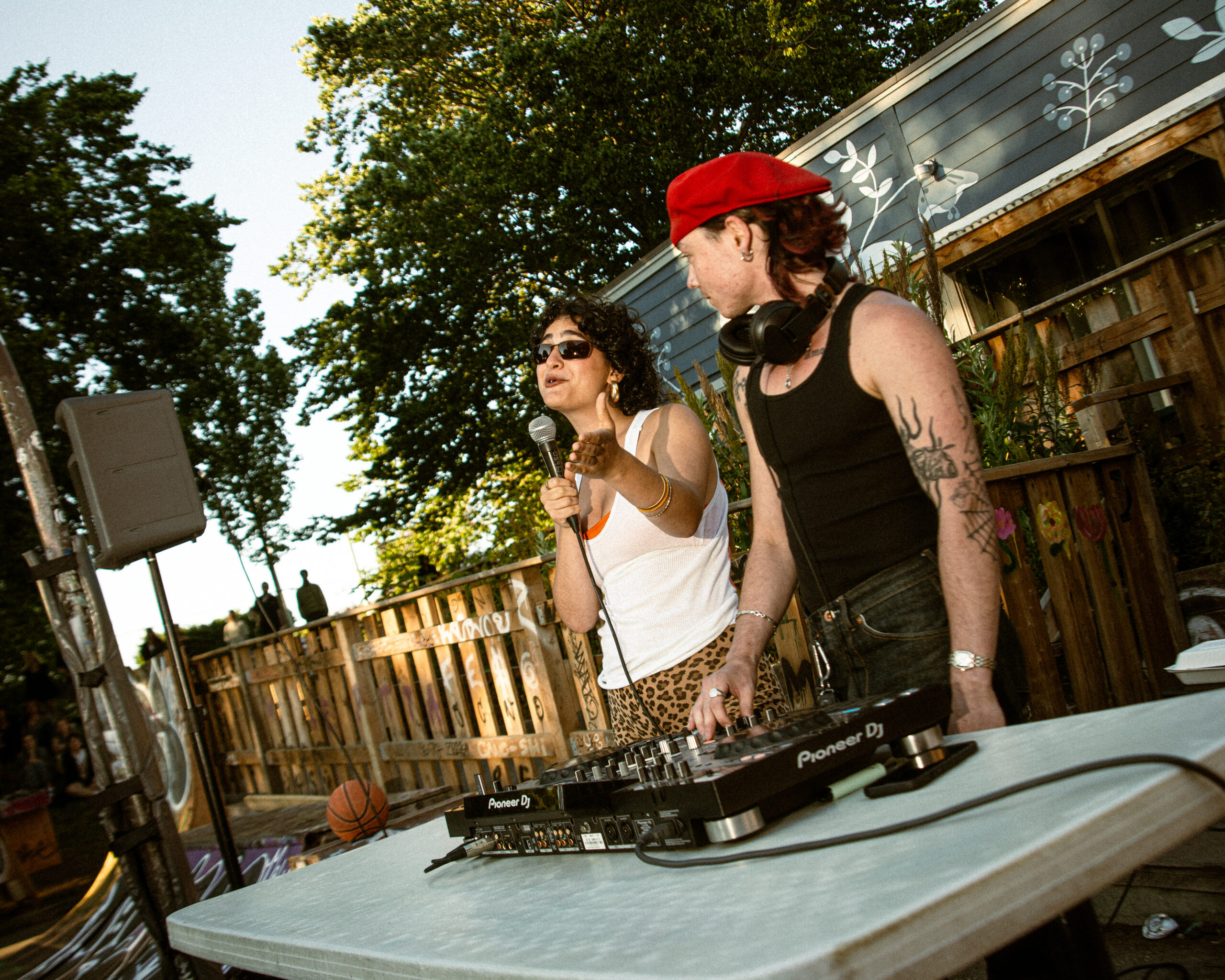
As golden hour settled over the crowd, local DJ Nitro started up an energetic backing track, deftly blending electronic hits with classic Hip-Hop tracks.
Models began to strut along the concrete, each stopping to pose atop a cement manual pad. Some blew kisses, others held fingerguns, and all were the very picture of cool confidence amidst the balmy day.
As Elhav put it, these models were the people “[who] skateboard, [who] blow bubbles…who spend their time outside doing this,” even including executive members of UVic Skate.
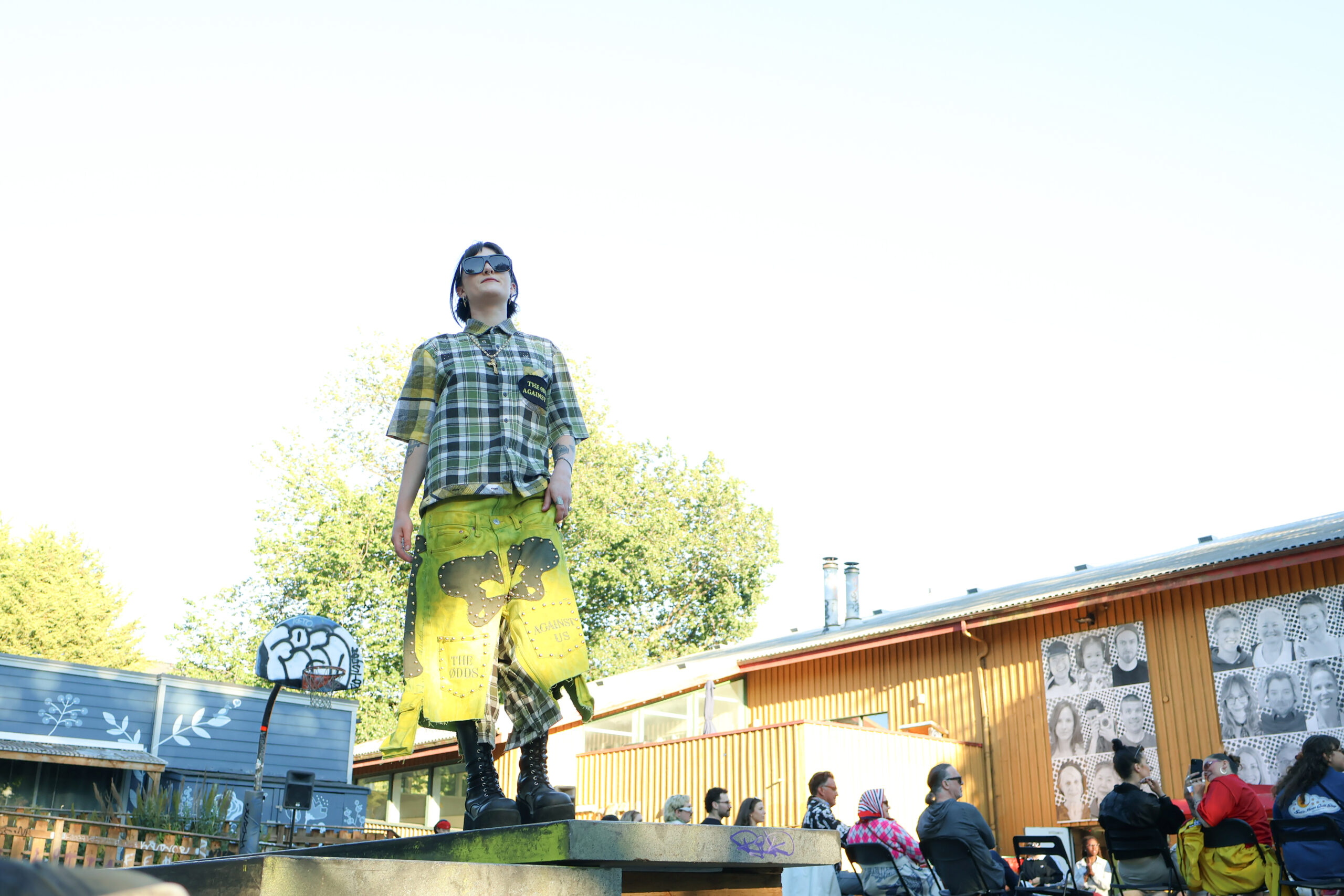
Photo by Zoe Trottman.
First of the designers were The 0dds Against Us, a brand based out of Vancouver whose fresh designs were bursting with metal rivets and neon plaids, each of their six looks more eye-catching than the last.
The studio’s elevated streetwear was defined by boxy silhouettes, artistic tattered hems, and statement chains. On each outfit were skeletal patches in the shape of femurs, pelvic bones, and more — flipping the internal outward in an embroidered expression of memento mori.
Models Davey Long, Audrey Young, Heidi Kebede, Donny Kim, Andrei Dimaano, and Terrell Mourato embodied each look, sauntering across the concrete with a laidback vibe.
According to fashion line collaborator 16k.freddy, the studio’s reappearing motif “16k” represents nostalgia and the longing for great times — namely the year 2016. Freddy also said their pieces are 100 per cent upcycled and handcrafted, with many pieces sewn from scratch.
Next in the lineup, created by Bodhi LaPerriere, came Sonder Studios. As Elhav aptly wrote, the brand “is heavily inspired … by 90s streetwear, vintage military clothing, and 2000s high fashion,” influences which were on full display through the studio’s three looks.
Their maxi skirt and short vest, modeled by Emmy Skylar and made of deep charcoal denim, mirrored the tones of the asphalt underfoot while offering an elegant twist. Tieg Mifflin modeled a similar denim and khaki number, the dark wash jacket sliced through with a swirling jungle print.
Meanwhile, model Finn Barker wore a practical black hoodie simply printed with “Sonder,” evoking skate culture’s love for branded clothing, ubiquitous with such names as Supreme and Vans.
Following on the runway, Mayflower Textiles showcased a number of upcycled ensembles plucked straight out of a 2000s romcom. The charming looks were both fun and feminine, and one could imagine each model strutting past the runway and into a first date.
Stark printed graphics, metal eyelets, and asymmetrical cuts (as seen on Iona Aire and Naomi Brown) cemented a handmade feel, befitting a clothing project that prides itself on “sourcing vintage fabrics and materials.”
One hot pink top, modeled by Ashen Quiñones, featured a grey trash-can printed beside the numbers “‘26”, perhaps a subtle commentary on the state of this year. Offering another bright pop amidst the collections more subtle color palette, a rainbow of mismatched buttons traced the puff sleeved dress shirt worn by Kebede.
Mifflin donned Mayflower Textile’s sole ‘masculine’ look, with an orange-black tee, written with “Mayflower,” and red ink-stained shorts — the archetypical skater outfit only lacked a real board.
Next up was Scrapped Studios, a Vancouver based clothing brand by Chanelle Herrera and Cole Smith, focused on “elevating and prolonging the life of second-hand clothing.”
A sport’s jersey halter top, also worn by Quiñones, ignited murmurs concerning the timely overlap with the FIFA world cup. Meanwhile, model Matyas Tesfamariam wore a matching mosaic set, a pair of jeans and jacket merging darkwash with sky-blue denim, showcasing the studio’s technical artistry.
That denim stretched into Dimaano’s look, whose star-stamped jean shorts paired with a tee featuring a freeform, almost liquid, print. A newsboy cap and handkerchief lent a contrasting hipster lean to the otherwise skatewear outfit.
Model Phoebe Rogers wore an almost punk getup, with a Harley Davidson halter top accompanying green camouflage shorts and glossy cowboy boots. Large earrings and bangles were the language of this studio, with silver metals complimenting each individual look.
Named by Designer Kiara Jeanette for her late Aunt Jeanette, Ette Designs is a clothing brand rooted in confidence, ethical artisanship, and the celebration of her African heritage. Her designs explore the intersections of contemporary silhouettes and traditional patterned fabrics.
For Jeanette, dedication to ethical production means using deadstock materials, as she said “fabric from bigger companies that would be thrown out … then [is sold] for a cheaper price, so that’s where I get a lot of my fabrics.”
“I do my own sewing, or I have different sewists in Victoria and Vancouver … everything’s [small batch], made by people I can actually talk to and they’re paid fair,” the designer added.
Ette Design’s geometric bomber jackets, modeled by Marc Micu and Naomi Brown, were paired with a pair of matching boxy shorts and plain athletic shorts respectively; one, a zigzagging print of vibrant primary colors, the other full of greyscale dots and dashes.
The newly debuted Pollyanna Cowgirl, a creation of Annabelle Crossley, was all about playing with negative space, complete with star-shaped peekaboo panels and elaborate lace-up ties.
What’s more, glitzy patterns like leopard paired with checkered gingham and plaids to create a collection part Bratz dolls part rave fashion.
The project’s “playful and sensual” design philosophy was on full display with pieces like a half-skirt half-bloomer worn by Juniper Mericer, or a white ripped ribcage long sleeve on Rogers.
Likewise, a matching denim star bikini and tie-up chaps turned heads, with red flames running along model Mimi Beauregard’s legs.
Complimenting each designer’s ready-to-wear clothing, Elhav’s expert styling was realized with accessories from vintage vendor Avantique and eyeware from Eyefinery Optical Studio.
As the show wound down and the sun set, conversations ignited, and the audience could be heard discussing standout designs and cherished thrift stores in Victoria. Elhav soon addressed the crowd, thanking all the talent and volunteers who worked on the show before cheering “I love this community!”
The subsequent afterparty turned the show’s broiling heat down to a simmer. Inside the Fernwood Community Center designers sold their clothing featured in the show beside nail artists, graffiti artists, and other vendors. “It’s as ready to wear as you can get,” said Elhav.
Sustainability was certainly the word of the evening. Elhav described Victoria’s fashion as “very scrappy and very secondhand.”
“We are an island, so we need to know how to cultivate what we have,” they said.
Techniques like upcycling secondhand clothing, sewing from deadstock fabrics, and equitable labor practices were all treated by designers as givens — a notable divergence from the status quo of fast fashion and textile pollution.
One local business, Shasta Lily Barkman, even advertised private sewing lessons and custom mending of clothes.
DJ blac asphalt and indie band from UNDERGROUND set the crowd alight, with folks dancing to the frenetic music. Outside, circles of attendees played basketball and soccer, while refreshments passed from hand to hand, courtesy of new Korean corn dog vendor Up Dog and beverage company Softer Drinks.
HEAT wasn’t just a hotbed for up and coming designers, but also new models. The show was Vancouver Island University student Tino Maruta’s very first time modeling, strutting the runway in a number from Scrapped Studios.
Her split-green bikini top and baggy shorts, made from two pairs of men’s pants, were elevated by a draped lace shawl crafted from a tablecloth — while their “sunburnt” makeup and maximalist jewelry came courtesy of Maruta herself.
Sat behind the designer’s booth, a metal rack packed full of repurposed clothes, Maruta said of Herrera and Smith; “as a plus sized person, seeing someone else make clothes in my size … means something to me.”
Being represented in fashion, and even simply shopping for clothing, has been a struggle for her, and others with larger bodies. Thus, Maruta delighted in having a look tailored to her measurements, calling it a euphoric experience.
Maruta went on to say they wanted to model not just clothes, but confidence and joy. “I love to inspire … I’m doing this for baby Tino.”
As she watched the line of models walk out the door, her nerves were set on edge, but as everyone erupted in cheer, the positive energy behind the scenes reassured them. “Everyone had such a good time doing this,” she said. “Modeling is not taking away but living through the piece … whatever you’re wearing, own it.”
All too often, fashion is a realm of imitation and appropriation. As streetwear steadily makes its way to elite catwalks, or, as Elhav notes in a piece on Substack, “Mark Zuckerberg’s new Meta skateboard-themed store,” credit and control is stripped from the marginalized communities who push the boundaries of style and design. The very creations meant to critique and exceed the mainstream are absorbed, their sharp teeth filed down.
Yet, HEAT flipped the script. As Elhav wrote, “I really hope this show felt like a love letter and thank you to the Black and Brown communities that created so many of these subcultures’ styles.”
Discussing the representation within the show, they said “I went with my heart, and my heart was inclusive…. When you live diverse, your work’s diverse.”
Two years ago, Elhav attended her first ever fashion show through VicFits.
“The whole time I was thinking, I don’t want this fashion show to end,” they said. “‘How do I get off my phone and into the room?’”
Now — after a frenzied two months balancing manpower, logistics, and advertising (or as Elhav calls it, “making something from nothing”) their question was answered with an outpouring of local support.
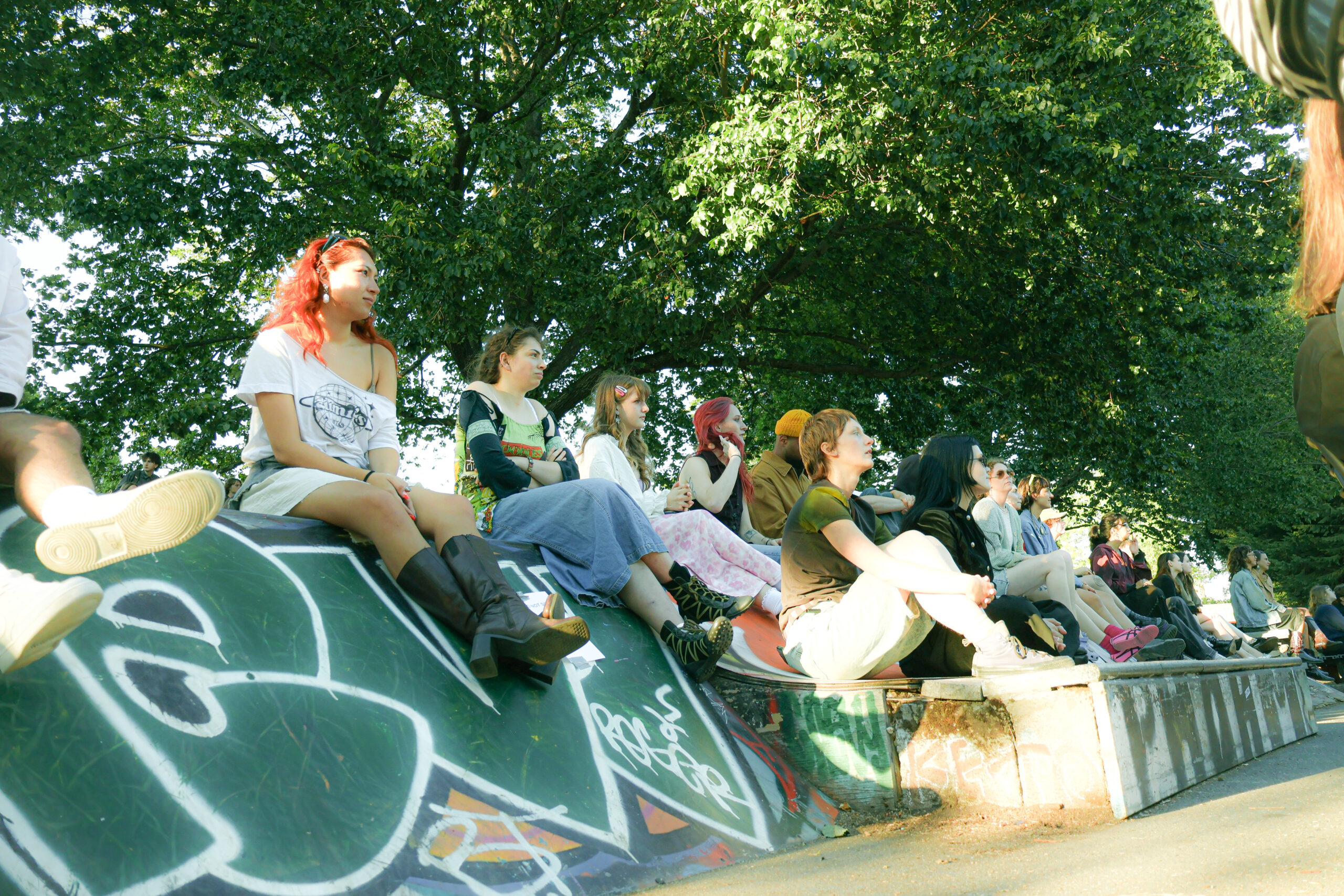
Photo by Zoe Trottman.
Perched on a wooden skate ramp, wearing a “VicFits” tank they’d spray painted 20 minutes before the show, Elhav looked out towards the lingering crowd and smiled.
“I love the skate community here, and my goal for this show is literally to just put them on a pedestal … we just really love this place and want to preserve it. And the way you preserve it is that you use it and you love it and you take care of it.”