Sign up for the Slatest to get the most insightful analysis, criticism, and advice out there, delivered to your inbox daily.
Ko Bum-seok, the local police chief of Hope Harbor, a small South Korean village near Korea’s Demilitarized Zone, stands over a massive dead cow, cursing. The cow—which has been mauled but, interestingly, not eaten, by an unknown large creature—lies in the middle of a road, blocking traffic. Bum-seok (Hwang Jung-min) is made aware of the carcass by his cousin, Ko Sung-ki (Zo In-sung), a member of a local group of hunters. The boys lie to Bum-seok that the cow was killed by a tiger, and it doesn’t take much for him to believe them. As nearby wildfires have isolated the village from communications with the outside world, Bum-seok asks his cousin’s group to follow the beast’s trail and catch it, while he heads into town to investigate the matter further. What he finds is a community in the throes of devastation: Storefronts are demolished, cars are toppled, and the town is empty except for the occasional band of men, heavily armed, yelling and riding around on trucks attempting to shoot at something Bum-seok can’t see. The wildfires have diverted all available police backup, rendering Bum-seok the town’s lone defender, at least in theory. It’s been mere minutes, but we’ve been injected into what feels like a scene from a war film after the battle is over—except Hope Harbor’s battle has only begun, and the town is losing.
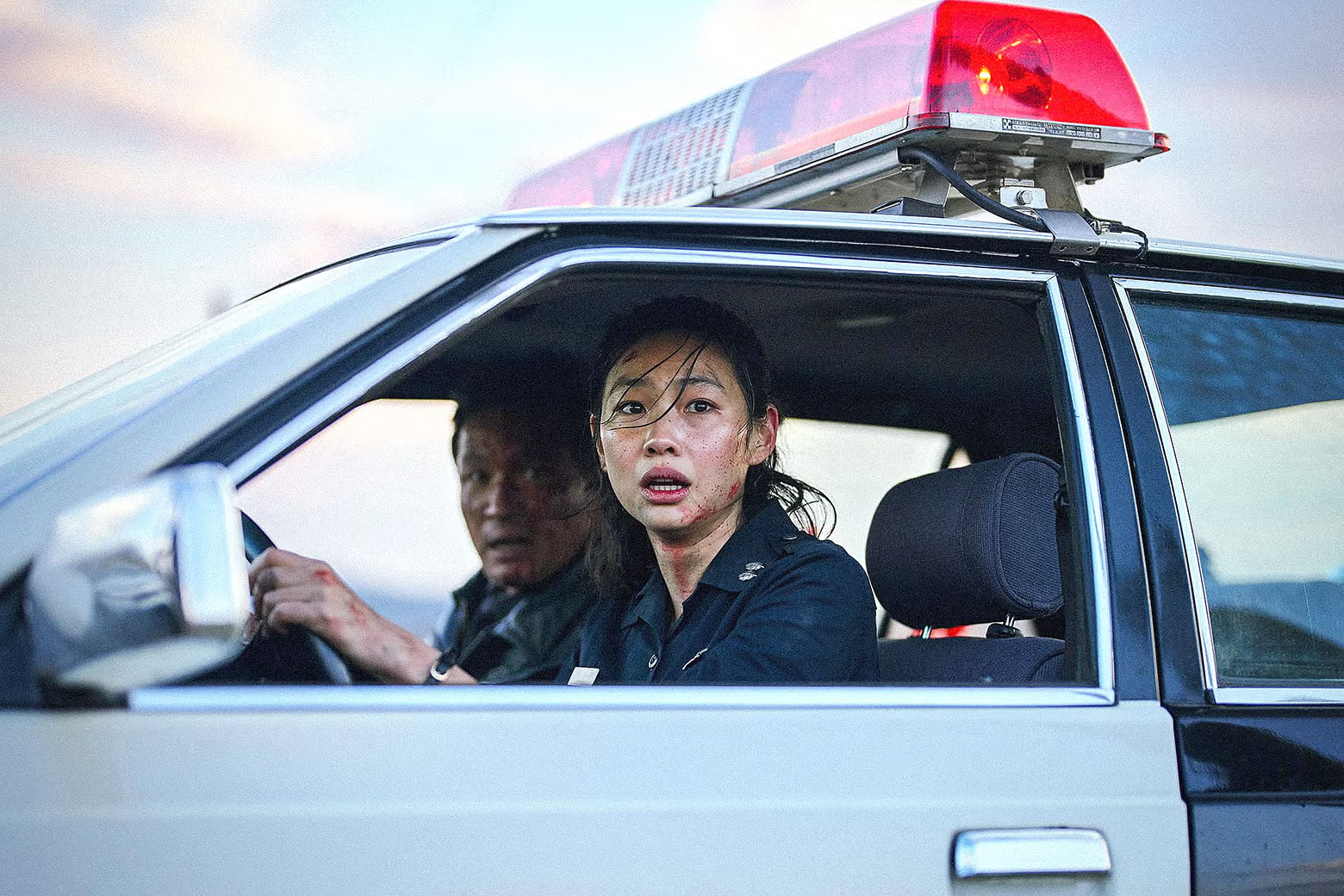
This is how Hope, the new sci-fi action-thriller from South Korean filmmaker Na Hong-jin, begins. Coming on the heels of his previous feature-length film—the 2016 horror flick The Wailing, which achieved universal critical acclaim and is generally considered a masterpiece—Na is back after a decade with what is arguably Korea’s most high-profile release yet. Hope, a two-and-a-half-hour romp, is reportedly the most expensive Korean feature film ever produced, with a budget of approximately $46 million (KRW70 billion), and is said to be opening on 1,500 screens (including in special formats, like 4DX), making it the widest Korean film release since Parasite. The fanfare makes sense given the picture’s larger-than-life exploration of a hokey small-town police chief, Bum-seok, who must team up with his gung-ho rookie deputy, Im Sung-ae (Squid Game’s Jung Ho-yeon), to protect their small town of mostly elderly inhabitants from a mysterious monster. The cast involves a mix of veteran Korean actors, like Hwang and Im Hyun-sik, alongside well-known Western actors, such as Michael Fassbender, Alicia Vikander, Taylor Russell, and Cameron Britton. And yet, for all that star power, reviews for Hope remain mixed at best, with a score of 67 on the review aggregator Metacritic.
I can understand why many critics would take a middle-of-the-road stance with this movie, which attempts to infuse elevated comedic writing with a hilariously silly use of visual effects, not always successfully. But this is actually what makes Hope so special and, above all else, deeply entertaining.
The opening set piece of Hope—an hourlong scene of Bum-seok going through a demolished Hope Harbor in pursuit of the monster—is fantastic. With the village consisting of a maze of small alleyways and paths, you soon realize how chilling it is to hunt for something that could be lurking around the corner when your whole town is all corners. Bum-seok passes dead bodies everywhere, many of the fallen his friends. And he encounters a number of interesting townies, from a retired colonel to a group of badass locals with a surprisingly large artillery—“Where did you get these?” Bum-seok asks regarding the firearms, in what would become a running joke, given South Korea’s incredibly strict gun regulations versus the manifest need for weapons here—who try to kill the creature, only to have their truck thrown into the air and crash-land near the officer minutes later. As the action cuts over to Sung-ki and his men in the woods hunting for the beast, unaware that it is ravaging their hometown, and making chilling discoveries of their own, the opening hour of Hope contains some of the most exhilarating and interesting “chase” sequences I’ve seen in some time.
Yet, while the danger remains palpable, Hope’s opening is also a masterful comedic epic. As in Dog Day Afternoon, when Al Pacino magnificently bumbles through the opening bank robbery, you just know you’re in for a wild ride. Bum-seok’s gullibility regarding the tiger should have been the first sign that he is lacking in skill. He falters at every loud noise, falls over himself, attempts to put extra bullets in his pocket without realizing they are simultaneously falling out, and shoots at the wrong people because he’s too scared to even open his eyes. It’s a wonder he got the job in the first place, considering that the older (and mysteriously armed) constituents of Hope Harbor have more composure and gumption than Bum-seok, who hides behind the cool veneer of his sunglasses and heeled boots. Throughout the film, everyone gets in on the comedy—like an elderly local, Mr. Hae-sul (Im), who shows up for one scene wherein he reveals some pertinent info regarding the creatures to Sung-ae via a long, poop-centric anecdote that had my screening in stitches.
But after this promising opening, Hope fails the No. 1 rule of great horror: Don’t show the monster, at least if it’s not really amazing. And what’s shown is a rather ridiculous CGI composition, in which the monsters—who are portrayed by Fassbender, Vikander, Britton, and Russell in a nature I won’t spoil here—look like the types of creatures a child who grew up on Power Rangers might draw. They are instantly recognizable as their human, actor selves, which makes the suspension of disbelief that much harder. The tonal difference between the sound writing of the human interactions and the rudimentary feel of the story’s monsters is whiplash-inducing. The film then begins to offer up far more questions than it cares to answer.
Hope may not be perfectly even throughout, but it is unbelievable—in the best sense—that these kinds of deeply foolish moments can still happen on big screens today. The way that the movie vacillates between being actually good and so bad it winds up good is a delightful experience, if you can be open-minded enough to have some fun with it. Taken together, it feels like an immediate cult classic, where you simply can’t believe that someone committed some of these things to film but are so grateful they did. It’s both a movie you laugh with and one you laugh at, and it’s made better by that fluctuation. Sure, there is a lot that Hope seems to be trying to impart about, say, empathy for foreign beings we may not understand or about the strength of tight-knit, insular communities. But none of that is as palpable as the sheer thrill of the adventure it takes you on. In an era when everyone is worried about technological advancements rendering cinema and art soulless, Hope manages to feel uniquely human.