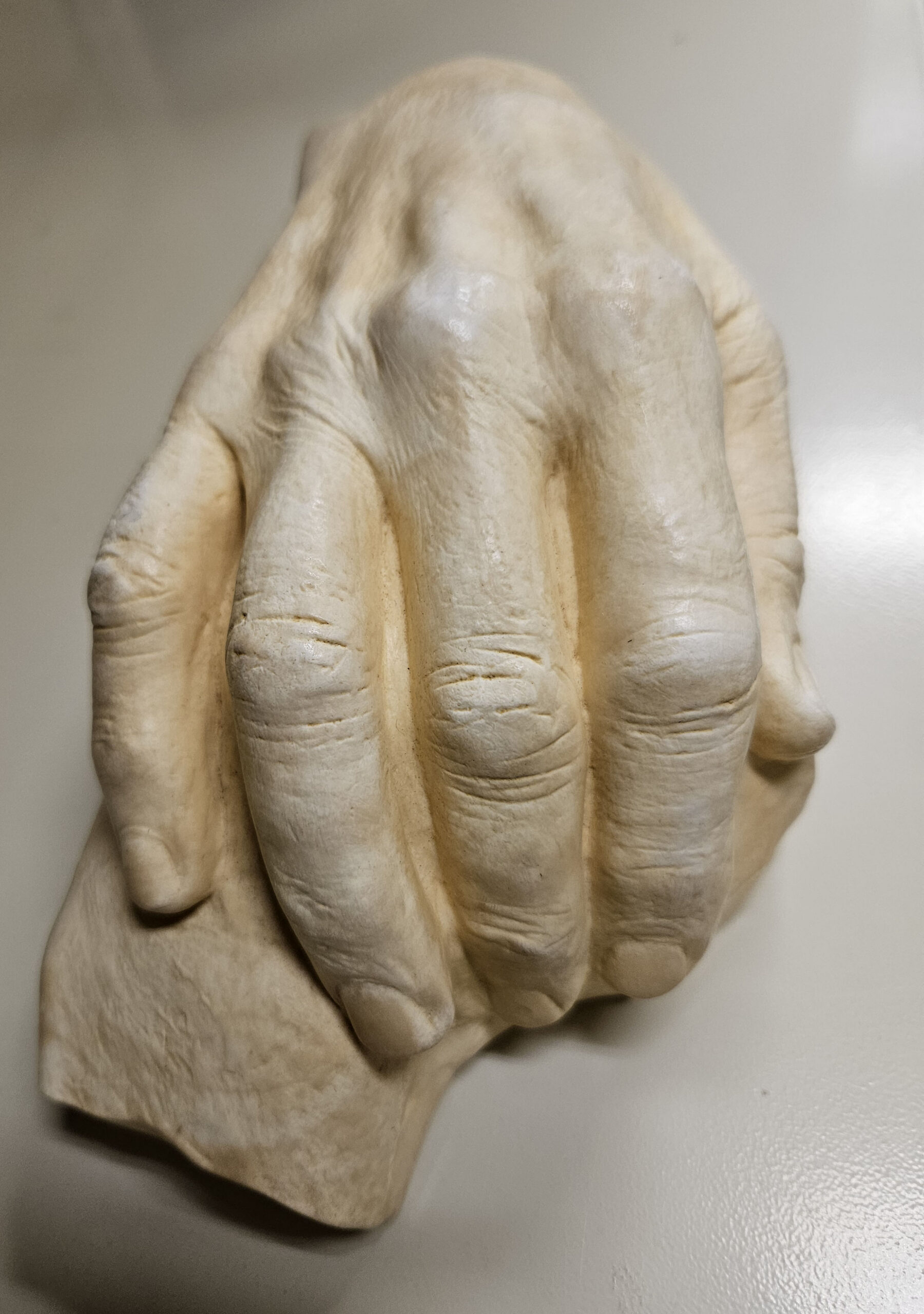
Everyone remembers their first time purchasing a plaster hand. Mine is a gripping story. I was in Weimar, Germany, and found Franz Liszt’s right hand in a gift shop. The incredulous look of the person at the register paled only in comparison to that of the agent screening my bag at the airport on the way home. Nothing shuts down the hum of activity like being loudly asked, “Sir, are you transporting any body parts?”
I wasn’t thinking fast enough, or I might have explained that even the Library of Congress has its hands in this type of collecting, although their reach is not as great as you might expect. One can count the number of hands on two… there are just a half dozen or so examples in the Music Division, and they are largely plaster casts of phalangeally phenomenal pianists (who also tended to be composers).
An exception at hand belonged to Charles Martin Loeffler, whose music was the second to be heard in the famous Coolidge Auditorium on October 28, 1925 (his “Canticle of the Sun” immediately followed J.S. Bach’s “To God on high all glory be,” BWV 715). Loeffler was a well-respected violinist in addition to being a major composer of the day, and we have a cast of his hand (w)ringing the neck of a similarly torso-less violin.

Our next holding comes in a pair, and it is easy to imagine the famed composer Erich Korngold seated at the piano, playing themes from his latest opera or an upcoming studio hit. The Library holds the bulk of Korngold’s musical output in its Erich Wolfgang Korngold Collection, which includes correspondence, business papers, programs, and photographs in addition to many of his extant manuscripts. In Korngold’s film scores, the music was sometimes self-referential with operatic leitmotifs, making the score a self-aware meta-corpus of sorts, much as his hands had an autonomous metacarpus (had to work for that one).
We then have the right hand (upon which he could always depend) of Ignace Jan Paderewski, the famed Polish pianist and politician. As is often the case with famous figures, their traces can be felt across the special and general collections in the Library. In Paderewski’s case, researchers can explore photographs, programs, and writings in the Helena Liibke Collection on Ignace Paderewski, with a pinch of further materials including programs, caricatures and correspondence sprinkled throughout its holdings.
Diverting from our plaster cast of characters, we have the bronzed hands of Danny Kaye, realia from the Danny Kaye and Sylvia Fine Collection. Despite not reading music, Kaye drew on his innate musicality to conduct orchestras to help them raise money, with Victor Borge-like antics added to his routine. His hands were mounted—an unusual condition, he might note—in such a way that it seems like they are perhaps set backwards, if looking from the perspective of a pianist or conductor. But if displayed the right way, palms-up in a “Who, me?” gesture, they embody the spirit of the entertainer. Had they been cast in gold, they surely would have won a Palm d’Or.

Just when you thought it was too much to handle, there aren’t many hands left to shake a stick at. Our next contributor was best known as a pianist, but he was also an influential pedagogue, composer, and editor. I came to know him as a child through his editions for Schirmer of Chopin and Liszt and others. Let’s give a hand to the incomparable Rafael Joseffy, whose apropos appendage is held in its own nest-like bed. In addition to several manuscripts of short piano pieces, the Library also holds drafts and sketches of his technical exercises related to his “School of Advanced Piano Playing.” Be warned: we have not been able to put our finger on an index, but these kinds of manuscripts are always fascinating to thumb through. There is much to discover in these folders for those whose piano technique could use a helping hand.
Lastly in our brief survey marking the mitts of the Music Division, we have Nicolai Medtner. We have several works in manuscript by Medtner at the Library, including a special and newly relevant work that was acquired not too long ago: Medtner’s piano quintet, which was among his final works and was of great personal significance to him, as he worked on the piece for over forty years. Mostly known for his piano music and the sonatas in particular, Medtner left just a few examples of chamber music, and the piano quintet is his swan song. The hand of the great composer-pianist can be felt throughout the piece, and the Coolidge Auditorium will witness its first performance of the piece, with the manuscript on display. The concert will take place on Friday, November 13 at 8pm, and features the Bennewitz Quartet with pianist Arsentiy Kharitonov. Click here for more information.
While it is nice to connect to our resources remotely in this digit-al age, you can always come by the Performing Arts Reading Room for a more hands-on encounter with our collection items. All hands are on deck to point you in the right direction in response to any research queries, be they (t)humble or a handful.