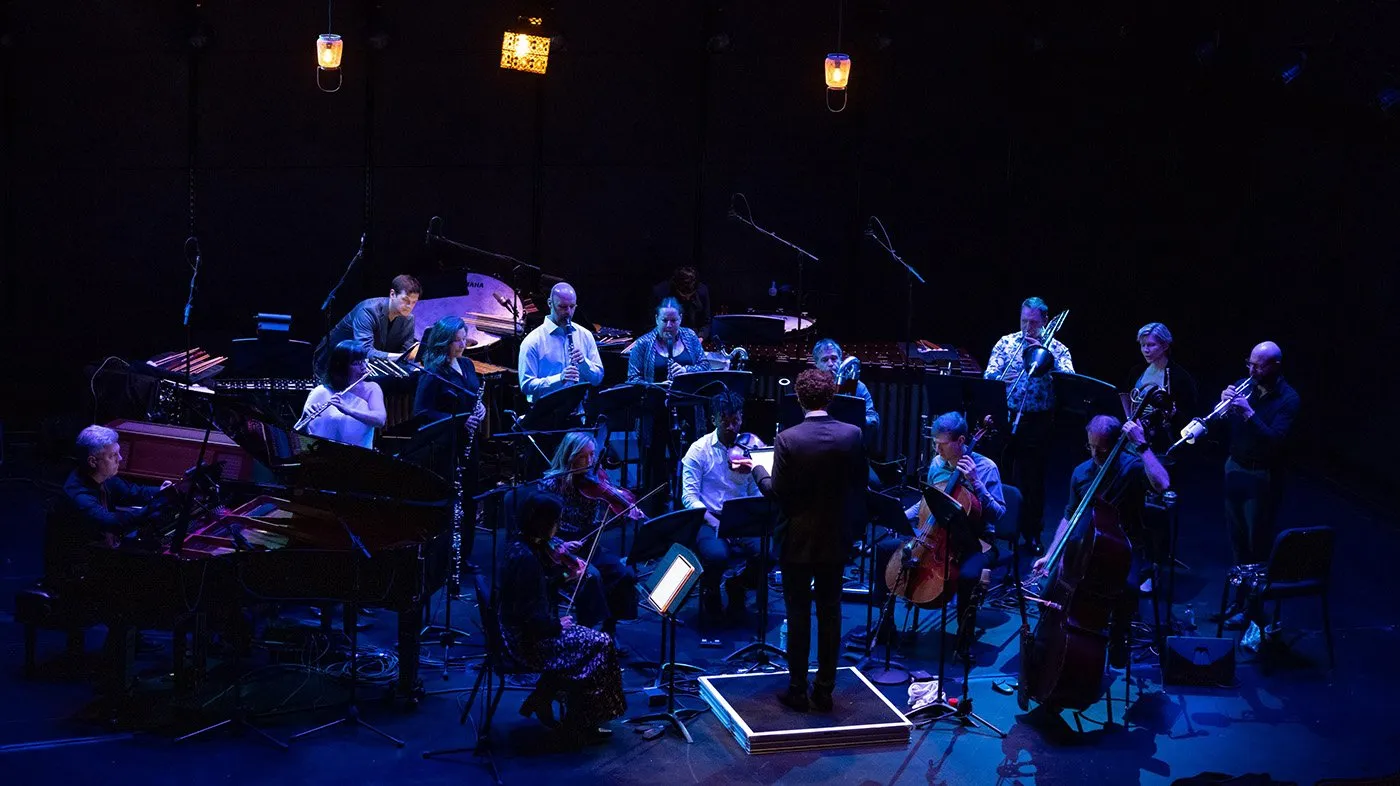
Alarm Will Sound, one of New York’s premiere new music chamber orchestras, performed in the Thursday Night Music series at the Isabella Stewart Gardner Museum Calderwood Hall, October 29th, 2026. Rather than presenting a concert of multiple works, conductor Alan Pierson lead AWS through Georg Friedrich Haas’s towering 2000 work in vain, one of the most talked-about pieces of the Spectralist catalogue. Heavily inspired by the work of Tristan Murail, the concert-filling 70-minute work also famously requires changes in the hall lighting to reflect its programmatic material, plunging the hall into darkness, even sans stand lights for performers and conductor, forcing musicians to memorize the music and play in the dark.
Considering that this piece is spectral in composition, Haas makes frequent use of just intonation (hereafter referred to as JI), pitches in music tuned to their proper frequencies over a given or implied fundamental to represent actual overtones. The way these are combined then creates different timbres from instruments within the ensemble. This practice was especially noticeable in the strings, where the majority of the ensemble (Courtney Orlando, Christopher Otto, and Austin Wulliman on violin; Andrew Griffin and John Pickford Richards on viola; Irene Han and Jordan Bartow on cello; Pat Swoboda on bass) frequently played differently tuned sul ponticello passages with each other. Rather than sounding crunchy and harsh, the dissonances lined up and created bright and dark timbres composited from the interlocking overtones. This playing style is not only extremely difficult to execute, but when done correctly, it sounds effortless. Erin Lesser and Brandon Patrick George on flutes, Christa Robinson on oboe, Bill Kalinkos and Madison Greenstone on clarinets, David Bennette on saxophones, Michael Harley on bassoon, Laura Weiner and Nicolee Kuester on horns, Michael Clayville and Tim Albright on trombones, and Iwo Jedynecki on accordion, spread out their sounds, showing how the entire ensemble could alter own pitches. John Orfe on piano, Christ P. Thompson and Matt Smallcomb on percussion, and Jacqueline Kerrod on harp further supported the ensemble, though their instruments weren’t as able to adapt to JI, meaning they cut through with ET intervals at various points to great effect.
Audio engineer Daniel Neumann (and possibly lighting engineer, as the program makes no mention of any additional personnel for that role) supported the ensemble, while Pierson provided direct and sharp control of the ensemble, other than in the moments in darkness. Through his spare conducting, Pierson communicated his ideas clearly; this reviewer definitely felt comfortable under his guidance. The aforementioned lighting change in the hall was used to excellent effect. This reviewer has experience performing in darkness, chiefly in the role of improvisation ensembles, and so understands the requirements of listening intently across multiple voices of the group being performed with. Suffice to say, it is quite challenging when the music is freely improvised, let alone meticulously notated, let alone even further comprised of exact microtonal tuning. The experience in hall is quite different from recorded versions of the piece, adding in the inherent theatricality of the performance requirements. On its own, the music itself, while engaging, sometimes falls into the traps of Spectralism: it does one thing in the form of using justly tuned intervals in interactions to create different colors and timbres. If one is looking for a melody or harmonic sequence or even intervallic sequence, it will not usually be found here. Of course, the piece does that one thing exceptionally well, but it is worth noting that the work could be trimmed down by 10-15 minutes without losing much of its identity. Interestingly, Haas also makes use of infinitely falling and infinitely rising material near the climax of in vain, executing the Shepherd’s Tone well across a vast chamber orchestra, something that some of the other Spectralist composers don’t always achieve.
Kerrod had some well executed harp solos breaking up some of the JI harmonies, sharp attacks piercing the harmonic field. Jedynecki blended his accordion well into the winds and even the strings, making it a chameleon within the ensemble. Like many Spectralist pieces, the sounds emerged from the lowest pitch, a double bass fundamental, handled powerfully by Swoboda.

Alarm Will Sound operates at the forefront of modern compositional practice. Engaging with many of today’s most sought after and emerging composers, AWS shows that it can practically do anything asked of the ensemble. Perhaps we in Boston will (hopefully) see more of this wide-ranging practice soon.