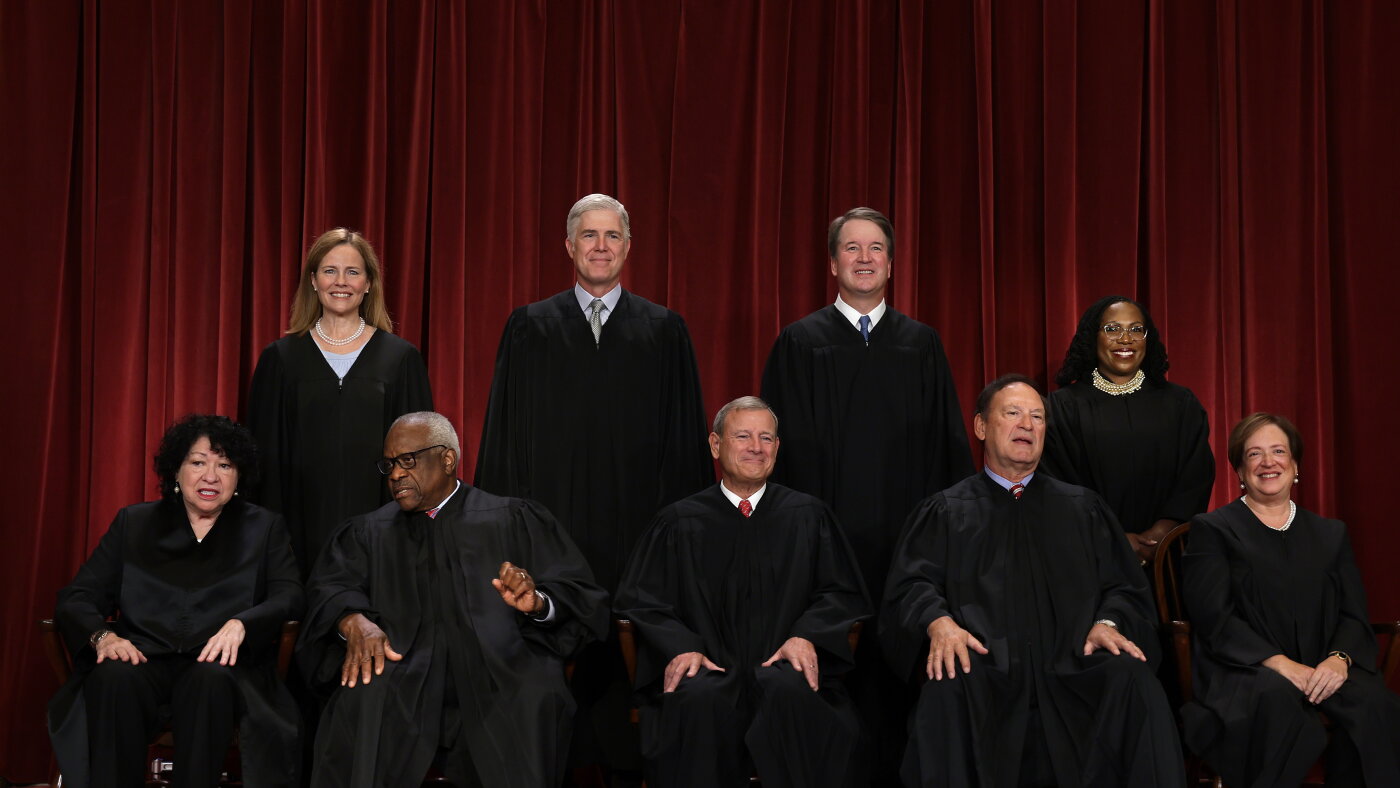

Four of the nine Supreme Court justices — seen here in their 2022 official portrait — recused themselves from a music copyright case this week, meaning there was no quorum to hear the matter.
Alex Wong/Getty Images
hide caption
Alex Wong/Getty Images
Something unusual happened at the Supreme Court this week: so many justices stepped aside from a case about music copyrights that the court could not hear it.
Major publishing companies and lobbying groups for movies and the recording industry all lined up this past summer to ask the Supreme Court to accept a case about who owns foreign copyrights.
Two of the most prominent lawyers who practice before the high court, Paul Clement and Lisa Blatt, had contributed briefs in the case. Yet the court never got to the substance, apparently because of extracurricular work by nearly half of the justices.
Legal observers say the situation highlights a broader institutional issue with the court’s recusal policy, which is largely self-enforced.
“All this work was done, probably hundreds of lawyers participated in this matter, they all strategically said, ‘Let’s bring this case to the court now,’ and then what happened?” asked Josh Blackman, a constitutional law professor at the South Texas College of Law in Houston. “There’s no quorum.”
No quorum, because four of the nine justices recused themselves. The court did not explain why Sonia Sotomayor, Neil Gorsuch, Amy Coney Barrett and Ketanji Brown Jackson stepped away from the case.
But the watchdog group Fix the Court has an idea: All four of those justices have book deals with Penguin Random House, part of a German conglomerate that’s a party in the music copyright case.
“When you have a financial stake in a party or your finances could somehow be impacted by the outcome of a case, under federal law and the Supreme Court code of conduct, the justices are supposed to recuse,” said Gabe Roth, who leads Fix the Court.

Good news, bad news
Roth and other experts said this is a good news, bad news situation. It’s a good thing the justices followed the recusal rules, they said.
But the recusals in this case point to a deeper problem, said Renee Knake Jefferson, a legal ethics expert at the University of Houston.
“When four justices need to step aside, the Supreme Court can no longer decide the case, and that becomes an institutional problem, not just an individual ethics issue,” she said.
This problem is acute at the nation’s highest court, because “there’s no other justices who can step in and substitute for them,” Knake Jefferson added.

Knake Jefferson said the justices who want to write books could put money from their advances and royalties in separate accounts, that they couldn’t touch until retirement. The court had no comment on that proposal.
Three years ago, the Supreme Court published a code of conduct. But the long and short of it is, the justices largely police themselves.
Blackman, the law professor, said Congress should pass legislation to address the book royalties issue.
“We need to have the justices focused on their day job more,” Blackman said. “Grant more cases, decide more opinions, write more. The books are fun, but that’s not why they’re there.”
Tim Kappel is a lawyer for the songwriter in the case the court declined to hear. In a written statement, Kappel said the recusal speaks to the broad impact of copyright law and the expansive definition of what it means to be an artist.
“This fight was and will continue to be on behalf of all artists, even those who happen to sit on the Supreme Court,” Kappel said.