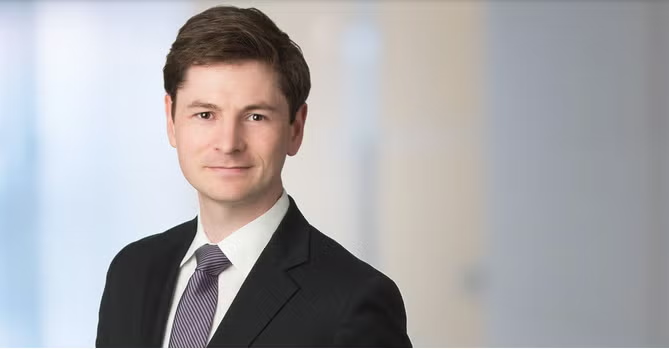
David Munkittrick, OC ’07, studied Piano at the Conservatory and History in the College before pursuing a career in law. His interest in music, however, has remained an important part of his professional life. After attending law school, he joined Proskauer Rose LLP, working in music litigation practice. He recently returned to Oberlin to lead a workshop on music copyright and artificial intelligence, exploring the legal questions surrounding use of copyrighted music in generative AI.
This interview has been edited for length and clarity.
What initially drew you to pursue a double degree at Oberlin?
When I was looking at colleges in high school, I was pretty much 100 percent certain that I wanted to do some kind of double degree. The focus at the beginning was always on music. I thought that was where most of my time and attention would be, but I liked school too much to give that up. I also wanted to have an academic side to my education. And Oberlin, frankly, seemed like the best possible place to do that.
At what point did you begin considering a career in law?
For my first three-plus years at Oberlin, music was the focus. I thought whatever I did after Oberlin would involve piano or performance in some way.
Then I made this fateful decision in my junior year to stay in Oberlin over the summer to work, make some money, and practice and learn repertoire for recitals and competitions. Oberlin is perfect for doing those things over the summer, but it’s also dead: there’s just no one there.
I had this moment sitting in a practice room in Robertson Hall when it hit me that I didn’t think I wanted to do this for the rest of my life. I knew I wanted to continue with school, so I started looking at history and musicology graduate programs. They were interesting, but seemed like more of the same. I wanted something different.
Almost randomly, I came across a law school program and started looking at the curriculum. Out of everything I had considered, that was what caught my attention most. I think part of it was the historical element, reading old case law and learning how our systems and laws develop. It also involved American history, which interested me after studying European history, and had a practical element –– an understanding of how things work in the real world.
I decided to pursue law school, but first I did an internship with a judge in Minneapolis the following summer to make sure it was a world I wanted to enter. That went well, so I took the LSAT and went to law school.
Did your background in music influence your decision to pursue copyright law?
I don’t know if it was necessarily because I studied music, but my interest in music certainly did. I knew I wanted to keep music as part of my professional life if I could. There are a lot of different ways to remain involved in music, but I focused on copyright in law school, and it was one of the reasons I came to Proskauer and got my foot in the door with its music litigation practice.
There are a number of ways studying music informs the practice of law, but one of the main ones is the work ethic, dedication, and focus that it takes. When I went to law school, I saw other students from different disciplines and majors really struggle with the level of work that law school demands, but I basically just switched practice hours to study hours.
For musicians who may be less familiar with copyright law, could you explain the distinction between the rights associated with a musical composition and those associated with a particular recording?
This is what makes music copyright complicated. Whenever you’re doing something with music, you’re almost inevitably dealing with two different copyrights and two different copyright holders: one for the composition and one for the sound recording. Different people generally own those two different rights. In the music business, record labels own the copyrights to sound recordings, while songwriters, composers, and music publishers own or control the copyrights to compositions.
For example, if I publicly play a sound recording, that’s a public performance, which is one of the rights protected by copyright. But if I’m performing both the recording and the composition, I need permission from both the composition owner and the recording owner.
Does your experience as a musician affect the way you think about AI’s implications for artistic creation?
I think it does, because I have an idea of what a musician’s perspective might be. But talking to different musicians in different areas of the industry, I know there’s a wide range of views on AI.
Some composers are using it as part of their composition process. Some songwriters think it’s the best thing that ever happened to their careers: suddenly, they can take songs that have been sitting around, get them finished, and get them out the door.
Despite that, I think just about everyone has some level of concern or worry about what AI means for the future of music, musicians, and their livelihoods.
That’s already happening on Spotify and other platforms. They’re being inundated with AI-created tracks, and some of them are getting lots and lots of listens.
What advice would you give students navigating artistic and professional careers amid these technological changes?
Don’t ignore technology. You don’t have to be pro-AI, and you don’t even have to use it. But if you ignore it and have no idea how it works or functions, or how to use it, you’re likely to be left behind.
The future economy and marketplace are probably going to require some facility and familiarity with these new technologies.