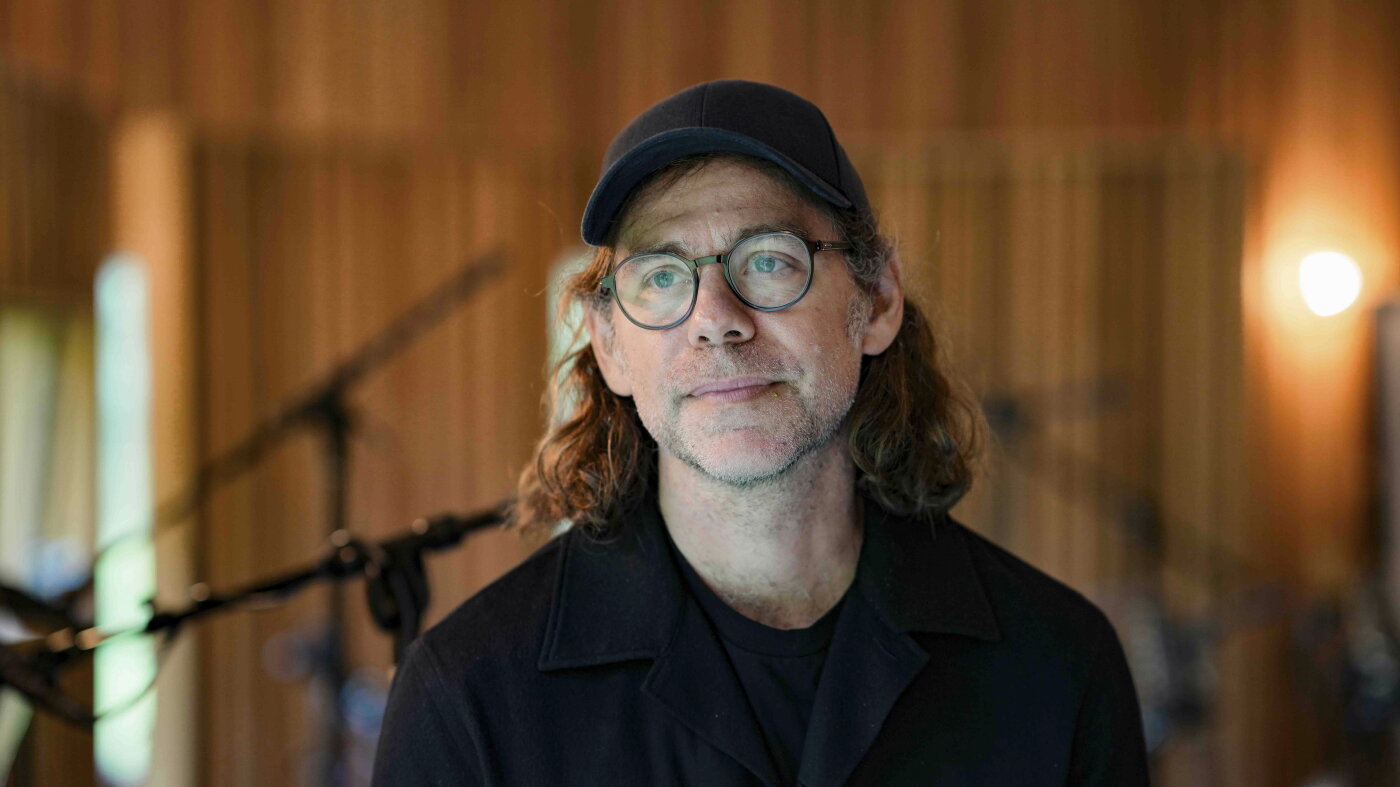

Aaron Dessner, a musician, producer and songwriter, at Long Pond Studio in New York’s famed Hudson Valley. He has produced songs and albums for Taylor Swift, Noah Kahan, Laufey, Ed Sheeran and Gracie Abrams.
Keren Carrión/NPR
hide caption
Keren Carrión/NPR
Noah Kahan’s fourth studio album, The Great Divide, opens with a gentle piano melody that trickles in over the hum of late summer air, thick with humidity and a slight buzz of crickets. The slow introduction sets the scene of a changing season before unspooling into the breakout star’s changed outlook on his hometown. But that first moment of serenity also captures the essence of Long Pond Studio — New York’s famed Hudson Valley outpost of producer Aaron Dessner — where Kahan traveled to write and record several songs on the album.
“I think this place reminds him of where he grew up. It’s disarming,” Dessner told NPR on a recent visit. “You feel very far from the music industry. You feel very much in nature.”

Dessner walks the grounds surrounding the studio.
Keren Carrión/NPR
hide caption
Keren Carrión/NPR
Surrounded by farmlands and towering willow trees, Long Pond is an unassuming wooden building resembling a horse barn. That’s what it used to be when Dessner, best known as a member of the rock band The National, moved here with his family over a decade ago from Brooklyn. Inside, the studio is an open room with tall ceilings and cedar-paneled walls that evoke the earthy scent of a sauna, instruments stationed all around. Large windows overlook the studio’s namesake pond out back, which is enveloped by shrubs and greenery. The idea, Dessner says, was to be able to see water from any point inside the studio. When artists visit to work with him, they typically stay in the studio’s spare room, which is on the same property as Dessner’s family home.
“It’s very nourishing. There’s so much oxygen and there’s so much light,” he says, relaxed yet soft spoken on his living room couch. “I think there’s artists that are coming from more of an urban existence. It can be jarring at first. They can be kept awake by the crickets or the frogs, or they’re scared of the bear that lives across the pond.”

Laura Sisk (left), Taylor Swift, Jack Antonoff and Aaron Dessner accept the album of the year award for Folklore at the Grammy Awards in 2021.
Kevin Winter/Getty Images for The Recording Academy
hide caption
Kevin Winter/Getty Images for The Recording Academy
Long Pond has been mythologized in pop culture since 2020, when Taylor Swift traveled to the secluded studio to record a live version of her critically acclaimed album Folklore, along with a Disney+ documentary called Folklore: The Long Pond Studio Sessions. She and Dessner had worked on the album remotely during the pandemic, which was a total shift from the synthpop of 2019’s Lover. It became one of Swift’s most celebrated releases of her career, and led to a years-long creative partnership between the two. It also turned Dessner into a sought-after producer for a rising class of pop stars and singer-songwriters, including Laufey, Ed Sheeran, Gracie Abrams and Kahan.

In that role, Dessner oversees much of the creative and technical process of writing and recording. He cultivates a kind of rustic, lived-in sound on the songs and albums he works on, often leaning into live instrumentation and the atmospheric feel of the studio. Some artists, he says, like Abrams, stay on the property for weeks at a time, leaning into the isolated and unplugged feel of the space. Dessner says almost all of his collaborations start off with a personal connection: someone he met through a friend or mutual colleague or even at the Grammys. The Recording Academy has recognized Dessner in the past for his collaborations with Swift and for his music with The National. This year, several albums he’s worked on — including Kahan’s, Abrams’ and Brandi Carlile’s — are bound to get Grammy nominations. And for the first time, Dessner may also be nominated for producer of the year, non-classical.

A note from Taylor Swift is left on Dessner’s audio console.
Keren Carrión/NPR
hide caption
Keren Carrión/NPR
It’s an interesting pivot for a musician and songwriter who grew up learning to play songs by the Grateful Dead and later cut his teeth in the New York City indie scene. Dessner and his twin brother, Bryce, started The National with friends from Ohio in the 1990s. In the early days, he says, the band would book its own shows and often play to empty rooms. The National’s rugged, brooding sound would eventually grow to have a massive following; Dessner also branched out with the folk project Big Red Machine alongside Justin Vernon. He’s produced albums for rock peers including Sharon Van Etten and Local Natives, but many of the stars he works with now have very different careers.

Bryce Dessner, (left) Matt Berninger and Aaron Dessner of The National perform onstage at the Brooklyn Academy of Music in 2010.
Roger Kisby/Getty Images for American Express
hide caption
Roger Kisby/Getty Images for American Express
Artists like Kahan and Abrams have mostly come up in a musical landscape increasingly defined by streaming numbers, social media followers and viral soundbites. Dessner is quick to point out they’ve hustled just as hard as he did in his early days of gigging — but he acknowledges that the side of the music industry he came from doesn’t carry the same parasocial glare as the one they inhabit. As a result, the 50-year-old maintains the quiet sensitivity of someone who has largely stayed out of the spotlight.
“I make music for emotional reasons, primarily. When I was a kid, it was a way of calming myself. If I had anxiety or if I was depressed, it was an outlet,” he says. “Then it became healing. I still relate to it primarily that way, and I really don’t think that much about music in a commercial way or in a commodified way.”

That demeanor seems to bring out something visceral in his collaborators. When Kahan arrived at Long Pond, Dessner says, the 29-year-old wasn’t expecting to make anything just yet; he mostly just wanted to hang out and decompress. He was coming off the meteoric success of his breakthrough album, 2022’s Stick Season, and all the touring and press demands that came with it. Dessner says Kahan was burnt out, and he wanted to give him the breathing room he needed. Many artists, he says, are often in a fragile state when embarking on a new project. His approach is to go in with a light touch.

Noah Kahan performs at the Grammy Museum on Sept. 3 in Los Angeles.
Alison Buck/Getty Images for The Recording Academy
hide caption
Alison Buck/Getty Images for The Recording Academy
“I try to really let there be space for uncertainty. I try not to come in with some big notion already, like, ‘Let’s make this kind of record,'” Dessner says. “I know that a lot of producers do that, but it’s just not my interest. I’d rather see where someone is and what chemistry or alchemy there might be between us in the room.”
With Kahan, the songs started bubbling up almost immediately. They wrote “Porch Light” on that very first day, a banjo-driven song that slowly builds into a complicated reckoning with Kahan’s newfound fame and its impact on his loved ones. The pair continued working together through late summer 2025, when they recorded the album’s opening track, “End of August,” with the studio doors open and the sounds of the surrounding forest pouring in. Sonically, Dessner’s production adds an understated elegance to the songs he works on, crafting melodic patterns that become almost meditative through layers of strings, piano and percussion.

Top: A variety of guitars are set up next to a drum kit and other musical equipment at Long Pond Studio. Left: A section of Dessner’s audio console. Right: Dessner plays the piano.
Keren Carrión/NPR
hide caption
Keren Carrión/NPR
His knack for getting people to open up, both emotionally and creatively, extends far past the young stars whose sound he’s shaping. In 2024, the day after hosting and performing in two landmark concerts with Joni Mitchell at the Hollywood Bowl, Americana superstar Brandi Carlile flew out to Long Pond. She says she felt hungover in multiple ways; she was reeling from the end of a years-long collaboration with Mitchell, which led to the iconic artist’s first public performances in decades. Carlile had also recently recorded an album of duets with none other than Elton John. She says she needed to find a way back to herself; the meeting with Dessner was supposed to be the last “business” commitment on her schedule before taking a break. Then she showed up late at night, without her guitar, and they just started talking.

“The conversation wound up being a little bit of a therapy session for me,” Carlile tells NPR. “I remember asking him, ‘Hey, from the perspective of a producer that doesn’t really have a dog in the race in terms of my life, where do you think I should go as an artist?’ And he had a couple of quiet thoughts, and then he explained to me the way we could write if we decided to do that together.”
Carlile posted up at the studio, which she says felt weirdly unsettling at first. Dessner largely left her to her own devices, and as she figured out where to turn on the studio lights or how to use the shower, being alone transformed from a sense of discomfort into a feeling of liberation. Together, they began writing and recording Carlile’s first solo project in years, 2025’s Returning to Myself, a more stripped-down and acutely intimate version of the singer-songwriter.

Brandi Carlile performs at the Grammy Museum on Oct. 12.
Rebecca Sapp/Getty Images for The Recording Academy
hide caption
Rebecca Sapp/Getty Images for The Recording Academy
“A lot of the sensitive work that Aaron does, he does before you’re there. He creates these pieces of music, and some of them are structural and some of them have soundscapes and then some of them are kind of personal,” Carlile says. “You become a guest in it, and whether you take the initiative to make it your own is up to you. [There’s] very little pressure from Aaron, but he knows who he is, and he knows what parts of his ideas to keep and which parts of his ideas to surrender to another collaborator.”
For the song “A War with Time,” Dessner played Carlile a sketch built around an electric guitar riff that reminded her of late-1980s, early-’90s songs by Mike + The Mechanics and Bruce Hornsby. She says the music instantly brought up vivid memories of her first visit to New York City as a 21-year-old, and lyrics started pouring out. While working at Long Pond, Carlile says, she sometimes became overcome with emotion, working through what she was feeling or remembering. Dessner gave her space to feel “unobserved,” continuing to play alongside her as she let inspiration flow.
“The collaboration with Aaron is not heavy or binding. It feels really innocent and free and like it could be whatever you need it to be,” she says. “It made me not have to consider all the weight and responsibility I have attached to me as an artist and in my life. I was really surprised at what it felt like to lay that burden down at Long Pond and just get to write some songs with somebody that was such a light presence, an unconditional presence.”

Dessner overlooks the long pond behind his studio.
Keren Carrión/NPR
hide caption
Keren Carrión/NPR
Leaning back on the couch of his converted farmhouse, Dessner acknowledges that it can be weird or even daunting to embark on such a vulnerable process with artists he might not know super well. But clearly, he’s fostering a deeply restorative experience for his collaborators. There’s another artist pulling up shortly after our interview, right around the time his kids will be back from school. For someone who stays as busy as he does, Dessner says he doesn’t really like knowing who’s on the schedule or what comes next. It makes him anxious; his manager books all of that for him. Rarely, he’ll make the first move. He recently reached out to Molly Tuttle, mostly as a fan, because he loves bluegrass and Americana. He says he’ll see if that goes anywhere, but for now, he knows this phase of his career has taken on a new timbre.
“It’s been a very strange turn of events for me, personally, that I went from making National music and Big Red Machine music and, like, weird art music with my brother — that somehow I ended up in these high echelons of pop music and mainstream music,” Dessner says, noting how much he likes sneaking odd time signatures and quirky song structures into that world. “I just naturally pick up instruments and play them, and to have that lead to this strange career … it’s crazy, and mostly, it’s joyful.”