Overall distribution characteristics
Data traffic
Figure 3 presents the visualization of the data flow and direction of 32,985 Ganlan buildings across China. It shows significant differences across three dimensions: provincial-level administrative divisions (13), ethnic groups (35), and types (5). The flow paths and quantitative allocation among nodes at different levels reveal clear interlacing and coupling relationships. At the provincial-level administrative division dimension, there is evident spatial clustering and segmentation. At the ethnic group dimension, the connection strength between different ethnic nodes and the number of Ganlan buildings shows magnitude differences. For the type dimension, the tributary flows display significant differentiation. Multidimensional flow variation provides an intuitive topological basis for analyzing the spatial distribution mechanisms of Ganlan.

The figure visualizes the flow and direction of 32,985 Ganlan buildings across three dimensions, where the left presents 13 provincial-level administrative divisions, the middle presents 5 Ganlan types, the right presents 35 ethnic groups, and the numbers denote flow values.
Number
Among the 13 provincial-level administrative divisions (Fig. 4), the number of Ganlan buildings exhibits a highly dispersed distribution. The difference between the maximum (Yunnan Province, 8166, accounting for 24.8%) and the minimum (Heilongjiang Province, 16, 0.04%) is greater than the interquartile range, indicating extreme unevenness in the regional distribution of Ganlan. Regarding the number of villages containing Ganlan, Guizhou Province ranks first, with 765 villages (25.8%), followed by Yunnan (665), Hunan (625), Guangxi (342), and Chongqing (149). In terms of county-level distribution, Yunnan Province also ranks first (112, 23.2%), followed by Sichuan (92), Hunan (66), Guizhou (64), and Guangxi (60).

In this figure, the Y-axis represents 13 provincial-level administrative divisions, and the X-axis represents quantity, including: a number of Ganlan buildings, b number of villages with Ganlan distribution, and c number of counties with Ganlan distribution.
Density
This study applied dot density estimation (DDE) to visualize the degree of spatial clustering of Ganlan and to quantify the density distribution weights within provincial-level administrative divisions. Figure 5 shows that the spatial distribution pattern of Ganlan across China is substantially influenced by geographical conditions, covering most regions south of the Yangtze River, with particularly significant clustering in the southwest. The distribution decreases gradually outward from this area and drops sharply in the eastern flatlands of the middle and lower reaches of the Yangtze River. The main center is located at the border areas of Guizhou, Guangxi, Hunan, Hubei, and Chongqing, where multiple density cores connect to form a concentrated belt-shaped “cluster”, which constitutes the core region of China’s Ganlan dwelling culture. Secondary centers are observed in Yunnan, western Guizhou, southern Guangxi, and Hainan. The main and secondary centers exhibit an east-west connecting pattern.

This figure shows the distribution density of 32,985 Ganlan buildings across China, the color gradient from green to red represents the spatial clustering degree from low to high (range: 0.85–216.68), the north river is the Yellow River, and the south is the Yangtze River.
Tables 2 and 3 provide the density rankings of Ganlan. The top three at the county level include Liping County, Guizhou (178.37), Congjiang County, Guizhou (149.03), and Longsheng County, Guangxi (135.28). At the prefecture level, the top three are Qiandongnan Prefecture, Guizhou (132.96), Xiangxi Prefecture, Hunan (116.13), and Guilin City, Guangxi (108.11). This reveals a clear spatial polarization phenomenon, with smaller clusters also observed in Anshun (Guizhou), Yulin (Guangxi), Honghe (Yunnan), and Haikou (Hainan). Areas outside these concentrated regions show a relatively dispersed distribution with large fluctuations.
Distribution characteristics by ethnic attributes
Number
The data show that the distribution of Ganlan across China covers 35 ethnic groups, nearly two-thirds of China’s 56 ethnic groups. According to the intervals in Table 4, five ethnic groups—namely, Miao, Tujia, Dong, Zhuang, and Yi—each have more than 3000 Ganlan buildings, accounting for 62.4% of the total; four groups—namely, Yao, Dai, Buyi, and Hani—have 1001–3000, accounting for 19.5%; four groups—Han, Naxi, Li, and Shui—have 501–1000, accounting for 16.2%; 11 groups, including Bai, Lisu, and Chaoxian, each have 101–500, accounting for 7.9%; finally, 11 groups, including Hui, Dulong, and Mosuo, each have fewer than 100, accounting for only 1.9%. Furthermore, Fig. 6 shows that the distribution of Ganlan numbers among the 35 ethnic groups is highly imbalanced, with a significant gap between the maximum (Miao, 6144, 18.6%) and the minimum (Pumi, 29, 0.09%), far exceeding the fluctuation range of the median values. In terms of ranking by single ethnic group, the top five are: Miao (6144, 18.6%), Tujia (4371, 13.3%), Dong (3433, 10.4%), Zhuang (3375, 10.2%), and Yi (3270, 9.9%).

The figure displays the number of Ganlan buildings for ethnic groups in descending order, where the Y-axis represents 35 ethnic groups, and the X-axis represents the number of Ganlan buildings.
Spatial distribution
Figures 7 and 8 show that the Ganlan of 35 ethnic groups presents interwoven, embedded distribution patterns across geographical space. For individual ethnic groups, the Han cover the widest area, spanning eight provincial-level administrative divisions: Yunnan, Guizhou, Hunan, Chongqing, Hubei, Guangdong, Fujian, and Taiwan. Next are the Miao, distributed across seven divisions, followed by the Yao and Zhuang (five divisions each), and the Tujia and Dong (four divisions each). Regarding the ethnic diversity of Ganlan within a single provincial-level administrative division, Yunnan Province ranks first (24 ethnic groups), followed by Guizhou (13) and Sichuan (7). Among the 35 ethnic groups, except for the Li in Hainan and the Chaoxian in Jilin and Heilongjiang (each confined to a single province), the Ganlan of the remaining 33 ethnic groups all exhibit cross-provincial interwoven and embedded distribution patterns.

This diagram analyzes the distribution weight of Ganlan buildings across two dimensions, where rows represent 35 ethnic groups, columns represent 13 provincial-level administrative divisions, and color intensity is proportional to the percentage of distribution association (0.0000–1.0000), as indicated by the color bar.

The figure shows the analysis results of the spatial distribution of ethnic groups inhabiting Ganlan buildings across China, where different colored dots represent the corresponding ethnic groups.
Direction
Based on the overall distribution of Ganlan in China, we conducted spatial analysis of the distribution of Ganlan among 35 ethnic groups using the standard deviation ellipse (SDE) method (Fig. 9). From the diffusion directions of SDE, the Ganlan distribution of each ethnic group exhibits a clear direction, with substantial variation in the azimuth angle θ. The two predominant diffusion directions are “west–east” (θ between 0.7° and 9.3°) and “southwest–northeast” (θ between 10.4° and 87.1°). Additionally, six ethnic groups—Dai, Bulang, Lahu, Dulong, Maonan, and Gaoshan—exhibit a “southeast–northwest” diffusion direction (θ between 15.3° and 77.8°).

The figure shows the analysis results of the spatial clustering degree on the distribution of Ganlan buildings across 35 ethnic groups using the standard deviation ellipse, where different colored ellipses and centroids represent the corresponding ethnic groups.
Table 5 lists the 10 ethnic groups with the highest concentration and dispersion levels of Ganlan distribution. Regarding SDE concentration and centroid coordinates, the Tujia exhibit the most concentrated distribution (standard deviation ellipse oblateness of 0.108); they comprise the border regions of Chongqing, Hubei, Hunan, and Guizhou, with the centroid located precisely at the junction of these four provinces/municipalities. The Chaoxian group ranks second in concentration (oblateness of 0.2); distribution is limited to parts of Jilin and Heilongjiang Provinces, with the centroid located in Yanbian Chaoxian Autonomous Prefecture, Jilin. Although the Miao have the largest number of Ganlan buildings, their distribution remains relatively concentrated (oblateness of 0.258); this group covers the entirety of Guizhou as well as most areas of Enshi (Hubei), Hunan, and Chongqing, with the centroid located in Zhenyuan County, Qiandongnan Prefecture, Guizhou. The Dong (oblateness of 0.294) are mainly clustered in Qiandongnan Miao and Dong Autonomous Prefecture, Guizhou, with the centroid in Liping County. The Yao (oblateness of 0.301) are primarily distributed in the border areas of Guangxi, Guangdong, Guizhou, and Hunan, with the centroid in Yongzhou, Hunan. Regarding dispersion, the Bulang show the most dispersed distribution (oblateness of 0.952), extending from Xishuangbanna Dai Autonomous Prefecture to Nujiang Lisu Autonomous Prefecture in Yunnan, with a pronounced “south–north” direction. The Hui follow (oblateness of 0.928), distributed across Yunnan and Guizhou with a distinct “west–east” dispersal pattern. The Bai (oblateness of 0.808) have their centroid in Dali Bai Autonomous Prefecture, Yunnan; however, due to scattered distribution in Hunan and Hubei, they present a broader “west–east” dispersal. The Naxi (oblateness of 0.738) and Dai (oblateness of 0.687) exhibit relatively obvious “south–north” and “west–east” dispersal patterns, respectively.
Distribution characteristics of type attributes
Number
Figures 10 and 11 show significant differences in the number of the five Ganlan types. Among them, Type III (Mature Ganlan), with 15,798 buildings (47.9% of the total), encompasses 21 ethnic groups and 11 provincial-level administrative divisions, making it the dominant Ganlan type. The remaining types are as follows: Type IV (Hybrid Semi-Ganlan, 7533 buildings, 22.8%) includes 11 ethnic groups and seven provinces; Type II (Primitive Timber Ganlan, 3702 buildings, 11.2%) includes 18 ethnic groups and three provinces; Type V (Enclosed Ganlan, 3595 buildings, 10.9%) encompasses five ethnic groups and four provinces; and Type I (Primitive Bamboo Ganlan, 2357 buildings, 7.1%) covers 11 ethnic groups and one province.

In this figure, the X-axis represents the number of Ganlan buildings, the Y-axis represents 5 types, and colors denote the corresponding 35 ethnic groups.

In this figure, the X-axis represents the number of Ganlan buildings, the Y-axis represents 5 types, and colors represent the corresponding 13 provincial-level administrative divisions.
Spatial distribution
Figure 12 presents the spatial distribution of Ganlan Types I to V, exhibiting a west-to-east distribution pattern. Combining the spatial cluster analysis (Fig. 13), the following can be observed: Type I is the most clustered, primarily distributed in the border mountains along the Myanmar–China border in Yunnan Province; the main centers are in Dehong and Xishuangbanna, with ethnic groups such as Dai, Jingpo, Wa, and De’ang being typical. Type II is distributed to the east of Type I, primarily covering much of Yunnan as well as the border areas of Sichuan and Guizhou; its main centers are in Diqing, Nujiang, Chuxiong, and Honghe, and representative ethnic groups include Yi, Lisu, Mosuo, and Lahu. Type III has the widest distribution, covering most of Yunnan (eastern), Guizhou, Sichuan, Guangxi, Hainan, Jilin, Heilongjiang, Fujian, Taiwan, as well as major parts of Guangdong, Hunan, and Chongqing. It exhibits a clear spatial polarization phenomenon at the borders of Guizhou, Hunan, and Guangxi, with dominant ethnic groups such as Zhuang, Dong, Yao, Buyi, Li, and Gaoshan. Type IV is primarily concentrated in the adjacent regions of Guizhou, Chongqing, Hubei, Hunan, and Guangdong. The main centers are located in Qiandongnan (Guizhou) and Xiangxi (Hunan), where the Miao and Tujia ethnic groups are dominant. Type V is concentrated at the border between Hunan and Hubei provinces, exhibiting the most significant spatial polarization phenomenon, primarily dominated by the Tujia ethnic group.

It shows that the spatial distribution of Ganlan Type I–V exhibits a west-to-east spatial distribution pattern, where different colored dots represent the five types, respectively.

This figure integrates the spatial distribution analysis results of various types of Ganlan, where the left column shows the respective density distribution characteristics of Type I–V, and the right column shows their respective spatial clustering degrees.
Direction
According to the SDE analysis results in Fig. 13, the geographic distribution of the five Ganlan types exhibits two dominant diffusion directions: Type III has a “southwest–northeast” direction (azimuth angle θ = 46.1°), while the remaining four types exhibit a “southeast–northwest” direction (azimuth angle θ ranging from 42.4° to 47.3°, with a more concentrated direction). In terms of dispersion, Type IV exhibits the most concentrated distribution (oblateness of 0.151); Type III follows (oblateness of 0.176), comprising the widest distribution range of Ganlan in China. Type II (oblateness of 0.25) is concentrated in central Yunnan. Type V (oblateness of 0.411) shows a relatively dispersed distribution. Type I exhibits the greatest dispersion (oblateness of 0.489), with the most pronounced directional distribution along the Myanmar–China border.
Figure 14 shows that despite the significant differences in the number of the five Ganlan types, the centroids of each type are relatively independent: Type I and Type II have centroids located in Dehong and Pu’er, Yunnan, respectively; Type III and Type IV have centroids in Qiandongnan, Guizhou, and Tongren, Guizhou; Type V has its centroid in Xiangxi, Hunan. The distribution areas of these types are also relatively concentrated, with low degrees of spatial overlap and interlocking. This indicates a certain regional independence in the historical development and evolution of Ganlan while presenting a strong “west-to-east” spatial continuity pattern.

The figure shows the results of spatial analysis on the distribution of Ganlan types (I–V) using the standard deviation ellipse, where different colored ellipses and centroids represent the corresponding ethnic groups, and the arrows denote the west-to-east spatial evolution.
Transmission and evolution patterns
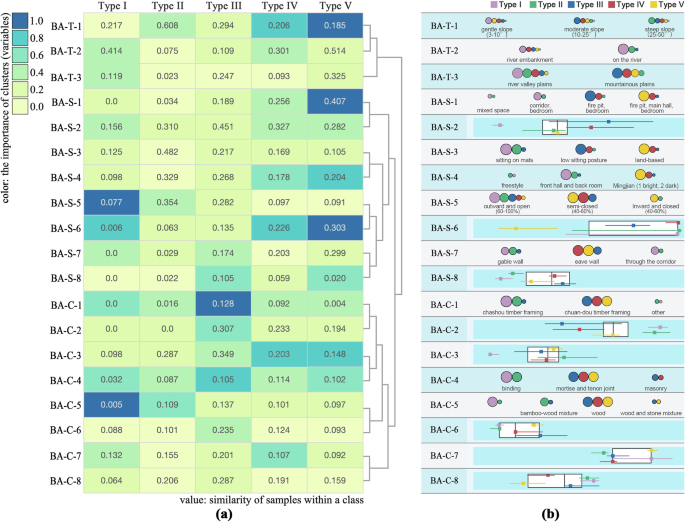
Historically, the middle and lower reaches of the Yangtze River—where the Baiyue ethnic groups lived—are considered the origin of Ganlan architecture, with southwestern provinces such as Yunnan and Guizhou serving as the dissemination areas. Table 6 and Fig. 15 use Thiessen polygon analysis to quantify the radiation range, influence areas, and spatial interrelationships of the different Ganlan types. Combining the cluster results for the spatial and construction attributes of Ganlan (Fig. 1) shows that the spatial distribution of Ganlan Types I to V reflects the evolutionary process of Ganlan types:

In this figure, the left column indicates the clustering degree of Ganlan types (I–V) among 35 ethnic groups, and the right column illustrates their radiation range, influence areas, and spatial interrelationships across these groups.
Type I (primitive bamboo Ganlan)
The most geographically remote, with the most primitive construction technology. Its Thiessen polygon coefficient of variation (CV) is 1.46, indicating the most significant clustering distribution. This type retains the original Ganlan form and mat-dwelling lifestyle associated with the Baiyue ethnic groups: a typical “fork-hand” structure, no bay system, firepit-centered interiors, and fully elevated ground floors, with bamboo (for structure and walls) and grass (for roofing) as the main building materials. Archeologically, the Hemudu site (ca. 7000 BP) has revealed mature mortise-and-tenon joints, while bronze artifact depictions from the Shizhaishan culture in Yunnan (ca. 2500–2000 BP) show Ganlan structures with fork-hand forms similar to those at Hemudu, suggesting that southwestern Yunnan (the core distribution area of Type I) may have preserved primitive techniques introduced by early Baiyue migrations (pre-Han period). The Huayang Guo Zhi (Chronicles of Huayang) records that during the Qin–Han period, certain branches of the Baiyue among the “Southwestern Barbarians” still “dwelt in trees, piling up timber to live above ground, ” corroborating the antiquity and stability of Ganlan forms in this region.
Type II (primitive timber Ganlan)
Although the CV value is slightly smaller than Type I (1.19), it follows a cluster distribution pattern, retaining its original mat-dwelling form. Due to geographical proximity, this type is highly similar to Type I in terms of elevated building form, structural form (fork-hand), joint construction (tied joints), and spatial organization (firepit-centered, entrance at the gable). Buildings are constructed using Type I’s tied-joint techniques, with smaller column feet (about 0.1 m in diameter) and tighter column spacing (1.5–2 m), forming the typical “thousand feet-to-the-ground” style found in Gongsan, Nujiang.
Type III (mature Ganlan)
The CV value significantly decreases compared to the previous two types (0.41). The polygon area is considerably larger; the distribution is generally random and dispersed, showing a significant expansion trend. This type adopts a more mature column-and-tie timber construction, with building heights increasing from the previous single story to two to three storeys (70.2%) and even 4 storeys (15.3%). At the same time, the spatial openness decreases to 39.1%. Not only has this type matured in spatial and construction attributes, but it has also given rise to local subtypes in different regions, such as the low-foot Ganlan of the Li ethnic group in Hainan Province and the heated-bed Ganlan of the Chaoxian ethnic group in Jilin Province. From the perspective of architectural technological history, the column-and-tie timber frame was systematically documented in the Song dynasty treatise Yingzao Fashi. Its technological maturation and dissemination coincide with the settlement and agricultural development of Baiyue descendants (ancestors of the Zhuang, Dong, Buyi, and other ethnic groups) in Guizhou and Guangxi during the Song and Yuan periods. Furthermore, the Qiongzhou Fuzhi records that the Li people “dwell in stilted houses, keeping livestock below,” confirming the widespread existence of Ganlan buildings on Hainan Island as early as the Tang dynasty.
Type IV (hybrid semi-Ganlan)
The CV and SD values are the smallest (0.32, 0.338), making it the most evenly distributed type. The data for this type show significant differentiation in terms of “percentage of raised-floor area” (BA-S-6) and “column feet height” (BA-C-3), evolving into a semi-Ganlan type with partial elevation and partial grounding. This morphological development is closely linked to the migration of the Miao and Yao ethnic groups from the middle reaches of the Yangtze River to the mountainous areas of Hunan and Guizhou from the Tang–Song–Yuan periods onward. According to oral historical sources such as the Miao Epic and the Yao Pinghuang Juandie, after the Miao ancestors entered the mountainous regions of southeastern Guizhou and southwestern Hunan, they adapted the fully elevated Ganlan forms of the plains into a “half-stilted” configuration to accommodate steep slopes.
Type V (enclosed Ganlan)
The CV value increases to 1.21, with the distribution showing a more noticeable concentration. This is attributed to the type’s location on the periphery of ethnic minority regions in Southwest China and its transitional zone with Han culture, where the diffusion and development of Ganlan residential culture have contracted. This type features an enclosed Ganlan form that is more similar to traditional Han architecture, characterized by three- and four-courtyard layouts. The large-scale emergence of this form is also directly related to the implementation of the “the bureaucratization of native offices” policy by the central government in the Tujia regions during the Ming and Qing dynasties.
Thus, Types I to V not only signify the divergence in Ganlan forms from the original “common origin” to differentiated types between ethnic groups and regions; they also demonstrate a dual continuity in both spatial geography and historical chronology: From the westernmost Yunnan border—represented by the Dai and Lisu, with relatively primitive building technology and mat-dwelling forms—to the mature Ganlan of Guizhou and Guangxi, with column-and-tie timber construction and more diverse forms; then to the hybrid semi-Ganlan in Hunan, Hubei, and Chongqing—with partial grounding and partial stilted forms—and, finally, evolving into the enclosed Ganlan of the Tujia ethnic group at the Hunan–Hubei border, deeply influenced by Han courtyard layouts.
Natural driving factors of spatial typological distribution patterns
Climate
The core feature of Ganlan architecture is “elevated ground floor, upper-level living,” along with a steep-pitched roof, permeable and detachable enclosing walls, and a fire pit set inside. This design adapts well to the climate of southern China, particularly the areas south of the Yangtze River36. There is a direct relationship between the climate conditions and the spatial distribution of Ganlan.
Figure 16a shows that Ganlan is primarily concentrated in the north subtropical humid zone and tropical humid zone, with a small distribution at the edges of the cold-temperate semi-humid zone and plateau temperate semi-arid zone. It is rarely found in arid or semi-arid climates. Figure 16b shows that annual average precipitation is the most significant climate factor affecting Ganlan distribution; buildings are concentrated in areas with more than 1050 mm of annual precipitation. Provinces like Guizhou, Hunan, Guangxi, and Hainan experience annual precipitation ranging from 1490 to 2330 mm, while Taiwan exceeds 2520 mm37. These regions experience heavy rainfall and long rainy seasons, leading to surface water accumulation and wet soil. The elevated ground floor associated with Ganlan architecture prevents direct contact with the ground, making it an ideal residential form in these regions. For instance, in Xishuangbanna, Yunnan, the rainy season lasts about 202 days each year; the Lancang River, passing through the area, ranks third in Asia in terms of water volume. During floods, river valleys can expand up to a hundred miles38. Stilted bamboo Ganlan of the Dai ethnic group stand at heights of 2.8–3.2 m, allowing floodwaters to pass underneath to avoid structural damage. Figure 16c shows that high-humidity environments enhance the adaptability of Ganlan. The karst and tropical coastal areas of southern China have a year-round relative humidity above 80%37. The airflow generated by the elevated ground floor helps reduce the adverse effects of humidity on both the building materials and the indoor living environment. Finally, Fig. 16d shows that temperature conditions indirectly influence Ganlan distribution by affecting residential comfort. The subtropical and tropical regions where Ganlan is distributed experience high temperatures for extended periods, with annual average temperatures ranging from 19.7 °C to 22.6 °C and annual maximum temperatures above 31.4 °C37. The “chimney effect” produced by the elevated floor and pitched roof of Ganlan helps expel hot air, making it well-suited to the “ever-summer, no-winter” climates of regions like southern Yunnan, Guangxi, Taiwan, and Hainan. In contrast, in regions like Guizhou, Hunan, and Hubei, where winter temperatures are relatively low and humidity is high, firepits are used for heating. In places like Jilin and Heilongjiang, where the Chaoxian ethnic group resides, “fire floors” are set up under elevated ground, meeting the need for indoor warmth while preserving a mat-dwelling lifestyle.

a The climate zones distribution of Ganlan, b the annual average precipitation distribution of Ganlan (8.2–2526.4 mm), c the annual mean humidity distribution of Ganlan (0–84.18%), d the annual average temperature distribution of Ganlan (−25.7–31.6 °C).
Figure 17 illustrates the correlation between the five Ganlan types and climate factors. Type I is distributed in regions with the highest annual average precipitation, rainfall days, annual humidity, and the highest and lowest annual temperatures, with two-thirds of its distribution in the tropical humid zone. Types II to V show a gradual decrease in these factors. Therefore, regarding the typological evolution characteristics, Type I is most closely related to the elevated ground floor height and openness of the enclosing walls, adapting to the high humidity and rainy climate. This is followed by Type II, and Types III to V show a gradual decrease in these features. This distribution pattern reflects the adaptive strategies of the buildings to the climate environment.

In this figure, different colors represent various climatic factors, with 0–1 indicating the degree of correlation.
Topography
Topography is one of the core factors shaping the spatial pattern of Ganlan architecture. Elevation, slope, and terrain type have a significant spatial coupling relationship with Ganlan distribution, which further refines its distribution patterns. These factors constrain building site selection, structural design, and functional adaptation, generating distinct regional distribution characteristics for each Ganlan type.
Elevation directly influences Ganlan distribution density. The main region where Ganlan is distributed includes topographic units such as the Yunnan–Guizhou Plateau and the Hengduan Mountains. With the exception of Hainan Province, where the average elevation is below 500 m, all other regions are mountainous, with elevations above 500 m. This aligns with the distribution of karst topography in southern China (Fig. 18a). The terrain is highly complex, with high mountains, valleys, plateaus, and intermountain basins, exhibiting significant vertical variation. Figure 18c shows that Ganlan is most concentrated in mountainous and river valley areas with elevations between 500 and 1950 m. High mountainous areas with elevations above 2500 m, however, are gradually replaced by stone and earth structures due to low temperatures, high wind speeds, and the thermal loss of elevated structures. Among them, Type I is primarily concentrated in areas with elevations between 800 and 1200 m, typically around low-to-medium mountains with wide valleys. Type II is distributed in the most rugged terrain—predominantly in high mountain valleys, such as the Nujiang region—where the elevation difference between the river and surrounding mountains is nearly 4000 m, with Ganlan buildings distributed at elevations of 2000 to 2500 m. Types III and IV are mainly distributed in mid-low mountainous terrain with elevations between 1000 and 1500 m (77.9%), such as the low mountains of Guilin, Guangxi, and the river valleys of Qiandongnan, Guizhou. Type V is found in the Wuling Mountain area, distributed in the transition zone between the second and third steps of China’s topography39. It features small basins, plateaus, mountains, gorges, and steep slopes, with the lowest elevation of all types, primarily found below 1000 m.

a Distribution of Karst in Southern China, b relationship between the height of Ganlan’s bottom column feet and topographic distribution, c elevation (−263–8627 m), d slope (0.00–60.80°).
Figure 18d shows that the slope is a key indicator for determining the applicability of Ganlan. In areas with slopes exceeding 30°, Type I and Type II dominate, with column feet heights of 3–3.1 m, adapting to the steep terrain. In areas with slopes between 15° and 30°, Type III adapts to the topography through varying column feet heights, mitigating large-scale land leveling while reducing soil erosion. For example, all 1468 Ganlan buildings in the Qianhu Miao Village of Leishan County, Guizhou, are arranged along contour lines of the mountain, with column lengths adjusting to the slope, forming a stepped settlement. In areas with slopes less than 15°, column feet heights decrease, and a combination of plateau terrain results in Type IV semi-Ganlan or Type V enclosed Ganlan. Figure 18b shows that the column feet height of the five Ganlan types exhibits a positive correlation with terrain elevation and slope.
Vegetation
As shown in Fig. 19, the vegetation coverage in areas where Ganlan is distributed ranges from 0.4 to 0.9, with an average of approximately 0.76. Ganlan buildings are most abundant in regions with vegetation coverage between 0.6 and 0.8, accounting for 71.5% of the total; areas with coverage between 0.4 and 0.6 account for 21.67%, and areas with coverage between 0.8 and 0.9 account for 6.83%. This data indicates that Ganlan distribution highly overlaps with regions of dense vegetation resources.

In this diagram, X-axis represents vegetation coverage intervals (0–1), Y-axis indicates the number of Ganlan buildings, and different colors represent the five types, respectively.
The vegetation in areas where Ganlan is distributed is mainly tropical rainforest (e.g., the Yarlung Zangbo River Grand Canyon and areas to the south, Xishuangbanna in Yunnan, Hainan, and southern Taiwan) and subtropical evergreen broadleaf forests (most of southern China). In tropical rainforest areas, Type I Ganlan accounts for 82.9%, particularly in Xishuangbanna, where bamboo is abundant (12 genera and over 50 species40), with Dendrocalamus membranaceus (yellow bamboo) and Dendrocalamus sinicus (giant dragon bamboo) comprising over 80% of the building materials. Consequently, Type I is also renowned as the “Bamboo House.” Bamboo, with its high strength (greater tensile strength than wood), short growth cycle (3–5 years to maturity), and light weight (naturally hollow), is particularly suitable for constructing Ganlan in steep terrain. The bamboo-woven floors and enclosing structures are highly breathable, further adapting to the humid and hot climate.
Within subtropical evergreen broadleaf forest areas, with abundant tree species such as Chinese fir, oak, camphor, and pine, these forests provide a stable wood source for Types II to V, accounting for 93.86% of the materials used. Notably, the Qingshui River basin in southern and southeastern Guizhou, where Type III Ganlan is distributed, has been renowned for its high-quality Chinese fir since the Ming Dynasty, when it became a significant timber-producing area. Following the Qing Dynasty’s bureaucratization of native officers, the region became known for its fir trade41. Thus, Chinese fir became the most essential material for Ganlan construction. Before the widespread use of brick tiles, fir bark served as the primary roofing material. In Type V areas in the Wuling Mountains, between elevations below 2000 m, subtropical evergreen broadleaf forests mix with temperate broadleaf forests, while above 2300 m, temperate coniferous forests dominate42, with abundant resources of Chinese fir and pine used as construction materials.
Moreover, the cost of material acquisition further limits the distribution of Ganlan. In remote mountainous areas, where material resources are scarce, Ganlan construction depends entirely on locally available materials. If no usable bamboo or wood is available within a 3 km radius, the probability of construction drops to 17.1% (Table 7). Thus, vegetation coverage, vegetation type, material characteristics, and acquisition costs not only define the distribution boundaries of Ganlan but also fundamentally determine the distribution pattern of Ganlan: “settling near forests, building according to available materials.”
Human driving factors of spatial typological distribution patterns
Ethnic migration
Archeological findings indicate that Ganlan sites from the Qin Dynasty and earlier were excavated in the regions south of the Yangtze River; the earliest forms of Ganlan are traceable to the primitive “nest dwellings” in the river network and swampy areas of this region43. Later, the ancient Indigenous Baiyue ethnic group developed a Ganlan dwelling model in response to the humid, waterlogged environment. Since the Han Dynasty, the Baiyue ethnic group began migrating southward and westward44, forming two main pathways for the spread of Ganlan construction techniques.
This study employs a geographically weighted regression (GWR) model and linear regression analysis to quantify the impact of Baiyue ethnic migration trajectories on the spatial heterogeneity of Ganlan distribution44. In model specification, an adaptive bandwidth was selected and optimized based on the AICc criterion, and a Gaussian kernel function was applied to characterize distance decay effects. For model diagnostics, the local R² distribution was examined to capture spatial variations in explanatory power, and the condition number was reported to assess local multicollinearity. All grid cells exhibited condition numbers below 30, indicating stable and reliable model estimates. The GWR analysis further reveals significant spatial non-stationarity in the influence of ethnic migration on Ganlan distribution. The intensity of this influence is not spatially uniform but exhibits pronounced regional differentiation. As shown in Fig. 20a, in southern Yunnan and southwestern Guangxi (Line 1a), local R² values generally exceed 0.5, indicating that the migration of the “Xiou” and “Luoyue” subgroups exerts the strongest explanatory power for Ganlan distribution. This aligns closely with Line 1a’s southwestward migration along the Xijiang River basin into Yunnan and Guangxi, where it merged with the indigenous Baipu ethnic groups, and with the intact preservation of Hemudu-era Ganlan typology in the Dai bamboo houses of this region. In the border area between Hunan and Guizhou (Line 1b), local R² values cluster in the 0.48–0.50 range, reflecting a slightly weaker influence. This corresponds to the “Yangyue” and “Yuyue” migration, which, after integrating with local mountainous environments, transformed the “fully elevated” Ganlan into a “semi-elevated” form, resulting in a hybrid technological diffusion pathway. Figure 20b shows that along the southeastern coast to Hainan Island (Line 2), local R² exhibits a north-to-south increasing trend (from 0.46 to 0.48), suggesting that the impact of the “Minyue” and “Nanyue” migration on Ganlan distribution strengthened at the southern terminus (Hainan Island). This may be attributed to the relative insularity of the island environment and gave rise to Ganlan subtypes such as the Li ethnic group’s “boat-shaped houses.”

a Line 1a (yellow) represents the Baiyue subgroups, such as “Xiou” and “Luoyue”, and line 1b (blue) represents the “Yangyue” and “Yuyue” subgroups, b line 2 represents the “Minyue” and “Nanyue” subgroups.
Inter–ethnic interaction
Inter–ethnic interaction is a key driving force in the evolution of Ganlan types, encompassing multiple dimensions ranging from political integration, economic trade, and technological diffusion to cultural fusion. This study conducts a second-order cluster analysis using “spatial organization” variables (spatial formality, elevated height, building morphology, floor plan layout, degree of openness, percentage of raised-floor area, entrance mode, number of bays) and “construction technology” variables (structural form, number of stories, column feet height, joint construction, building materials, number of fire pits, roof pitch, interior wall height). Figures 21 and 22 indicate a strong correlation between the influence of Han culture from Central China and the interactions between various ethnic minorities in the evolution of Ganlan types.

In this diagram, different colors represent Ganlan types (I–V) in the outer ring and the various ethnic groups in the inner ring, illustrating the degree of association between them.

In this diagram, rows represent Ganlan spatial attribute variables (BA-S series) and construction attribute variables (BA-C series), columns correspond to Ganlan types (I–V) and their sub-clusters, and the blue-to-orange color gradient indicates the degree of association between variables and clusters (0.00–1.00).
Based on the spatial organization variables, the Han Chinese concept of “courtyard system” and “ground-based dwelling” has profoundly influenced the evolution of Ganlan features, serving as a direct manifestation of cultural fusion. In terms of the frequency of interaction with Han culture—measured by four influencing factors ranked from low to high: administrative jurisdiction, immigrant settlement and land reclamation, commercial exchange, and geographical proximity—increased, the five Ganlan types exhibited a significant rise in indices for architectural complexity and enclosure degree of the planar layout. Conversely, indices for openness to climate interface, elevated height, and percentage of raised-floor area showed a clear decreasing trend. From the construction technology variables, the geographical distribution of the five Ganlan types, from west to east, also shows a trend of technical evolution from primitive to complex, revealing the pathways of technological diffusion. As the column-and-tie wood construction system matured through interaction with multiple ethnic groups, and the mat-dwelling lifestyle gradually faded, indices for building material durability, structural form, joint complexity, and interior wall height exhibit an upward trend, whereas the indices for roof slope, column feet height, mat-dwelling, and hearth show a downward trend. For example, in the Xiangxi (Hunan) and Enshi (Hubei), where “the bureaucratization of native officers” policy was implemented from the Ming Dynasty, political integration directly accelerated the transformation of architectural forms. Cluster analysis shows that in Type V Ganlan samples, the spatial “openness” decreased by 41.5% and 18.8%, respectively, compared to the geographically distant Type I and III. The “percentage of raised-floor area” (the ratio of the elevated floor area to the total land area) decreased from 100% in the Type I origin area to 29.3%.
Specifically, Type I is distributed in the most remote areas. On a geographical and cultural level, there was minimal exchange with Central China, maintaining the most primitive Ganlan building form that has evolved from the fusion of the Baiyue ethnic group and the local Baipu ethnic group since the Baiyue ethnic group migrated into the region in the past. The degree of cultural fusion is relatively low, and technological diffusion has not yet reached this area. This type is mainly concentrated among indigenous ethnic groups with similar local customs results in relatively confined social and cultural spheres, with limited economic trade and external connections. Adjacent to Type I, Type II is relatively similar in the original form but uses wood due to differences in vegetation resources. It is also influenced by the housing of the Di-qiang ethnic group from the Tibetan Plateau; some Lisu, Nu, and Tibetan Ganlan in the Nujiang Basin adopted the log cabin-style walls, reflecting technological exchange between neighboring ethnic groups.
Compared to the original characteristics of Types I and II, Type III reflects more integration with Han architecture, evident in both its spatial organization (67.6%) and construction techniques (72.1%)—this is the result of the simultaneous deepening of cultural fusion and technological diffusion. This type uses the more advanced column-and-tie timber construction45 and adopts the Han architectural concept of “bay” (with three-bay layout being the most prevalent, occupying 84.3%). The most notable change is among the Zhuang, Dong, and Miao Ganlan located near the Guizhou-Guangxi border, the emergence of the Han “central bay” (65.2%)—a key element of the Han “ground-based dwelling” system (i.e., living at ground level rather than elevated)—and a tendency towards the “one central bay flanked by two smaller rooms” layout.
The most notable feature of Type IV is its hybrid form: a combination of “elevated” and “ground-based” living influenced by Han “ground-based dwelling” culture. During the Ming and Qing dynasties, its distribution areas experienced frequent cultural exchange with the Central Plains, influenced by military settlement, the bureaucratization of native officers, and commercial trade. In Type IV samples, the “building-to-ground ratio” (ratio of elevated floor area to grounded floor area) reflects the degree of absorption of ground living culture. Yao ancestors, who migrated south to Hunan and the Guizhou–Guangxi border during the Tang and Song Dynasties to escape war, adopted a “post-gold column” system: the front part was elevated and the rear grounded in a 1:3 ratio, accounting for 22.8% of Type IV. By the Ming and Qing dynasties, in the border areas of Guizhou and Hunan, the Miao, Tujia, and others increased the ratio of ground to elevated living to 1:1, accounting for 56.7%. In terms of “column feet height,” in areas like Anshun, Guizhou (military settlement zones during the Ming Dynasty), the average column feet height of Ganlan decreased from 2.2 m in Type III in Qiandongnan to 1.7 m. Elevated parts and walls were partly constructed with stone. Additionally, in Type IV, the centrality of the fire-pit room decreased to 40.1%, and the “hall room”—commonly found in Han architecture and typically used for ancestral worship—took its place, representing a profound embodiment of cultural fusion at the level of belief systems and spatial order.
In Type V, the “dominated ground-based dwelling, supplemented by Ganlan dwelling” ground-based Ganlan mode accounts for about 97.2%, with the architectural form most similar to that of Central China and the large migration of people from Jiangxi during the Ming and Qing dynasties46, the building forms exhibit a clear division into the main house, wing rooms, and courtyards, with Ganlan applied only to the wing rooms, commonly presenting residential patterns combining U-shaped courtyard, quadrangular courtyard, or even multiple courtyards. This reflects the trend of Han influence driven by political integration, commerce, and immigration.
Cultural clashes and technological exchanges between ethnic groups have driven the evolution of Ganlan types, collectively shaping the “west-to-east” direction: from open to enclosed, elevated to ground-based dwellings, and from free layout to a centralized, symmetrical ceremonial layout. Combining the second-order cluster analysis results, it is evident that, under the influence of inter–ethnic interaction, the characteristics of Ganlan types do not correspond to ethnic groups but reflect regional commonalities. For example, although the Miao are widely distributed, their Ganlan forms are fully elevated at the Yunnan–Guizhou–Guangxi border and are typically semi-elevated in northern Guizhou. Similarly, Zhuang Ganlan forms differ in northeastern and western Guangxi. In contrast, Ganlan structures in the same geographical area tend to exhibit clear similarities across ethnic boundaries, such as in northeast Guangxi, where the Yao and Zhuang Ganlan forms are nearly identical; in southern Guizhou, the Buyi, Miao, and Shui ethnic groups share the same form47. This data indicates that, in the context of multi-ethnic interwoven distributions, the exchange and interaction between geographically adjacent ethnic groups have a stronger impact on the evolution of Ganlan types than the ethnic attributes themselves.