A conversation with Michigan’s Democratic Senate nominee about public health, outside money, and a new kind of politics.
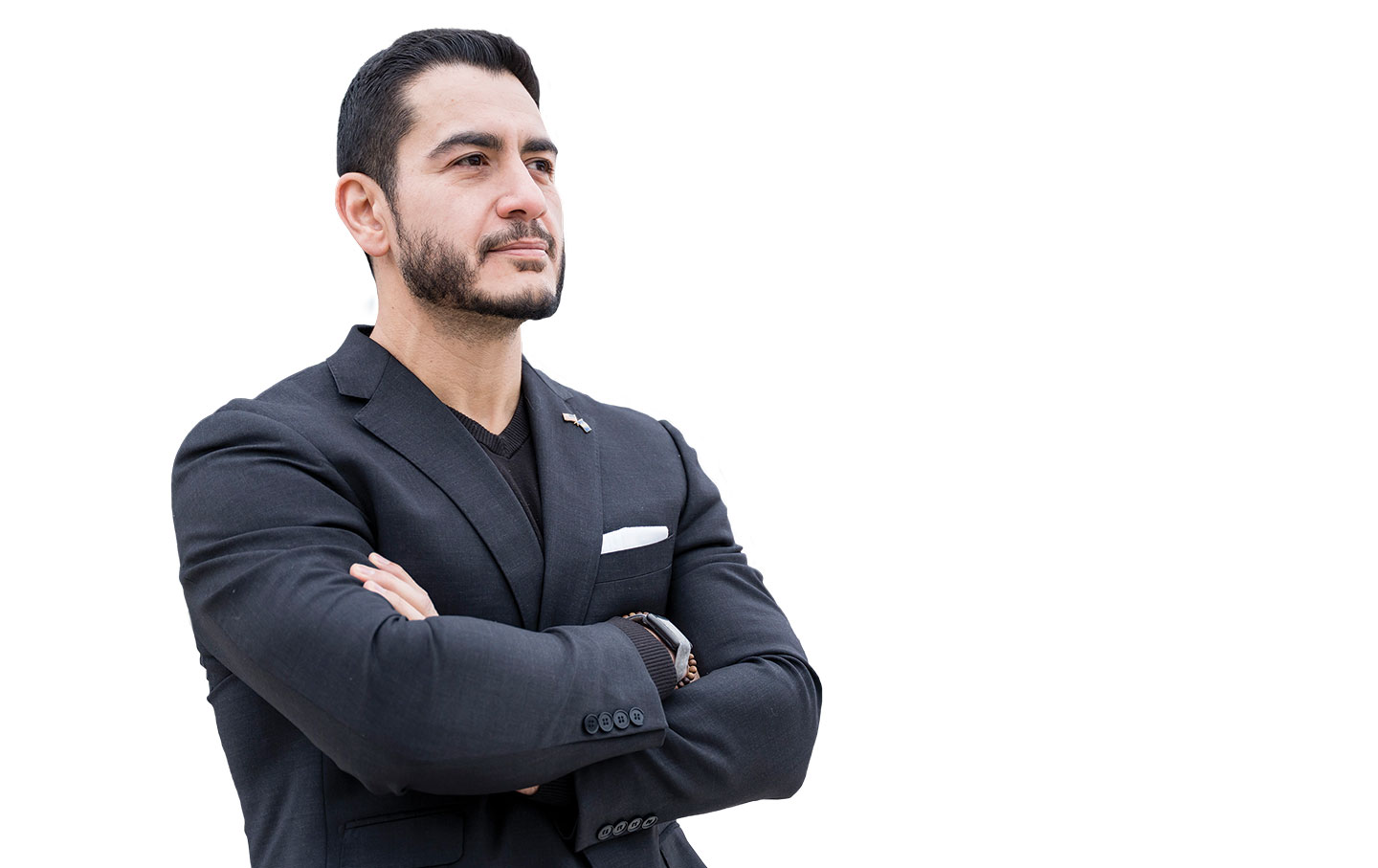
Abdul El-Sayed’s bid for Michigan’s open US Senate seat could well decide which party controls the chamber after November’s midterm elections. Historically, a candidate in such a position might run cautiously. Not El-Sayed. A Rhodes scholar and epidemiologist who, at age 30, earned national attention for his transformative work as director of the Detroit Health Department, the progressive Democrat boldly advocates for Medicare for All, ending US support for Benjamin Netanyahu’s government in Israel, and adopting a fresh vision of capitalism that empowers people rather than corporations. After his primary win in August, Nation editors Katrina vanden Heuvel and John Nichols spoke with El-Sayed at a favorite haunt of his, the Alba coffeehouse in Detroit’s Corktown neighborhood. T
The Nation: You’ve spent much of your life working in public health. Can you diagnose what’s wrong with American politics?
Abdul El-Sayed: One of the things that you learn pretty quick in medical school is that heart failure is about the heart, but it’s also about the kidneys. They have this really important relationship where your kidneys often regulate for your heart—because if the heart is beating against too much pressure, it’s on the kidneys to push water out. But what tends to happen is, once you find yourself with insufficient heart [strength], the kidneys don’t get enough pressure to know to offload. So they stop doing what they do, and the thing runs in reverse, beating up your heart, in effect. And I think what we have right now is a level of corporate capture of our politics, in every single part of American society, that is loading more on and running the system in reverse.
Our political system was always supposed to be able to act as a check on the richest and most powerful…. And now, what’s happened is that [we] have a political system that acts as a handmaiden to the richest and most powerful, accelerating the inequality that we have in our society. Our political system has become part and parcel of that inequity. It shows up in every part of our lives: whether it’s the food system, which is controlled by a couple of very large corporations and agribusinesses. Or it’s our healthcare system, which is captured by a few very large pharmaceutical companies and health-insurance companies. Or it’s our foreign policy, which is captured by a few very, very large weapons manufacturers and special interests. All of it is operating in a way that tends to drive money away from us and toward the very top.
I think if we don’t address that system of capture, we will find ourselves paying more for less, being squeezed in our work, and watching as our systems operate more to make rich people a lot of money than to actually do the things they’re supposed to.
TN: How do you talk about this system of capture in the context of a campaign where you’re being massively outspent by the wealthy and powerful?
Current Issue
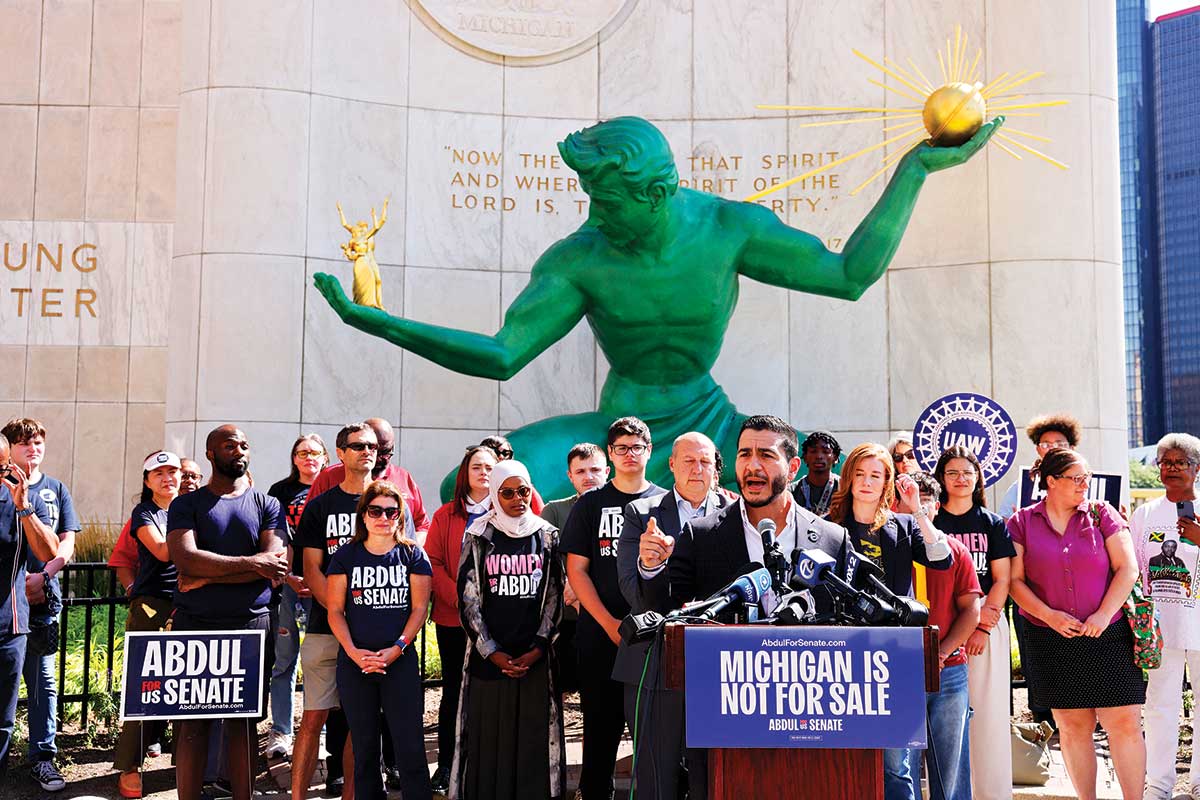
AES: If you know you’re going to be outspent in paid media, then you have to build really, really robust earned and [self-generated media] and a really, really robust movement on the ground. That’s what we did. We started out going everywhere, talking to everyone. I did 530 public events in the primary, across 110 different cities. We have been communicating and listening and showing up in people’s lives.
TN: You have argued that when candidates rely on lots of outside money, it’s a sign of weakness.
AES: If they’re getting huge amounts of outside spending, that’s a sign of weakness because it’s a crutch. It’s like, why do you need outside spending? That’s [my opponent, Michigan Republican US Senate nominee] Mike Rogers in a nutshell. That system of politics is the problem. And it’s based on this old idea that all that matters is how much money you raise to buy media. The money isn’t spent on town halls; it isn’t spent knocking on doors. It’s spent on 30-second attack ads.
TN: You’ve complained that candidates in both parties neglect the voters in order to chase after big donors and outside money.
AES: Yes. When you go out and meet with people, you’re learning a ton in a reception line; you’re learning a ton in a small roundtable. People are telling you what they want you to focus on. Whereas when you’re fundraising or having meetings with [lobbyists for special-interest groups], all you’re learning about is what the lobby wants from you.
TN: That message resonated in the primary. How do you build on it in a general election, in a swing state that backed Donald Trump in 2024?
AES: You keep listening and learning. I think it involves identifying the ways that your central message applies across a number of different issues. You know, some of the most important issues that I think a lot of folks who voted in 2024 for Trump are paying attention to right now are data centers and ultra-processed food. And I’m looking forward to having that conversation with them.
TN: Do you see ultra-processed food as one of the major public-health issues of our time?
AES: No doubt, absolutely. I mean, look, this is the thing about [Health and Human Services Secretary] Robert F. Kennedy Jr.: He’s right about a lot of the problems—he’s just completely batshit when it comes to the solution. He’s right that ultra-processed foods are a problem. But the answer is not beef tallow and raw milk. The answer is getting [Big Agriculture and food-industry] money out of our politics.
TN: You’ve argued that there are issues that people care a great deal about but that are not well discussed in campaigns or by the major media. One of these is the Israeli assault on Gaza.
AES: The selective attention to polling is really quite fascinating to me. Like, [Gaza] is an 80/20 issue. Data centers: 80/20 issue. Healthy food: 90/10 issue. Guaranteed healthcare: 70/30 issue. I think the mistake that traditional media makes is to think that they read in for the median voter, and to miss the notion that the median voter is not always aligned on “red” [or] “blue” questions. They’re aligning more on people-versus-the-elite questions, and that’s the big miss [by the media].
I go on CNN, and they consistently ask me about the right of a foreign country to exist, which is not an issue that most people are asking about, right? They’re asking about “Well, does that foreign country have a right to my tax dollars?”
TN: Groups aligned with the American Israel Public Affairs Committee (AIPAC) have spent heavily against you, attacking you personally rather than discussing Middle East issues.
AES: They don’t campaign on their issue. They are ultimately conceding public opinion [without acknowledging it], and that’s a pretty scary thing when you think of it from a democratic standpoint. How’s democracy supposed to work, right? If you have an argument to make, make the argument and then the public can decide. But when you come in and run 30-second attack ads, trying to assault somebody’s character because they disagree with you on an unrelated issue, that is an admission to having lost the democratic debate.
TN: You’re not a member of the Democratic Socialists of America. You’ve said, “I’m not a socialist. I’m just a capitalist who understands how capitalism works.” Talk about what you mean.
AES: We have a corporatist system; we don’t have a capitalist system. Go back and read Adam Smith: He talks about how there are no markets without morals. He talks about the central challenge to markets being monopoly, not government regulation. In fact, you need government to secure markets. And what’s happened right now, going back to the central diagnosis that you asked for, is that government has not only stopped securing markets; government has become a system by which the largest players can rent-seek, which is to destroy markets.
Capitalism relies on free entry and exit in markets, and supply and demand allocating the flow of capital. We don’t have that anymore. I would like to move us back to a capitalist economy [with] people being able to know that they are not subject to monopoly power when they’re seeking employment, and not subject to monopoly power when they’re acting as consumers.
TN: You’ve also talked about public goods, including healthcare.
AES: So, classically, public goods are the ones that everybody benefits from but are, as they say, non-rivaled and non-excludable. They’re the things that are the substrate of the market. Infrastructure is one of those things. Public safety is one of those things. Public education is one of those things. I think healthcare is one of those things. And even then, Medicare for All is not actually government healthcare; it’s government health insurance…. Medicare for All recognizes the fundamental provision of health insurance as a public good akin to infrastructure or public safety or public education, as part of the soil in which the economy works. That enables an actual market system in healthcare provision to function.
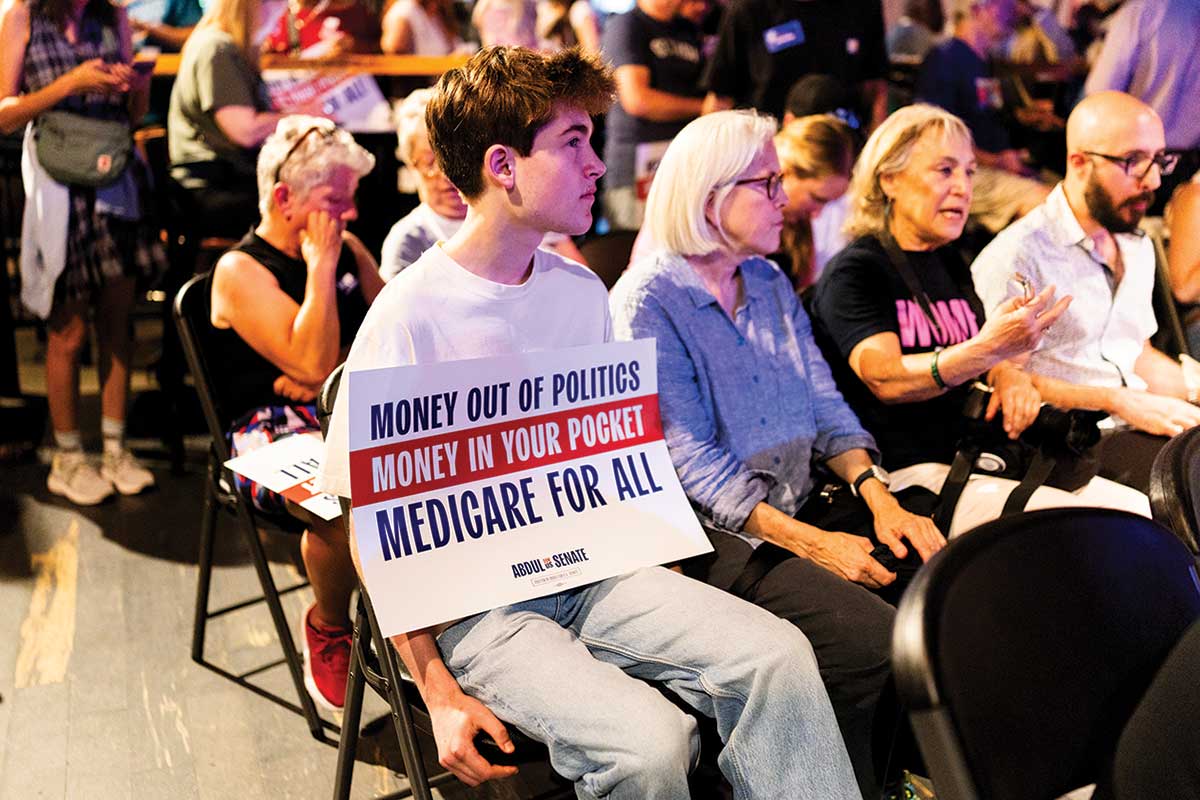
TN: Democratic Party leaders have resisted Medicare for All. Do you think a doctor who’s a big enthusiast for Medicare for All can change the debate in Washington?
AES: Hopefully, yes. Number one, I’ve spent a lot of my time studying this policy, wrote a book on it, understand the nuts and bolts of the legislation well, and hope to be able to work with like-minded colleagues to make the argument.
Second, there is a public conversation that still needs to be had, and part of my job is to be a leader of that public conversation in communities where we’re told we can’t win. The problem with the way that, too often, our party does politics is that we assume that people’s positions are fixed and then operate accordingly—rather than assuming that people want to engage in a thoughtful debate and want to be engaged on the broader issues of our time, and are willing to engage with us in a good-spirited conversation about what the best world ought to look like. A lot of what I’m testing out is the ability to go and have that conversation across places in the state of Michigan and win people over on that policy.
I think we need that in the party, to challenge the status quo. Too often, the industry is funding our party. So if you think that protecting your donors is more important than providing the best possible policy for your constituents, then you’re going to take it as fixed that you have to have an insurance industry that does what it does, and that the best thing you can do is incrementally move in directions to offer a little bit [better than the Republicans]. I just don’t think that is fixed. And I don’t have donors to protect—aside from the everyday people who support our campaign. So I’m not interested in what the health-insurance industry thinks, or what the hospital industry thinks, or what the pharmaceutical industry thinks. I’m a lot more interested in what the 10 million people in my state think.
TN: The New York Times says you’ve been the target of “a wave of Islamophobia,” much of it coming from President Trump. As a Muslim candidate, how do you speak about faith and politics?
Popular
“swipe left below to view more authors”Swipe →
AES: You know, it’s interesting because, for a lot of people, I’m the novelty. For both the people attacking me and the people just meeting me, I’m the novelty. I’ve been a Muslim in America my whole life, so I’m a lot more interested in the things that bring us together. Once people get past [the rhetoric from Trump and the Republicans], they will ask the more thoughtful question, which is not “How do you pray?”—it’s like “What do you pray for?” And I think I’ve learned that that is such an important space for connection. And it’s an opportunity for a broader conversation about what we all hold dear. So, yeah, people are going to attack me. Mike Rogers and Donald Trump can’t help themselves. But they want an America that’s small—and I’ve always known an America that’s big. Part of what I’m trying to do here is to show us just how big we really are, and how much more brings us together than separates us.
I got to be a twentysomething watching a guy named Barack Hussein Obama run for the presidency. What that told me about America and my place in America was profound. I believe in an America where, rather than be told how small we have to be by people like Donald Trump or Mike Rogers or JD Vance, we continuously prove just how big of an America we really are by coming together around the things that we need and deserve. This is one of those moments, where I can’t wait for Michigan and this country to remind us just how big we are. That, you know, an Abdul El-Sayed can be elected not because of or despite his name, but because we want to get money out of politics, put money in our pockets, pass Medicare for All.
TN: Do you see your campaign as opening the door to a new kind of politics that gets beyond petty partisanship and focuses on more fundamental questions?
AES: I hope so. Trump’s politics is entirely about punching down and groveling up. I do the exact opposite, and I think that’s what makes a lot of people very uncomfortable. You’ll never hear me talk down to somebody who, you know, is out trying to live their life. But I’ll talk down to Donald Trump every day, because he’s worthless. Same with Mike Rogers—worthless. These are terrible people who have weaponized their own greed against other people. I hate that. And I see it as everything that’s wrong with the way that we’ve allowed society to work. We allow the richest and most powerful to use their power and their money to game the system against everybody else. Do you remember when Donald Trump was defending his tax evasion? [Some people were] like, “Oh, he’s just so smart.” I’m like, “Bro, you’re greedy, and you lack any sense of scruples. And the system has been built to benefit people like you.”
When you ask about a new politics, we need a politics that is not afraid to stand up to power, whether it’s the power of large corporations [or] the power of a bully politician. We need a politics where we stand up to power and where we move the government to uplift people who don’t have it. That’s what I’m trying to do here.
More from The Nation
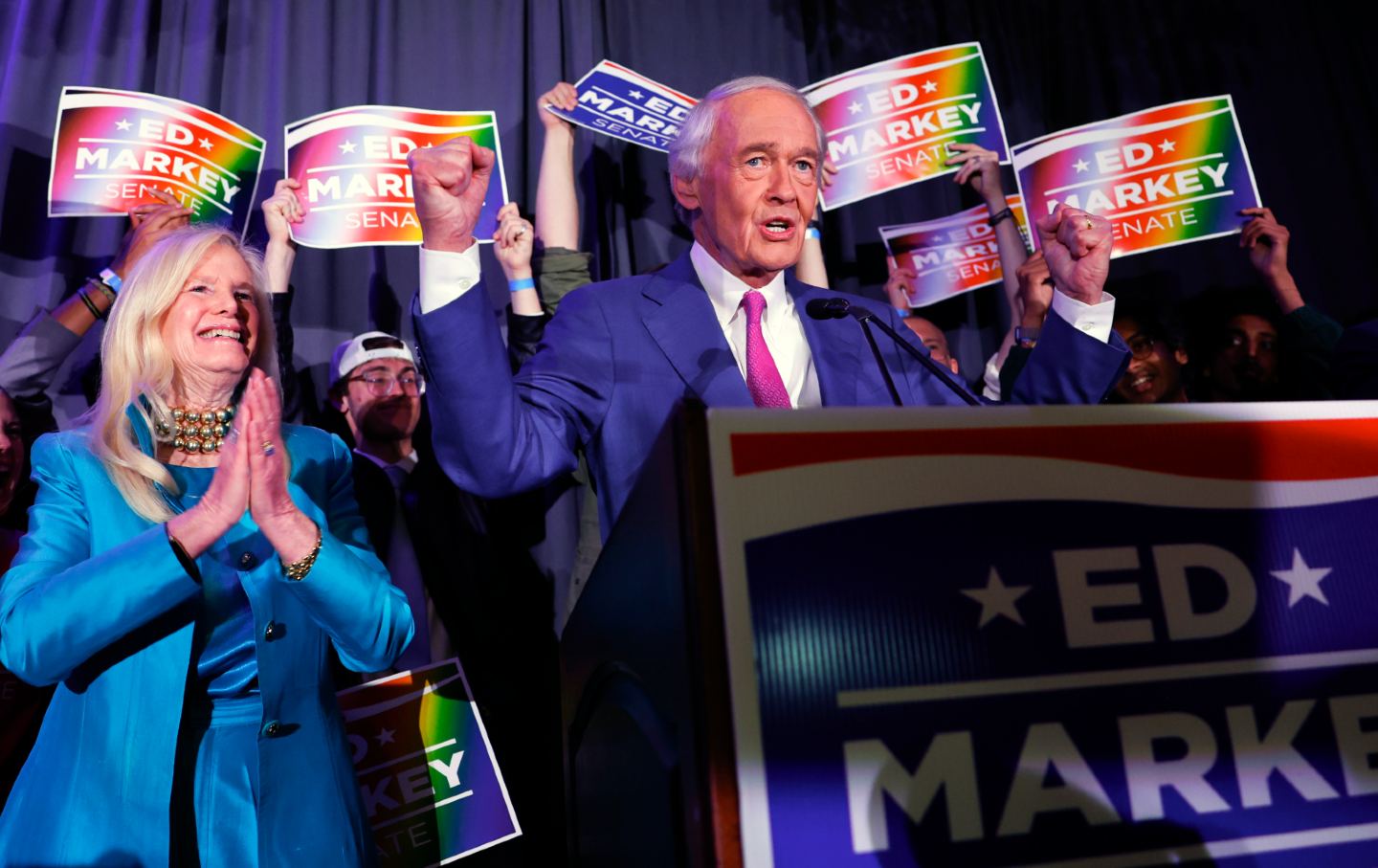
After his primary win, Ed Markey says he’s ready to take on “the criminal enterprises” of Big Tech.

Pro-Israel influence over US politics is weaker than ever—but that doesn’t mean the lobby’s demise is inevitable.
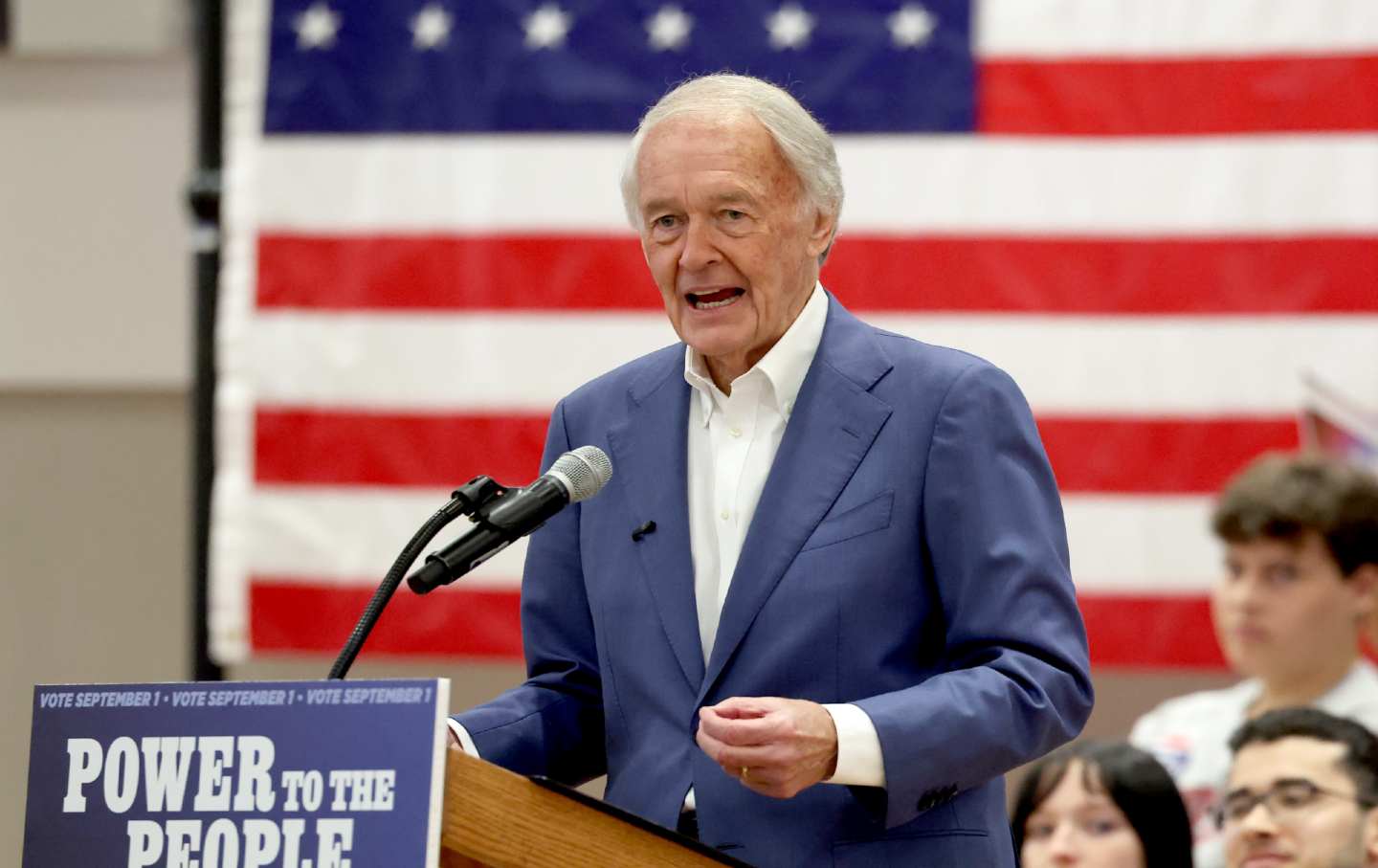
Moulton, a centrist opportunist, sought to unseat his incumbent opponent by posturing as a young progressive. Voters didn’t fall for it.
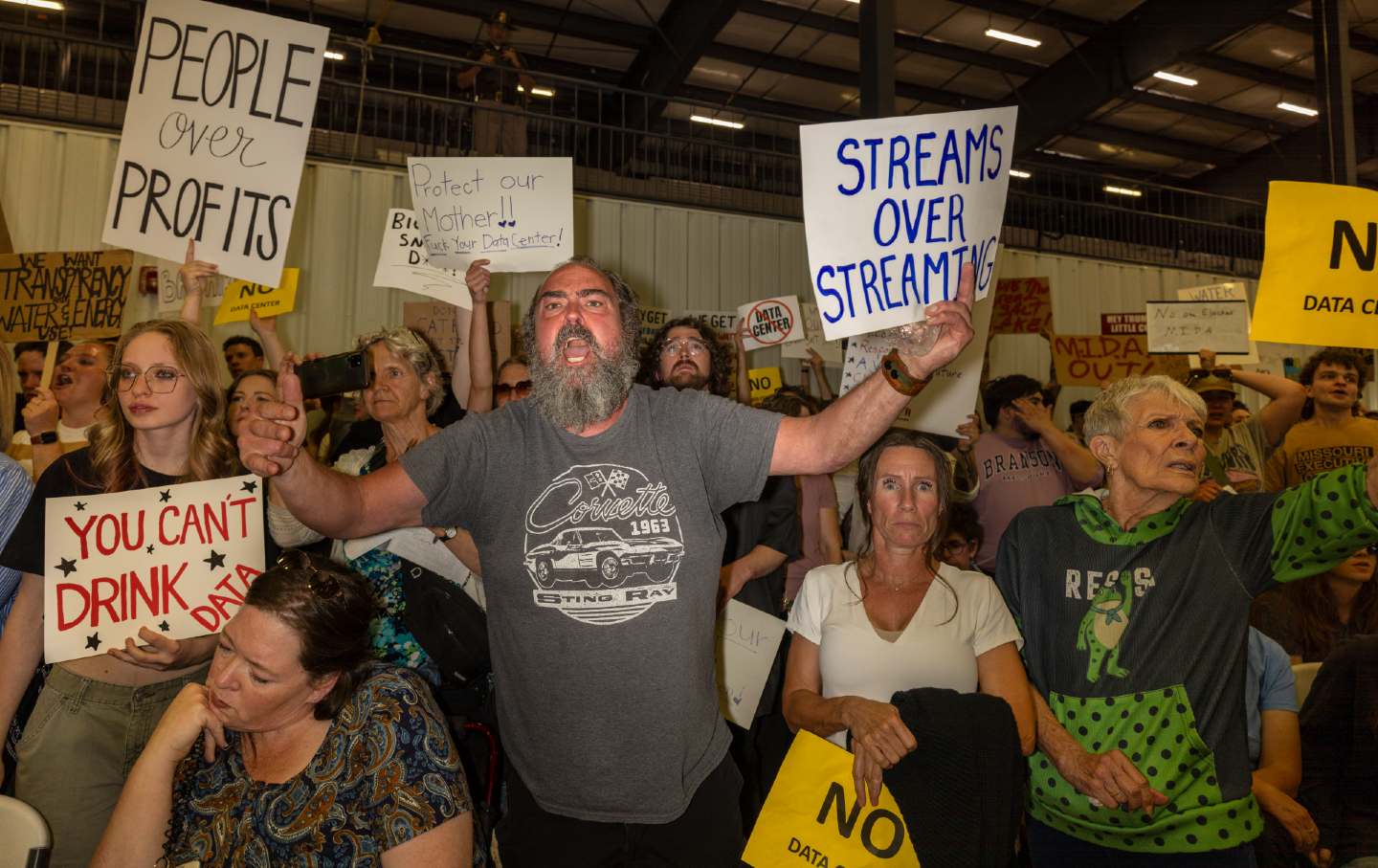
The grassroots revolt against AI oligarchs is reviving a more than a century-old fight against robber barons and their attempts to seize land, water, and political power.