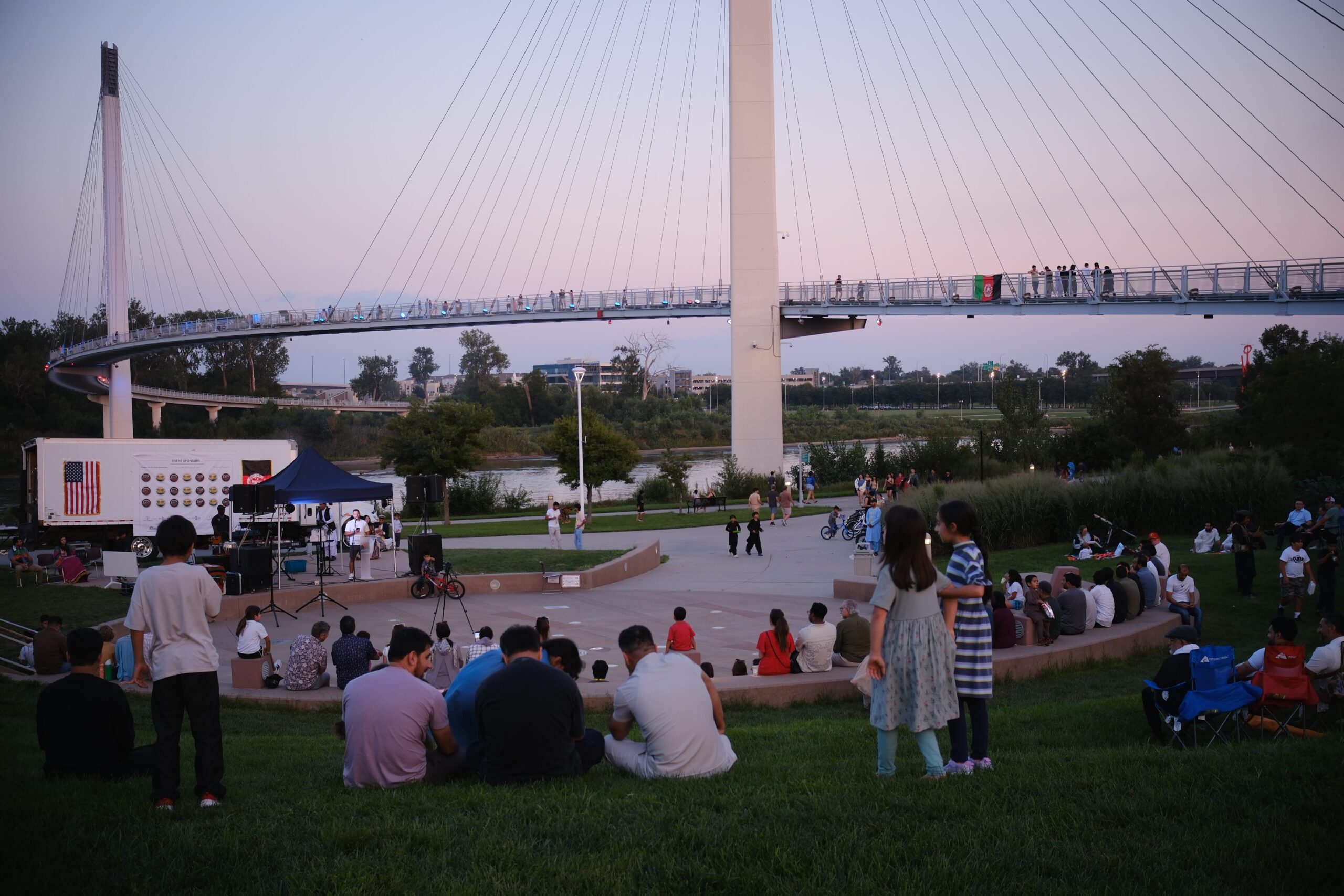
At Omaha’s Afghan-American Integration Day celebration on Saturday, attendees waved the Afghan flag – the tri-color version in use prior to the Taliban’s 2021 takeover of the country – and hung it from the side of the Bob Kerrey Pedestrian Bridge.
The bridge was lit up in the flag’s colors of red, green and black.
Organizations that serve immigrants and refugees, like the Center for Immigrant and Refugee Advancement and Lutheran Family Services, lined the sidewalk as girls in traditional dresses ran or rode past on scooters. A food truck served kebabs and soft-serve ice cream.
Mohammad Sahil, the founder of the Afghan Community Center, floated through the crowd of a few hundred people. He came to the United States in 2014 after working as an interpreter for the U.S. military for about 11 years. Like many Afghans who assisted American troops, he came to the country under the Special Immigrant Visa Program, or SIV, a program for Afghans who worked for or on behalf of the U.S. government.
Sahil and his wife began planning the first Afghan-American Integration Day in 2021 – before the Taliban takeover of the western-backed Afghan government and subsequent withdrawal of American troops. After the collapse, Sahil said the focus of the event shifted to acquainting new arrivals with Afghans who had established a life and community in Omaha.
“The purpose of this event is to bring all Afghans together, and then also bring American friends who are volunteers and who are working with our Afghan families, to connect them with each other,” he said.
Prior to the 2021 collapse, Nebraska’s Afghan population was relatively small. Most were people who had worked with American troops, like Sahil, and arrived under the SIV program; a smaller number arrived in the 1960s and ’70s, Sahil said. About 1,200 Afghans were resettled in Nebraska following the fall of the government in 2021, state officials said in 2022.

Negina Mohammadi and her sister, Asia, both arrived in Omaha from Afghanistan in 2021. Both said they came to love the city.
“At first, it was hard because [Omaha] is quiet, and we didn’t get to see people a lot,” Asia said. “But then later on, when we start school, university, and saw different people – we say it’s the best. I went to other states, but then I came back to Omaha, and I love Omaha.”
For the sisters, Saturday’s celebration was an opportunity to build community, make connections and celebrate their culture.
“We have a chance to meet all of our people from our country, and we can wear the dresses from our country,” Negina said. “Everyone can be together and have fun.”
The celebration also comes at a perilous time for immigrants and refugees, including Afghans, without solid legal status in the U.S. Temporary Protected Status, a humanitarian program for people facing armed conflict or environmental disaster in their home country, was terminated for Afghans last year. Humanitarian parole, another temporary status sometimes awarded to Afghans after 2021, was also terminated. And the SIV program was indefinitely paused at the end of last year.
Sahil said many Afghan refugees have a special connection with the United States – something he said makes them “very unique from other immigrant and refugee groups.”
“Afghans worked alongside the U.S. military in Afghanistan, and they supported the U.S. mission,” Sahil said. “When people see Afghans here, they’re thinking, ‘these people might be illegal,’ or something. But all these people that you see here, they are the ones that were actually putting their life for the U.S. mission in Afghanistan at risk. Their own lives.”